After holding Odysseus for 7 years on her island, Calypso was visited by Hermes who ordered her to release the man she had been in love with. Of course, after all that, she was the one accused of being seductive and puling the hero back from his ultimate task. Our hero turned down her offer of immortality, built a raft and left the nymph who took care of him when he was at rock bottom without a drop of hope. Indeed, indeed, we eventually cheer for the reunion of Odysseus and the virtuous Penelope. We sing songs about the King's wisdom and the faithful queen as well as the courageous prince who managed to make out his father in the beggar's clothing... Epics are usually written in favour of the hero, whose purpose is so important that everything along the way that becomes sort of an obstacle would be labeled "evil". I've always been sympathetic towards Calypso. She's like a female CEO that runs the whole island with nothing much exciting going on in her never-ending immortal life, and, forget not, without a companion. Then comes Odysseus, a hero of some sort, a mortal human yes, but look, she has the ability to convert him if they can reach consensus.
 |
| Odysseus and Calypso by Jan Brueghel the Elder. circa 1616 |
We know what happened in the end. Calypso's name became the synonym of a deceitful and seductive lover. Byron here, is comparing his beautiful "Florence" to the nymph, being self-pitiful about the love he never got. For someone like Byron who's so used to women throwing themselves to him, what he experienced with "Florence" was rare.

Florence, is the poetical alias for Mrs. Spencer Smith. In 1830, John Galt penned the memoir: The Life of Lord Byron, reserving one part of chapter 9 for the special incidents in Malta. Our adventurous heroine, was no other than Mrs. Spencer Smith. Her life, almost as equally scandalous and eventful as Byron's, had been indubitably some best topic in town. She'd been arrested by order of Napoleon, had a "romantic escape" with Marquis de Salvo and had wondrous expeditions with said gentleman, as noted in Napoleon's memoir by Laure Junot Abrantes.


It's only understandable that Byron would become affectionate over Mrs. Spencer Smith, although their relationship ended up platonic. It's decided: the lady won this chess game between the pair, beguiling Byron's yellow diamond ring for a keepsake without offering anything in return. Byron, on the other hand, wrote plenty of lines in memory of this chapter of his life.
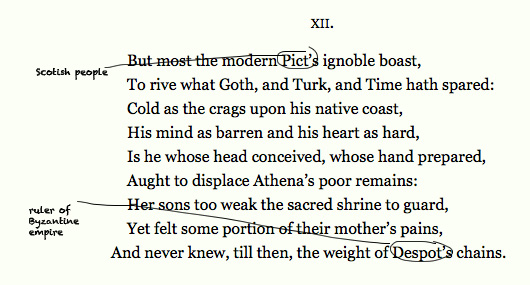
You can read one example below (with editorial notes by Prothero Coleridge):
_mrsspencersmith.jpg)

I'm not entirely certain if it's proper comparing Mrs. Smith to Calypso. Understandably there's the exaggeration from a Romantic poet. To me, Mrs. Smith was an independent woman in the early 19th century, who possessed unimaginable courage and character. It's rare for a woman to be like that at the time, a pretty risky business too. Byron was undoubtedly bitter that their relationship didn't advance, but his words also revealed much admiration and respect. After all, who doesn't prefer a worthy opponent and enjoy an exciting game to something dull and monotonous?

Diane, Hecate, now Calypso, all of whom possessing indescribable power over nature and men alike. All these goddesses or immortal beings have been appearing in this section of canto ii. There's never a shortage of female characters in Byron's life. They bewildered him since his childhood: his emotionally unstable mother, his childhood crush who ended up pursuing a more reliable marriage... at this point of his life he hasn't encountered the crazier bunch who are yet to occupy his emotional realm, including Caro Lamb, and the revengeful princess of parallelogram, his future wife Annabella Milbanke. At this point of his life, those magnificent women had been simply casting traps with their elegant gestures and soft voices, in which he called himself wasting his youth indulging.

This "lamenting" part of the poem also reminded me of Shakespeare's "Sigh No More" (from Much Ado About Nothing), where the deceitful characters had been men. A reverse relationship here, but equally entertaining. Romance had been, and will always be confusing for both men and women. Words of self-pity and comfort with sarcastic accusations remain to be some of the most interesting elements in literary world:
Sigh no more, ladies, sigh no more.
Men were deceivers ever,
One foot in sea, and one on shore,
To one thing constant never.
Then sigh not so, but let them go,
And be you blithe and bonny,
Converting all your sounds of woe
Into hey nonny, nonny.
Sigh no more ditties, sing no more
Of dumps so dull and heavy.
The fraud of men was ever so
Since summer first was leafy.
Then sigh not so, but let them go,
And be you blithe and bonny,
Converting all your sounds of woe
Into hey, nonny, nonny.

Unlike Odysseus on Calypso's island, Byron didn't spend too much time in Malta. Of course, the hero from Ithaca would be inspiring to him at least for the determination and loyalty. Byron once wrote that watching over the ocean from the cliff made him homesick. His childhood in Scotland brought him an accent he was always ready to get rid of, as well as many a sweet memory of the carefree years. In previous stanzas the poet has already expressed the desire to start over, lamenting over the cruel and never-pausing flow of time; and here, regretting the years wasted on his "personal Calypso's island", he's telling a cautionary tale to warn his fictional self.

Of course, we must not forget Byron's tendency to exaggerate: his emotional rollercoaster brings him instantly cheery and then suddenly gloomy, mostly because of unfulfilled or overwhelming love. For him it is an addiction that eventually brings more disappointments than joy. Passion established him and made him an everlasting name, yet at the same time, bound to destroy him.