The Burger Babbling
“Life is a box of chocolate” says Forrest Gump’s mum after we’ve all spent the entire first half of the film contemplating that the metaphor was gonna be “life is like a feather in the wind”. Bullocks, I thought, blurry-eyed after being drawn into this iconoclastic story yet once again, if life had been a box of chocolate, then at least you can read the ingredient list printed on the back. Nowadays they even give you visual guidance to let you pick your favourite flavors: the cone shaped one is milk chocolate with caramel fillings; or, the dark chocolate cube with pink stripes is raspberry flavored. Wanna change the order of consumption? Easy Peezy. Wanna skip an entire roll? Go for it. Unless you’re one of those people who choose to ignore all the clues and start at random, like going on blind dates and end up in exhaustion from meeting people from complete different worlds.
No, life is certainly not a box of chocolate, for unlike an honest, humble ingredient list, life only PRETENDS to give you choices, or let me rephrase, abstract ideas of choices. You’ll have visions of the outcome you were trying to get, which might turn out to be entirely different. It can certainly give you pleasant surprises, yet also disappointments. It’s a lot like when you order a burger at one of those places where you can decide what you want for each of the elements – what looks like a simple menu offers you a kaleidoscope of options beyond your imagination. And if you’re like me who’s just stepped in one of those joints for the very first time, it could become an overwhelming experience. You’re gonna need mentors and ask for perspectives, and of course, take risks and eventually hammer down your decision.
There are shortcuts of course. For example, you can try the recommended combination designed after generations of burger eaters’ experiences: the classics, the California style, the Mexican style, the vegetarian’s choice, etc., etc. You are allowed to tweak it a little bit depending on your slightly sticking out personalities, but those are certainly safe choices that couldn’t hurt your feelings, like a secure and safe life. You might not like it, you might even hate it upon first bite, but just like most people you’d probably end up sticking to it because, hey, you’re getting the protein and carbs you need, the taste might be mundane or boring, but what isn’t once you’ve gotten used to it?
Or, you can be a defiant and build your own burger. First you gotta choose your protein. Meat, it’s all about meat. After centuries and centuries of dietary evolutions it’s still meat we put on most of people’s plates. There’s nothing wrong with vegetarianism, but that’s a lifestyle that requires an entirely different kind of conviction and, well, financial support you can find those more expensive alternatives for your protein and fat.
And then you choose your vegetable; and then sauce, finally the buns; if you’re really, really hungry you can also get sides, beverages and desserts; I’m holding some prejudice against sliders: they sound like a choice made by people without persistence.
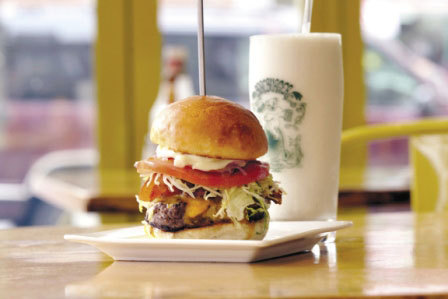
The waiter meticulously notes down your choices and finally with a smile and a nod, sends the order to the kitchen. In a few minutes, viola, you’re presented with your meal on a plain, undecorated tin platter, a sheet of wax paper separating the surface of the platter from the bottom later of your burger. You can see the sauce dripping from the edge and your bread, baked to shimmering shade of golden, releasing an indescribably energy: an amiable sense of familiarity, inviting, yet also like a stranger you just met but you had a déjà vu moment as if you’ve crossed paths in a different lifetime.
The next step determines weather the choices you just made for yourself is a success or a failure, or, well, a “tolerable”. The perfect scenario would be your meat, your veggie, your sauce and bread altogether create for you and explosion of amazing flavor that is ultimately both foreign and as if from a memory you’re born with, and it is a combination of tender, crunchy, greasy, refreshing, sweet, savory… it’d be a touching experience if you get very lucky, like a eureka moment for a chemist when they discovered a new kind of reaction.
You meat is like your occupation. Your life depends on it, so you better love it, otherwise even if you were getting your nutrient, it wouldn’t be an enjoyable process eating it. Sometimes your meat comes with bacon as an extra touch, like a part time job. For some people it brings infinite joy and makes their eyes sparkle; for some it’s just too much. Your vegetables are like your colleagues and friends, essentially who you choose to surround yourself with. They add varieties and distractions to your life and can change your attitude towards your career. Your sauce is your hobbies, adventures you take when you’re not working, dreams you pursue, or maybe just a Sunday morning in the park. Sauce can make all the difference. It’s actually THE element that does the trick: a really good sauce makes a good burger heavenly, and a terrible one tolerable. Of course, a bad cause ruins everything even all of your ingredients are of top-notch qualities. Your bun is the environment you’re in. No I’m not talking about the melting icecaps or the ozone hole, but the city you live in, the grocery store you shop at, the café where you get your morning Joe and greet the baristas who offers you a 10% discount because you accidentally revealed your student ID; your bun is the part that makes everything in tune; it soaks up the sauce and all the best flavors from your meat and veggies; it’s what contains you can pin you down and gives you a chance to readjust yourself from time to time even when all the other aspects of life keeps you spinning.
I can probably talk about all that with the ingredients that make up a salad, but a salad lacks the sense of mysteriousness a burger processes, especially from a spectator’s point of view. There are layers within layers about someone you’re staring right at yet couldn’t make out what’s truly inside of them. The beauty of the unknown, indubitably, extremely dangerous, likes a rose with invisible thorns.
Metaphysical Journey

The burger experience is sort of like the Eat Me cake experience Alice had. It makes you grow bigger and bigger until you’re able to reach the key to the secret of what your life means. Of course in reality it wouldn’t be as fast as in a metaphorical story, but you get the point. The beer that usually accompanies the burger, on the other hand, becomes the Drink Me potion that returns you the sense of vastness of the universe and the insignificance of your whole being. There’s a similar comparison with Dorito chips and Budweiser in Hamish Linklater’s the Vandal, absolutely mind-blowing. The moments between munching and burping with your friends sitting around a table are potentially when all the greatest ideas morph into shapes. Especially on a hot summer’s day, you mind would start to float as the humming sound of a ceiling fan becomes soporific and the lighting in the room seems to dim as time goes by; you feel like time becomes a tangible material instead of being a linear, abstract concept. Everything else is suspended and you start to think too much.
Alice’s journey down the rabbit hole, or if you prefer the looking glass version, is more than just a schoolgirl’s fantastical dream in defiant of the colourless adult’s world of words and figures without pictures between the pages. She’s on the threshold of discovering what’s the meaning of all the strange things she sees, a world offering no explanations but forces that thrush you upon an unfamiliar shore where you have chunks of solitude, a luxury of contemplation and reflection about all the nuances between the colours of leaves of grasses and, what the morning dew tastes like, or, how long can you keep your balance standing on one foot.
Let’s take a moment and go back to the burger joint. The journey – there’s no escape to it because it just comes to you as a part of your personal growth – it comes to you after you open the menu, and continues on until you’ve made your final choice and have eventually taken a first bite. There’s no coming back after that, but during your metaphysical journey of self-discovery and self-formation, you get to make choices and pick your paths like when Hercules had to decide whether glory with hardship or pleasure in a life at ease is more appealing.
Of course, there’s the other kind of journey where you basically browse through all the choices and make your pick in the very end. Your experience along the way is what matters and what makes you stronger. And again, that journey also comes to you like the wind sweep through Kansas City and lift Dorothy’s cottage all the way to Oz. When you’re least expecting it. There will be strangers who are simultaneously intrigued and terrified by you. And the feeling would be mutual I assure you. Karuki Murakami’s main characters usually have that kind of fate. They get thrown into “hard-boiled wonderlands” or post modernist realism where the environment is no more than a loosely formed concept. Beasts with strange coloured furs and primitive memories feeds into the collective unconscious of fictional characters and readers who also submerged themselves into world of imagination.
It’s in our human nature to go on the road. And this is where eastern and western philosophies converge. You never grow until you’ve walk the walk, says the elder and the wiser. Some of the more epic journeys had been inevitably dangerous and violent. For example the one Bilbo Baggins never intended, or the one Monkey King dreaded for a long time. Odysseus’ journey was to go home, but home is such a broad idea sometimes that it can mean everything that is whole and comforting: it’s a final destination of clarity, fulfillment and infinite joy, a final accomplishment of being content of who you are after you have discovered your worth and role in life, and are content about it.
You’re gonna need a vehicle before setting off. You can be on foot, or get a car, a motorcycle, a boat, or in some cases a pen, a computer; you can complete a journey within a room, at a museum, as long as by the end of the journey you’ve reached somewhere that makes you feel enlightened as if never before. The procession would be full of unknown factors. The sirens: the temptations; the current: the obstacles; the pirates: the enemies, or in a commoner sense, your haters. If the journey is a physical one, it’s advisable to go on the road, or set off sailing with at least one friend, unless you have boundless imagination and can endure solitude, or only hang out with the imaginary ones. Even the great time lord needs a companion to keep him sane and make sensible decisions. Keep yourself occupied and take notes of your thoughts. A journey without some mental distilment is like watching a movie but falling asleep in the middle of it. You’d end up with a title and an idea of what you’ve just experience, but no actual substances; or let’s still use the burger as an example: you can create a seemingly wonderful order, condiments and special sauces and all, but when you were presented with the final product, you accidentally knock down the platter. The purpose of your journey is very important; even if you don’t know exactly what it is when you first started. The process takes you to the destination, but it’s also a process of discovering where that destination is.


