Showing posts with label philosophy. Show all posts

12.5.13

Burger Babbling and Metaphysical Journey


The Burger Babbling


http://25.media.tumblr.com/tumblr_m8e6frt0CJ1rcqg76o1_500.jpg

“Life is a box of chocolate” says Forrest Gump’s mum after we’ve all spent the entire first half of the film contemplating that the metaphor was gonna be “life is like a feather in the wind”. Bullocks, I thought, blurry-eyed after being drawn into this iconoclastic story yet once again, if life had been a box of chocolate, then at least you can read the ingredient list printed on the back. Nowadays they even give you visual guidance to let you pick your favourite flavors: the cone shaped one is milk chocolate with caramel fillings; or, the dark chocolate cube with pink stripes is raspberry flavored. Wanna change the order of consumption? Easy Peezy. Wanna skip an entire roll? Go for it. Unless you’re one of those people who choose to ignore all the clues and start at random, like going on blind dates and end up in exhaustion from meeting people from complete different worlds.

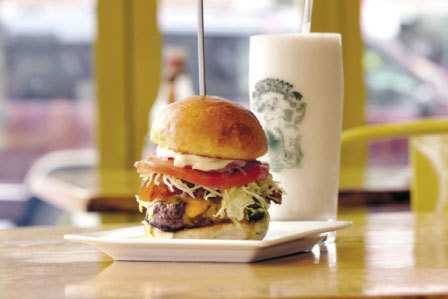
No, life is certainly not a box of chocolate, for unlike an honest, humble ingredient list, life only PRETENDS to give you choices, or let me rephrase, abstract ideas of choices. You’ll have visions of the outcome you were trying to get, which might turn out to be entirely different. It can certainly give you pleasant surprises, yet also disappointments. It’s a lot like when you order a burger at one of those places where you can decide what you want for each of the elements – what looks like a simple menu offers you a kaleidoscope of options beyond your imagination. And if you’re like me who’s just stepped in one of those joints for the very first time, it could become an overwhelming experience. You’re gonna need mentors and ask for perspectives, and of course, take risks and eventually hammer down your decision.

There are shortcuts of course. For example, you can try the recommended combination designed after generations of burger eaters’ experiences: the classics, the California style, the Mexican style, the vegetarian’s choice, etc., etc. You are allowed to tweak it a little bit depending on your slightly sticking out personalities, but those are certainly safe choices that couldn’t hurt your feelings, like a secure and safe life. You might not like it, you might even hate it upon first bite, but just like most people you’d probably end up sticking to it because, hey, you’re getting the protein and carbs you need, the taste might be mundane or boring, but what isn’t once you’ve gotten used to it?

Or, you can be a defiant and build your own burger. First you gotta choose your protein. Meat, it’s all about meat. After centuries and centuries of dietary evolutions it’s still meat we put on most of people’s plates. There’s nothing wrong with vegetarianism, but that’s a lifestyle that requires an entirely different kind of conviction and, well, financial support you can find those more expensive alternatives for your protein and fat.

And then you choose your vegetable; and then sauce, finally the buns; if you’re really, really hungry you can also get sides, beverages and desserts; I’m holding some prejudice against sliders: they sound like a choice made by people without persistence.

The waiter meticulously notes down your choices and finally with a smile and a nod, sends the order to the kitchen. In a few minutes, viola, you’re presented with your meal on a plain, undecorated tin platter, a sheet of wax paper separating the surface of the platter from the bottom later of your burger. You can see the sauce dripping from the edge and your bread, baked to shimmering shade of golden, releasing an indescribably energy: an amiable sense of familiarity, inviting, yet also like a stranger you just met but you had a déjà vu moment as if you’ve crossed paths in a different lifetime.

The next step determines weather the choices you just made for yourself is a success or a failure, or, well, a “tolerable”. The perfect scenario would be your meat, your veggie, your sauce and bread altogether create for you and explosion of amazing flavor that is ultimately both foreign and as if from a memory you’re born with, and it is a combination of tender, crunchy, greasy, refreshing, sweet, savory… it’d be a touching experience if you get very lucky, like a eureka moment for a chemist when they discovered a new kind of reaction.

You meat is like your occupation. Your life depends on it, so you better love it, otherwise even if you were getting your nutrient, it wouldn’t be an enjoyable process eating it. Sometimes your meat comes with bacon as an extra touch, like a part time job. For some people it brings infinite joy and makes their eyes sparkle; for some it’s just too much. Your vegetables are like your colleagues and friends, essentially who you choose to surround yourself with. They add varieties and distractions to your life and can change your attitude towards your career. Your sauce is your hobbies, adventures you take when you’re not working, dreams you pursue, or maybe just a Sunday morning in the park. Sauce can make all the difference. It’s actually THE element that does the trick: a really good sauce makes a good burger heavenly, and a terrible one tolerable. Of course, a bad cause ruins everything even all of your ingredients are of top-notch qualities. Your bun is the environment you’re in. No I’m not talking about the melting icecaps or the ozone hole, but the city you live in, the grocery store you shop at, the café where you get your morning Joe and greet the baristas who offers you a 10% discount because you accidentally revealed your student ID; your bun is the part that makes everything in tune; it soaks up the sauce and all the best flavors from your meat and veggies; it’s what contains you can pin you down and gives you a chance to readjust yourself from time to time even when all the other aspects of life keeps you spinning.

I can probably talk about all that with the ingredients that make up a salad, but a salad lacks the sense of mysteriousness a burger processes, especially from a spectator’s point of view. There are layers within layers about someone you’re staring right at yet couldn’t make out what’s truly inside of them. The beauty of the unknown, indubitably, extremely dangerous, likes a rose with invisible thorns.

Metaphysical Journey 


http://keanxchange.com/sites/default/files/pr/odyssey1.gif


The burger experience is sort of like the Eat Me cake experience Alice had. It makes you grow bigger and bigger until you’re able to reach the key to the secret of what your life means. Of course in reality it wouldn’t be as fast as in a metaphorical story, but you get the point. The beer that usually accompanies the burger, on the other hand, becomes the Drink Me potion that returns you the sense of vastness of the universe and the insignificance of your whole being. There’s a similar comparison with Dorito chips and Budweiser in Hamish Linklater’s the Vandal, absolutely mind-blowing. The moments between munching and burping with your friends sitting around a table are potentially when all the greatest ideas morph into shapes. Especially on a hot summer’s day, you mind would start to float as the humming sound of a ceiling fan becomes soporific and the lighting in the room seems to dim as time goes by; you feel like time becomes a tangible material instead of being a linear, abstract concept. Everything else is suspended and you start to think too much.

Alice’s journey down the rabbit hole, or if you prefer the looking glass version, is more than just a schoolgirl’s fantastical dream in defiant of the colourless adult’s world of words and figures without pictures between the pages. She’s on the threshold of discovering what’s the meaning of all the strange things she sees, a world offering no explanations but forces that thrush you upon an unfamiliar shore where you have chunks of solitude, a luxury of contemplation and reflection about all the nuances between the colours of leaves of grasses and, what the morning dew tastes like, or, how long can you keep your balance standing on one foot.

Let’s take a moment and go back to the burger joint. The journey – there’s no escape to it because it just comes to you as a part of your personal growth ­– it comes to you after you open the menu, and continues on until you’ve made your final choice and have eventually taken a first bite. There’s no coming back after that, but during your metaphysical journey of self-discovery and self-formation, you get to make choices and pick your paths like when Hercules had to decide whether glory with hardship or pleasure in a life at ease is more appealing.

Of course, there’s the other kind of journey where you basically browse through all the choices and make your pick in the very end. Your experience along the way is what matters and what makes you stronger. And again, that journey also comes to you like the wind sweep through Kansas City and lift Dorothy’s cottage all the way to Oz. When you’re least expecting it. There will be strangers who are simultaneously intrigued and terrified by you. And the feeling would be mutual I assure you. Karuki Murakami’s main characters usually have that kind of fate. They get thrown into “hard-boiled wonderlands” or post modernist realism where the environment is no more than a loosely formed concept. Beasts with strange coloured furs and primitive memories feeds into the collective unconscious of fictional characters and readers who also submerged themselves into world of imagination.

It’s in our human nature to go on the road. And this is where eastern and western philosophies converge. You never grow until you’ve walk the walk, says the elder and the wiser. Some of the more epic journeys had been inevitably dangerous and violent. For example the one Bilbo Baggins never intended, or the one Monkey King dreaded for a long time. Odysseus’ journey was to go home, but home is such a broad idea sometimes that it can mean everything that is whole and comforting: it’s a final destination of clarity, fulfillment and infinite joy, a final accomplishment of being content of who you are after you have discovered your worth and role in life, and are content about it.

You’re gonna need a vehicle before setting off. You can be on foot, or get a car, a motorcycle, a boat, or in some cases a pen, a computer; you can complete a journey within a room, at a museum, as long as by the end of the journey you’ve reached somewhere that makes you feel enlightened as if never before. The procession would be full of unknown factors. The sirens: the temptations; the current: the obstacles; the pirates: the enemies, or in a commoner sense, your haters. If the journey is a physical one, it’s advisable to go on the road, or set off sailing with at least one friend, unless you have boundless imagination and can endure solitude, or only hang out with the imaginary ones. Even the great time lord needs a companion to keep him sane and make sensible decisions. Keep yourself occupied and take notes of your thoughts. A journey without some mental distilment is like watching a movie but falling asleep in the middle of it. You’d end up with a title and an idea of what you’ve just experience, but no actual substances; or let’s still use the burger as an example: you can create a seemingly wonderful order, condiments and special sauces and all, but when you were presented with the final product, you accidentally knock down the platter. The purpose of your journey is very important; even if you don’t know exactly what it is when you first started. The process takes you to the destination, but it’s also a process of discovering where that destination is.

28.2.13

II : XVI - XXI Of the Sea and the Moon

Before commercial airlines were invented, there's only one way daredevils go exploring the world: hit the wave and go to uncharted waters. It hasn't been long since human being finally grasped the whole scope of our planet, if you think about it. For the most part of our race's time on earth, we've just been satisfied with the comfort of ignorance. However, once you tasted the sweetness of adventures, there's no turing back. 

Harold, for one, is cutting himself loose from all his past attachments, moving on to the next destination. Of course, it's easier to leave a place that had depressed him so much: Greece, was like a tomb of a civilization, a shell of what used to be so vivacious and rich.

Between 1809-1810, Lord Byron went back and forth from Greece (the general Mediterranean area) to Turkey (especially Constantinople, Troy, etc.) 
He visited important geographical marks in Odyssey and Iliad during that time including Ithaca, Odysseus' home, Athens, Troy, spending long bulks of time in that area, while writing the first two cantos of Childe Harold's Pilgrimage. 
The imageries in Canto the Second were, of course, fresh and vivid. 

The ocean possesses something entirely inexplicable to our logical minds. It pulls you in and calms you down even when you see those fierce waves and hear those restless howls. It's as though a kind of subliminal siren song draws you close to the heart of the ocean. There's no way to escape it once you're intoxicated by the salty wind. 


The "dark, blue sea" has been a constant motif in Lord Byron's poetry. Having spend so much time abroad and about, it's understandable that the ever-changing climes at the sea would inspire the romantic poet. In stanza XVII, the ocean presents itself as a peaceful and vast sight in front of Childe Harold's eyes, filled with spirit. The sea is an interesting symbol, for it represent different things for different people. Byron, for instance, was an individual who's saturated with knowledge of history, hence the ocean to him became more than just a body water, but rather a mote of memories that connects the past and the presents. Here's another poem about the ocean:

The Dark, Blue Sea
by Lord Byron
There is a pleasure in the pathless woods,There is a rapture on the lonely shore,There is society where none intrudes,By the deep sea, and music in its roar:I love not man the less, but nature more,From these our interviews, in which I stealFrom all I may be, or have been before,To mingle with the universe, and feelWhat I can ne'er express, yet cannot all conceal.-
Roll on, thou deep and dark blue ocean-roll!Ten thousand fleets sweep over thee in vain;

Read the rest of the poem here, and the attached video provides you with a narrative perspective of the literature. This poem, to me is almost an expansion and a microscopic view of a small segment of "Childe Harold".

Let your mind race when facing the dark, blue sea...
you wouldn't be able to resist it.


The structure of a ship crew, called warlike here by Byron, to me is more like a corporation. You have the Captain who commands the executive decisions like a CEO; you have the experienced boatswain who functions as the maintenance head; and you have the mate who would be more similar than you think to a modern day PR department, overlooking crisis and figuring out how to solve all kinds of problems.


It takes a lot of will power and the calmest personality to be a captain, for he is responsible for the well being of the entire crew, just like what a good CEO of the company would be. He would be the one to blame for the crisis and the last one to loose up. Recently I heard the story of the captain of a ship that went on an exploration voyage to the north pole. A man of few words, the captain revealed in front of the journalist that he's accustomed to danger and accepted the fact that you have to be ready to yield to the power of nature at any time.


The sea is also a provider of neutral environments where people can forget about all the daily nuisances. Maybe that's why we still go on cruises although many a times those voyages prove to be the opposite of what the advertising says. Of course, it depends on what you ask for in the first place. Personally I've always had this fantasy of going sailing at the sea and see all the different colours of the water and all the different shapes of clouds. You get what you sign up for...minus the romanticized part. 

The brine consumes it all. 
The flow of your thoughts stirs into the unknown. 
The process is irreversible. 


The other universal motif that fascinates people across time and space is, if you still haven't guessed it yet, the moon. Every single poet, visual artist, singer as far as I know, regardless of age, cultural background, gender or race, has used the ethereal being, the moon, as a subject and a muse. Chinese poet Li Bai in Tang Dynasty would look up the sky with his drunken eyes, inviting the moon and his own shadow for another round. It's a whimsical sight, incredibly zen.


There are endless tales about the origin of moon and fascinating lores explaining the man in the moon, or in my case, I grew up knowing that the goddess Chang Eh took a leap of faith in her desire of coming immortal, left her home and her husband, and took residence in the palace of the moon. There's a white rabbit and a flowering three there to keep her company. The moon has always been a place of solitude and self reflection for philosophers throughout history. Since man's first step onto the surface of moon, we already know that it's a barren satellite planet of the earth, tucking and pulling the tides being one of her functions; yet we still enjoy fantastical stories with no scientific basis about the moon. Why? Because the moon we talk about in stories is more than a boring astronomical being, but a symbol that connects humanity and makes us one.


Here's a modern rendition by Pigpen Theatre Co. telling the tale of how the moon changes shape. A story of the steward of the moon with shadow puppetry in digital animation...the cutting edge modern and the traditional, the handicraftsman and the digital editing, you can't get more integrated than that!


23.2.13

II : VII - IX A Slightly Depressing Fact

"I know nothing but the certainty of my own ignorance." Socrates said that. He's got a lot of great one-liners on the same subject. Here's the somewhat depressing truth: we are all insufferably ignorant. As a matter of fact, the more you learn, the more certain you are about that. There's just so much that you wish you had learnt during your childhood, when your memory was at its prime.

Socrates' Trial

Being one of the smartest guys in human history, Socrates humbled us all by admitting his limit, and the sad truth of how little power we have in the physical world. He also said once, that most of us wouldn't even realize our own ignorance, or even take comfort in it. The quest of seeking truth and the possession of certain knowledge can be terrifying, history being one of those dangerous subjects. 


As our poet walked the walk of unearthing the truths he sought in the ruins of the place considered origin of western philosophy, he's realizing the exact same thing, especially with the premonition of his own mortality hanging above his head! (His death at the age of 36 had been foretold) Standing in front of the remains of where ancient philosophers once gave seminars, with his blood saturated with history, there will be questions without answers. 

Those restless souls have been, and will always been the pilgrims of knowledge will death puts a halt on their journeys. 
Interesting fact about Acheron: the newly dead get ferried across it to enter the underworld. It's also called the river of pain. Vigil described it as the principle river and Dante called it the border of hell in Inferno, both poets being Byron's childhood idols.  

File:Charles Babbage - 1860.jpg
Charles Babbage

I'm feeling him as we speak, with so many unsolvable problems I'm facing everyday, as I read on about Byron's life, and all the untraceable facts. I could use internet and digital database -- modern communication has enabled us to do more than ever, to reach out farther than ever, but not, DEFINITELY NOT during 19th century, when scholars had to actually visit the sites for their researches. It's not until the later half of the 1800s when Byron's very own daughter Ada Lovelace began imagining what computers can do for human society. Her contribution to Charles Babbage's analytical engine earned her the name of "the first computer programmer".


There's a strange relationship between knowledge and religion. Some say that religion is a quitter's way out of explaining things they don't understand. The more you know, the more you'd question the existence of an omnipotent god. I've always preferred to think that most religious scriptures serve better as fables and moral guidances, rather than shackles of people's freewill.

The school of Athens witnessed some of the brightest stars of human society. Their wisdom is transcendental and boundless. The Bactrian sage mentioned here was Zoroaster, who suggested that the human condition is an endless struggle between what he called "asa (truth)" and "druj (lie)".  His philosophy had great influence on Middle Platonism as well as Judaism.

File:Raffael 071.jpg
Detail of The School of Athens by Raphael, 1509, showing Zoroaster (left, with star-studded globe).

Pythagoras was the Samian Sage that got called out in here, another influential people in Plato's life and shaping of his philosophy and world view, and of course, thus the entire western philosophy scope. You might remember his name from the mathematical theorem that goes like this:

a^2 + b^2 = c^2\!\,

His other contribution includes tetractys and various musical theories. Aristotle once called him a supernatural being. Aristotle exaggerated out of admiration, of course. Pythagoras, like all those amazing educators in the School of Athens, was just another pilgrim of truth that wouldn't rest until...there's actually no destination on their journeys, only another, and another step further.

File:Sanzio 01 Pythagoras.jpg
Pythagoras, the man in the center with the book, teaching music, in The School of Athens by Raphael


"All that we know is, nothing can be known." Indeed Socrates said that too. At tis point of Childe Harold's journey, we are facing serious problems like regrets and the limit of the mortal. All those philosophers in the past are gone, though their words lived on. The Sadducees, mentioned in Stanza 8, dind't believe in resurrection. Life is a one time opportunity and there's no turing back. Socrate's orchard experiment depressed all of his students who wished for a second chance. The slightly frustrating truth is: we will infinitely be relatively ignorant. But that shouldn't stop us from craving for more knowledge, for the flip side of that frustrating truth is, there will always be pilgrims of truth picking up what we left behind. People in the future will always be able to solve the mysteries we cannot untangle during our lifetime.

A Tom Stoppard quote perfectly demonstrates this:

"We shed as we pick up, like travellers who must carry everything in their arms, and what we let fall will be picked up by those behind. The procession is very long and life is very short. We die on the march. But there is nothing outside the march so nothing can be lost to it. The missing plays of Sophocles will turn up piece by piece, or be written again in another language. Ancient cures for diseases will reveal themselves once more. Mathematical discoveries glimpsed and lost to view will have their time again."
                                                                                                 ---- Septimus   Arcadia, Act I 

There's always more to know.