Showing posts with label lisboa. Show all posts

7.2.13

I : XXVII - XXX Harold My Hedgehog, Or Harodyssey?

Why do we travel? Why do we try to discoer uncharted water, climb unconquered mountains? Not JUST for the scenery that's for sure. We've heard tales of hero's journeys in solitude since the beginning of time. Hans-My-Hedgehog did it; Odysseus did it; Confucius did it (although he's got other purposes); all the way towards the end of time (think of the mad man in a box; the Doctor has been travelling through time and space for eternity, a modern day Vathek if you ask me!) There will always be strange men (AND women now that we have more freedom and rights to do things) going on the road, leaving all their attachments behind to seek personal growth, and gather experience from the wounds and struggles they shall encounter.  

Hans My Hedgehog Art Print
Hans-My-Hedgehog by James Barker

Why all that pain? Through trials and errors we fall and we pick ourselves up, and we continue to walk on...there is one thing for certain: travellers will sure end up with invaluable stories, knowledge that they can share with all, answers they can offer to solve problems of those who stayed behind. Indeed we travel for the the transformation. 

Hans-My-Hedgehog took off to seek his fortune in the bewilderedness because he was born different, and flawed to be sure. His transformation is personal and in a symbolic sense by all means. Odysseus' journey, on the other hand, involves far more people and the fate of not only himself, his family but also his nation; gods are involved too: Athena did her best to aid him while Poseidon being a pain in the neck, both giving Zeus such an uneasy time. 

Post image for Odysseus, Precommitment, and the Siren Song
Odysseus on His Journey: Struggle Against the Siren Songs

It is rather dreadful having to decide which league Childe Harold should belong to: is he Harold My Hedgehog? Or is he a Har-Odysseus, destined for greatness, and his adventures shall have an effect on generations to come? He fits quite well in both categories, to me at least. 

The leitmotif in Hans-My-Hedgehog's story is "burning the animal skin". Like Hans, Harold is simultaneously his own worst Nemesis and savior. Harold is melancholy and dreary of his own life and the post-war era. His attitude and character flaws become a coat of quills, which is to be burnt by the personal growth and transformation he seeks through his journey to foreign land. 

Of course, Childe Harold is also answering the calling of his destiny, going on the road, like Hercules, choosing the hard , windy way instead of the comfort of easy pleasure. In Harold's case, he has learnt that pleasure gets him nowhere and it's wasting his ambition to keep living as a parasite on is father's once glorious property. 

Joseph Campbell's monomyth model explains the formula of how a hero comes into being, in other words, how would a hero's journey unfold. Many a story follows Campbell's formula, from Jesus Christ's path to Hercules' fulfillment, to the Star trek legacies: those are the archetypes that never cease to recur. Childe Harold's journey, although unfortunately cannot quite fit in the monomyth formula, what he sees on the road and the events he reflects on do have significant impact on the society the author lived in. The character also represents an entire generation and social group of people: the European upper-class youth who had the resource to do more than they had ever imagined, who had the potential to become more than what they had been limited to. 

One of the things that differs Childe Harold from the monomyth heroes is that, instead of getting supernatural callings and helps in fulfilling "god-given" tasks, Harold seeks God and enlightenment, if not religious, that is larger than life through his pilgrimage. It's almost as if Harold's journey is the antithesis to Joseph Campbell's formula. However, I see no conflict between those concepts. Whether it's a journey to smooth out our hero's quills, a transformation to perfect himself, or a journey to fulfill our hero's fate, a process of finding his purpose and responsibility to humanity, in the end it's the same quest of self-empowerment, an individual's nirvana from the ashes of his past.    

And here in this stanza we see Harold's internal conflicts: he's restless, depressed because for he realized the wasted time in his early youth; not even the best sights can distract him.


And we see him changing. He no longer seeks confort in carnal satisfaction or to dull his sense with alcohol, but rather reaches for a goal: his senses of inadequacy now gives him motivation to learn more, so that he becomes wiser by the end of his journey.


He keeps rolling on, hoping to take in as much as possible, but stops at Mafra.

Mafra Municipality was by all means not unimportant during the Iberian Peninsular War.  During the French invasion in 1807, for 9 months the Mafra National Palace was once the headquarters and garrison under the commend of Napoleon Bonaparte. Later in 1809, 48 of 156 the newly constructed fortresses in defense of Lisboa were within the municipality.

File:Palácio Nacional de Mafra (1853).jpg

Maria Anna of Austria was probably the luckless queen mentioned in this stanza (with her famous parties and extravagant celebrations indicated, as well as her children, the initial reason for the construction of the palace). However Dona Maria I of Portugal might be more relevant as she's the one who had to flee and take refuge in Portuguese Viceroyalty of Brazil during the war; she also suffered acute mental illness hence her name Maria the Mad.  I'll get back to this if I figure out who this queen is exactly in my future research.

File:D.Mara.II - A Pia.png
Dona Maria I, Queen of Portugal; José Leandro de Carvalho, 1808.


Again, why do we go on the road, why do we seek hardship while we can lay low and dance through life? Harold for one, at this point, can already tell you that the mountain air isn't naturally sweet, but he can taste the sweetness of his accomplishment as he breathe in the freshened new life.

5.2.13

I : XXI - XXVI A Laughable Disgrace

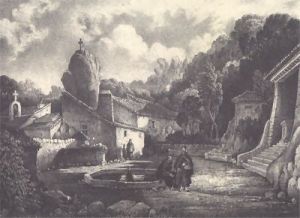
Convento dos Capuchos; path to the grotto
And still he questions what good it does to devote oneself to God all those years and yet, lives of the innocent still shed. Childe Harold's thoughts float as he takes in the views along the path up the hills. 


The friars in the convent lived the remaining of their days to make this a sacred place and yet, all is left after the destructions and rampage of the invaders, the land scorches and the crosses moulder.   


And he sees the remains of the palace, still exhibiting its beauty though ruined in time. Interestingly Vathek was mentioned in this stanza. Vathek, the main character in William Thomas Beckford's marvelous novel, is called England's wealthiest son by Byron. He is known to be an eccentric man who becomes terrible when in a bad mood. He had five palaces built to represent five senses, also devours knowledge to the point of greediness. Although it baffles me how can anyone have ENOUGH knowledge, but as it said in Beckford's original words (which was also on Vathek's magical saber),

"Woe to the rash mortal who seeks to know that of which he should remain ignorant, and to undertake that which surpasses his power".

Illustration from Vathek by William Beckford; Vathek motionless with surprise discovering Nouronihar extended on the ground trembling and pale; Watercolour
Coincidentally, Richard Westall illustrated a version of Beckford's Vathek, and Byron was also much taken by that story. Childe Harold's Pilgrimage wasn't the only work where he sited it. 


Now that Harold's on top of the mountain, it's only understandable that he weep upon the lost glory of what was once paradise on earth. It seems that it's a universal tradition for a poetic person who care about history to sign and contemplate when at a height, lamenting the loss through time.

Pleasance here means a pleasure-garden, a creation of the wealthy as the garden offers nothing but to please the eyes and serves for other recreational purposes. Portugal, in Harold's eyes, had been naturally of pristine beauty, yet those innate advantages were of no use when disasters hit. 

File:Jester01 recadre.png
Fool's Cap


Stanza No. 24 is when Byron starts to throw in sarcasm over the Convention of Sintra. He calls the official jesters, their crowns fool's caps, laughable even to children.


Growing up, I've learned about many a baffling and disgraceful conventions that the Chinese government had signed with foreign invaders during WWI and WWII. Throughout my schoolgirl years, I'd been taught to lament the loss of treasures of my own country because of war. I guess the sense of loss has become a collective unconscious that people of all cultures can relate to.

By the end of the peninsular war, Anglo-Portugal had been the winner. The French was supposed to surrender. However, instead of a painful journey home after being defeated completely, the French gets to pack and sail home, loaded with all of their supplies and goodies they raped from Portugal. What buffoons  Sir. Harry Burrard and Sir. Hew Dalrymple had been!

Sir Arthur Wellesley, 1st Duke of Wellington and his knights got held up in action. Bravery and common sense were of no use as they had to swallow the disgrace caused by a generation of embarrassment.


It seems that the battle resulted in the sneers of the lost and the disgrace of the victors. We always say that history is written by the victors, however, there isn't any real winners in this war, and neither of the two sides can pronounce the result without tasting some bitterness in their mouths.

4.2.13

I : XVII - XX Sintra : Where Heven and Hell Coexist

A great writer once said that tragedy is presenting the destruction of something beautiful. Imagine the astonishment and disappointment Harold is experiencing as he was exploring Portugal. On the 30th of August, 1808, almost a year previous to either Childe Harold or Lord Byron's visit,  the Convention of Sintra was signed to end the Peninsular War, an agreement that had been seen as a disgrace in the UK. Byron lamented more on the subject in a later stanza, but now as a first impression of the town, our hero is experiencing being awe-struck by the beauty and the horrid filth as a result of a nation's suffering.

The Gate of the Convent


Egypt's plague, I'm not sure what it indicates; however, the 10 plagues of Egypt might just suggest the disasters that has been troubling the people here. Also one of the ten, the Plague of Locust, previously served as a metaphor of the French invaders.


Now we are finally introduced to the beautiful, glorious sight of Sintra that is hard for a painter to depict, or a poet to phrase. In a letter to his good friend Francis Hodgson, Byron called Sintra the most beautiful in the world. No wonder he compared it to Elysium. The letter and notes by Elysium: a mythological place for afterlife from Greek religions. 

The letter I mentioned earlier was published in 1830 with notes by Thomas Moore (better known as Anacreon Moore), whom with John Murray, were responsible for burning Lord Byron's work after his death. 

Letter 37, on Page 91 of Life, letters and journals of lord Byron, with notes, [by T. Moore].


 By George Gordon N. Byron (6th baron.)


In front of us is a scene of mixed shades: a village of pristine beauty, a gift from nature as we see the serene water and elegant mountains; yet heavy from history and her spine bent from yesterday's suffering. We see a city that has just come to after having been spinning in the midst of disasters.


"Our Lady's House of Woe", is actually the house of "Our Lady of Punishment". It's official name is Convento de Santa Cruz da Serra da Sintra(Convent of the Holy Cross of the Sintra Mountains). The Convent of the Capuchos (Convento dos Capuchos) might be one of the most famous sight in Sintra, and Byron wasn't the only Romantic poet who lamented on it. Friar Honorio (Honorius in the stanza), the best known one of the ten friars who lived there died in 1596 after dwelling in a grotto for 30 years. He was said to have lived to be 100 by then.


Some kind of a legend to be sure.


3.2.13

I : XIV - XVI First Stop : Lisbon

Partial Map of Europe & First Part of Harold's Voyage

The year 1809 was, shall we say, pretty big for George Gordon Byron. H became 6th Baron Byron on the 13th of March, and then in the summer of the same year, he took off with good friend Cam Hobhouse and went off to sea. 


They travelled together to Falmouth, Cornwall, and got on Princess Elizabeth on the 2nd of July. Then what? You guessed it, on the fifth day, they reached the shores of Lisbon, Portugal. 

It's not certain at this point where had Childe Harold set off, but that could be more of a metaphorical departure from homeland. Plus, I don't see another, more likely harbour within the 5 days' radius that Harold can choose. So let it be that Harold also began his journey in Falmouth, Cornwall, not a bad place to call home. 

This stanza is filled with geographical fun facts of Britannia. Coming out of the English Channel, Harold first had to cut through the Bay of Biscay, or Golfo de Vizcaya in Spanish, a notoriously rough region of water (winds, waves and summer fogs), due to the continental shelf that extends far into the bay, hence "Biscay's sleepless bay".

Then there's the town of Sintra (the spelling Cintra ceased in use) in Grande Lisboa's subregion, although in this stanza Cintra probably means Serra De Sintra, a mountain range in western Portugal, certainly visible as the ship passes the Iberian Peninsular. Tagus river rushes north into the Atlantic ocean as the ship sails south. Tagus is the longest river on the peninsular (645 miles). Ovid sang about his "gold bearing sands", and in Richard Crashaw's Saint Mary Magdalene, or the Weeper, Tagus was also referred to as "golden".

by Ignacy Krasicki

Nowhere in the poem did Byron directly say that Harold and his crew had reached Portugal, yet we can tell from the excitement of those Lusian sailors: they've just gotten home! Lusian, short for Lusitanian, is an old name for Portugese. 


In an environmentalist's point of view, Childe Harold's Pilgrimage also metaphorically suggest the relationship between nature and human destruction. Of course, God also plays a part in here as he takes on revenge on behalf of the paradise squandered by human hands. The disasters mentioned in this stanza mainly include: the earthquake in 1755 which was detrimental to Lisbon, on top of which around the same time, France and Spain both decided that they're gonna invide Portugal. In 1807,  the French took over the country. 

Gaul is a term from Roman-era, suggesting the region where France and Belgium now are. The locusts, are of course, metaphorically the French invaders. The Peninsular War turned the heavenly land of Iberia into hell.  

The Second of May 1808: The Charge of the Mamelukes
by Francisco Goya, 1814


In 1808, there was a drastic turn of event. Portugal got help from her old ally Britain, which in Byron's words, was something really embarrassing, a last resort as well. Indeed, if Gaul's invasion was like cancer, than the British aid would be like chemotherapy - helping, but still another force of destruction.