Showing posts with label Iberian Peninsular War. Show all posts

21.2.13

I : LXXXIX - XCII Spain: A History of Violence

The Spaniards, the French and the Dutch all helped America during the Revolutionary War. On the 3rd of Sep. 1783, The Treaty of Paris ended the tedious war that crossed several continents and prolonged for almost a decade after United States had already declared its independence on 4th of July, 1776, the glorious date that you're supposed to remember as long as you're a citizen of planet earth and believe in liberty of humanity. Anyway, it almost seemed to me that the American Revolutionary War inspired the French Revolution, which broke out as early as in 1791, although most of us attributed the year of 1793 of more importance during the progress of the war, during which a young Napoleon Bonaparte proved his worth for the first time. 

Everything that happened was connected, dare I say, especially since the world is getting smaller as men's ambition and thirst for power grows infinitely bigger, and of course, communication is made more convenient. The rise of Lady Liberty indubitably influenced the entirety of western civilization. (The statue physically rose in 1886 but since it's commemorating 1776 in the first place, let's pretend that Lady Liberty had already been there in spirit.)

File:ColumbiaStahrArtwork.jpg
A modern personification of United States (Columbia) during WWI 

Columbia had been the name for a land with which we associate freedom, after the guy who discovered her of course, Christopher Columbus, whose accomplishment initiated the Spanish colonization of the new world. 


So why is that part of the history relevant to our subject of discussion now? Obviously there's the connection of the Spanish Empire, but it's far more than just a name. The War of Pyrenees, or better known as the Great War, pitted the first coalition during the French Revolutionary Wars. After the initial outbreak in January, France got in full on attack mode and in two months' time, decided to break up with her long-term-ally Spain. Spain was miserably defeated. 

Francisco Pizarro

There's almost a bitterness in the poet's tone. Francisco, Gonzalo, Juan and Hernando, those are the names of the Pizarro brothers, their reign in Peru was quite short (1531-1538) but still a major part in the Spanish conquest of the new world, Quito (The Royal Audience of Quito) being a part of it, was established in 1563, ruling most parts of Ecuador, northern Peru, southern Columbia and some part of Brazil. 

And now? Spain is under attack! It's all cause and effect says the poet. 


There are three major battles mentioned in Stanza 90, all of which violent and none can draw a conclusion to the never-ending conflicts. Wellesley gradually becomes a name almost as big as Napoleon, who would eventually defeat the legendary French modern Achilles, Byron's personal hero.

  • Battle of Talavera Think France, Spain and Britain as three gambler in Vegas. No matter what the statistics say in  the end, the biggest winner will always, did I say ALWAYS, be the house. Death was hosting the game this time, seizing his prize from all sides, with France losing the most at the battle of Talavera. Previously I mentioned this battle in The Inglorious Three, with Byron's descriptive and heart wrenching stanzas (around XLI) telling the tale of devastation.
  • Battle of Barrossa This was a pointless one: that day in March 1811, the ally of Britain, Portugal and Spain trying to lift the siege of Cadiz against France and the battle of Barrossa broke. Technically they won, according to numbers and what not, but Cadiz remained under French control until more than a year later. French Marshal Claude Victor was even able to bargain a partial victory. Of course in war if the two sides both won it also meant that they both lost. Again, the grave played the house.
  • Battle of Albuera Elaborated in stanza XLIII, (again, reference The Inglorious Three) the battle of Albuera was called the bloodiest of all during Peninsular War. Not only did it fail to lift the siege of Badajoz, it wounded the relationship between Spain and Britain, for it was said that Britain didn't play hard enough.

File:Marechal-victor.jpg
Marshal Claude Victor

All those struggles and all those lives lost, sill Spain didn't get her freedom and peace. It's such a tiresome and emotionally draining thing to do looking at the timeline of the war, for you see how people just so too far and plant so many seeds of evil over something rather trivial.


It is very hard to look at things the same way again after you've read lots about history. Sometimes, most of the time, we repeat the same mistakes our ancestors did. All the lost glory of past civilization was the cost of a transient vanity.


For Childe Harold, this has been a trip of personal growth. At this point, the boy who lamented the fall of his family estate is thinking about something much bigger. When you've climbed mountains and watched the rise and fall of nations, you would start to realize the frivolity of what you thought you held so dear.

13.2.13

I : XLIX - LII Sierra Morena's Sorrow

On the 4th of August, 1809, Byron's arrived at the Rock of Gibraltar, the southern end of the peninsular, leaning north towards Andalusia, more precisely, the region of Sierra Morena. I'm not entirely sure about the location of Childe Harold in this particular stanza, but if he can see the Moorish turrets, which I'm assuming was the Moorish Castle constructed in the Marinid Dynasty. 

File:Rock of Gibraltar 1810.jpg
The Rock of Gibraltar's North Front cliff face from Bayside (c.1810) showing the embrasures in the Rock.
The Tower of Homage was the tallest construction during the Islamic period of the peninsular, and played a huge part in the conquest of Iberia. Interestingly, there are two architectures on the peninsular that could have been the Moorish Castle. One is, of course, the one in Gibraltar; the other one, is the Castle of the Moors in Sintra, Portugal. There are clear distinctions between the appearances of the two. One is the only Marinid construction outside of Africa, the other, well, a Medieval castle made of stones, overlooking Sintra from the mountains. Both of them, however, witnessed much of the sorrow of people whose homes were ruined, and countries taken over by a trail of different conquerors. 

The Moorish Castle, Gibraltar by Terence Humphries


In 1808, the year before Byron's visit, Ferdinand VII had been King of Spain. He was, well, the other potato head (apart from Godoy) that primarily caused most of Spain's suffering. Stanza 50 is about him, his colourful story of betrayal and rumors of his birth.

File:Francisco de Goya y Lucientes 070.jpg
Portrait of Ferdinand VII by Goya

Landscape cloaked by an atmosphere of war becomes an entirely different kind of scenery. It's as though every single turn of the mountain path, or the fog, or the plantation all become saturated with military strategies. Simple, innocent landscape, now every thread of it is woven with tension.

File:Battle of Bailen.jpg
The Surrender at Bailén by José Casado del Alisal. Oil on canvas. Museo del Prado.
In stanza 49, the dragon nest is actually Province of Jean where The Battle of Bailen took place. Spain had a so-called victory and it ended with the negotiated surrender of French occupiers. At the same time, hero stories of Spain also ignited the spirit in Austria, whose warriors defended their homeland against France with passion. 


The spirit is up after the Battle of Bailen: it's no longer impossible to defeat Napoleon, says Spain, look what we've just done! Their victory was, of course, more of a temporary luck. Before long, Spain was once again almost completely lost to the Gaul, as Harold here "foreseeing" the bad omen coming down. Bear in mind that Byron wrote all this after his journey's done. He could make all of his political commentaries in Harold's name and call it speculations.

10.2.13

I : XXXIX - XLV The Inglorious Three

The Giant standing on the mountains is not there to polish the heroes' shining armours, but a blood-thirsty monster waiting for his cultivation. Pointless hatred between the three nations empowered the devil of war, and death was the bitter brew. 


The dawn before the battle must have been most suffocating.

Chaos, devastation, destruction. Each team advanced to protect the glory of their colour. It's rather subtly sarcastic of the poet to emphasize how it's is indeed a splendid sight for those who's got no attachments in the world, and then clearly pointing out that the winner in the end, is none other than the kingdom of the underworld.


If you don't go yowza over the writing of this stanza then I wonder what would ever impress you! It's insufferably breathtaking how the intensity of the battle, the complication of the relationships between the participants of the battle, are depicted with the three parallel opening lines. Then Byron, again, didn't in the least conceal his sarcastic attitude towards this pointless battle.

Namely it was the battle of Talavera, mentioned here. O it must have been a sorry sight if you'd been there. 7390 French, 1200 Spanish and 5500 British soldiers killed or wounded. Considering people back then can only kill with blades, these statistics are terrifying. (And then if you think about how many casualties in TODAY's wars we have, you can bend and weep forever.)

File:Battle of Talavera map.jpg
Map of Battle of Talavera


What Harold sees and what Byron laments is not only one particular tyrant, but the phenomenon of war itself. Glory and fame can make leaders blind. So much of the victory is a barter of human sacrifice and blood of their subjects. 


There's a time lapse between this stanza and the previous one. Byron was on the road between 1809-1811. On 16 of May 1811, the Battle of Albuera happened, not far from the sight of Talavera! Being a swift battle, Albuera was said to be the bloodiest battle during the entire of peninsular war, resulting the largest proportion of casualties.

File:Bereford.jpg
Marshal Beresford disarming a Polish lancer at the Battle of Albuera. Print by T. Sutherland, 1831


How do you campare the invasion of other countries, vandalizing foreign lands, to the domestic quarrels between neighbours? There we go again with Byron's subtle (or maybe not so subtle) sarcasm. Indeed maybe those soldiers will die in a less glorifying death in their home, maybe during a conflict of something worthless; however, isn't the war itself proved to be pretty worthless? Nobody won in the end, and all sides limped with their torn bodies and trails of bloodstain.


I'm more than a little confused about the timeline here.  In 1812, Anglo-Spanish ally finally got the French invaders out of Seville after they got in since January of 1810. Seville being the biggest and most flourished city in Andalusia, had always been the target of invasions. The triumphs might have been indicating driving the Moors our during mid century.

Ilion, or Ilium, or as we might just call it Troy, and then Tyre, a Phoenician port city, two of the wondrous places Byron juxtaposes with Seville, each representing an "inevitable" destruction of a beautiful city with vast riches.

There's a hope in the end as Harold turns his head away from the ancient ruins: virtue is the still most powerful warrior and can still bring conscience back to this land.

9.2.13

I : XXXV - XXXVIII Spain: A History of Blood Stain

The history of Spain is lined with conflicts between the Moor and the Christian. After the Battle of Covadonga, Pelagius of Asturias was the big guy. He established the first state independent of the Moors and reclaimed Iberian Peninsular, hence the beginning of Reconquista of the Christian. Pelagio's name was mentioned here by the poet, of course, to lament the Christian pride while at the same time, shed empathy to the Moors. 

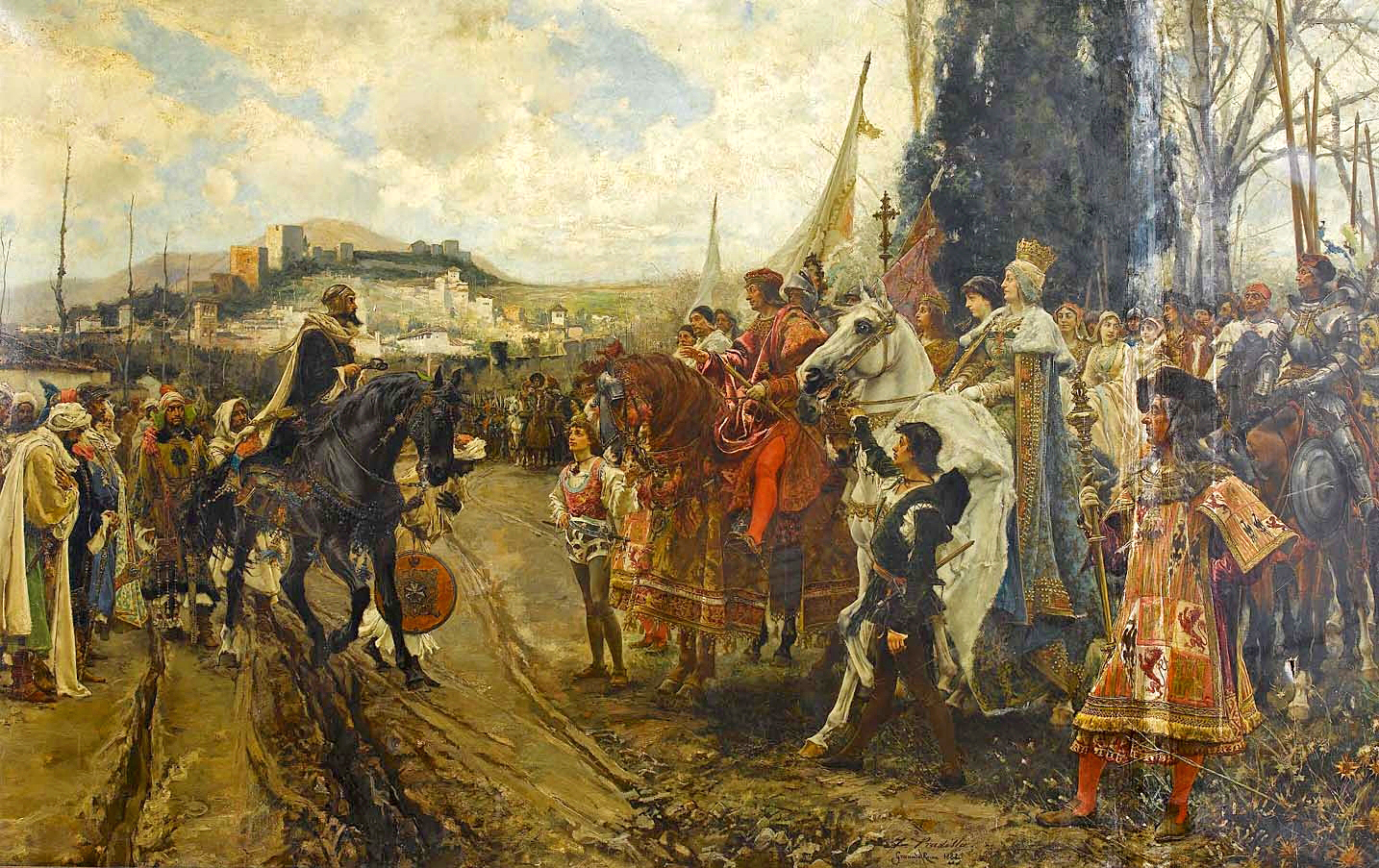
File:La rendición de Granada.jpg
The Surrender of Granada by Francisco Pradilla Ortiz


Around the year of 682, a general (possibly) under the name of Julian, Count of Ceuta sent her daughter, later became known as La Cava (means scarlet woman) Rumia, to King Roderic's court for education, only to turn into an affair between the daughter and the Visigothic King. Julian betrayed Hispania to the Moor...so of course the Christian later call La Cava a whore and Julian a traitor, while the Muslim deified the girl. Inspired by this story, there's Dana Broccoli's novel Florinda, later became a musical La Cava.

LaCava.JPG


All the poet is saying is: pride shouldn't come from materialized grandiose. Memories can fade and castles can rot, an army of thousands and defense of steel can be annihilated and eventually become some syllables in the bard's song. If lessons from the past cannot be learned, than a leader would be worthless, especially when he's content with superficial flattery of his subordinates. 

http://www.artble.com/imgs/5/6/e/514534/don_quixote.jpg
Don Quixote by Honoré Daumier 1868

Spain should be nothing short of bravery. Chivalry should be her middle name! The man of La Mancha amused the whole world but also showed them how honourable Don Quixote is as a Spanish knight. By 19th Century, King Charles IV had to ally with France during the peninsular war after previous defeats. Spain had been an underdog for so long, and, in those eyes of Harold with the same blunt bravery as Don Quixote, it's about time she wakes up and pick up her lance once again.

You could almost hear the drum rolls with the intensifying rhythms, stanza by stanza. Tis almost time for the big battle, and all you can feel in the air, in the whispers around you are war calls. All the lost souls in the battlefields, they died for the conflicts of nations!

The thing about wars in ancient times: those who shed blood in the heart of the fight, their lives seemed expendable. Doesn't make you flinch and shiver just to think about that? The tyrants, no scratch that, even the kindest rulers wouldn't really care about his peasant soldiers' lives during the war.

This peninsular has had rulers of so many different religious beliefs and ethnic backgrounds. A long tapestry of history shrank into a few words in this stanza. Siroc, for one, is short for Sirocco, a wind from Mediterranean sea that originates from North Africa, the homeland of those Moors that ruled this land for centuries past.

8.2.13

I : XXXI - XXXIV Lusitania and Hispania: The Unlikely Rivals

There's an apparent geographical change in sight: all of a sudden the mountainous region of Sintra has been left behind and we now follow Harold, or Byron to the plain. 

http://iamachild.files.wordpress.com/2012/05/the-shepherd-boy.jpg
Shepherd Boy


We see the serenity of Spanish prairie life and contemplate how easy it is to break that kind of peace. It's all so easy to get into conflicts, and it's all so easy to turn those peasants' paradise into hell.


Between Spain and Portugal, we don't see a lot of natural boundaries that are difficult to conquer. Tagus river touches gently upon both nations but never does anything too dramatic. (Speaking of Tagus, it took me incredibly long time to figure out that Byron meant Tagus by Tayo. He might have spelled it phonetically as Tajo (pronounced Tayo) was the Spanish name for Tagus.) Andalusia's Sierra Morena does lie between the two of them, but the mountains separates Spain from Moraco if anything, not Portugal! There's nothing terribly high, or deep, or vast, or ruthless that you think would have more chances pissing off either sides, stirring up some quarrels between "neighbours" whose backgrounds are so much alike.The Pyrenees on the other hand, is a MASSIVE boundary between Spain and France. In the 17th century the two of them fought for 24 years, yet ironically, they became allies in opposition of Anglo-Portugal in the 1800s.

[IMG]
Geographical Layouts of Iberian Peninsular


If there's one thing we can learn from what Childe Harold sees, it's that what it seems is never what it is. The peaceful appearance of what separates Portugal from Spain is merely an illusion, covering the hostile situation they're in.


Rio Guadiana, or Rio Odiana is one of the waterways between Portugal and Spain. It's also the fourth longest river on Iberian Peninsular. Where Guadiana flows is also close to Andalusia, a hot spot for the Moors and the Christians to shed blood. Paynim turban and Christian crest here, are used as parts to indicate the whole group of people.

Why do we get into fights? We now know that the natural boundaries play lesser part than religious beliefs. 

5.2.13

I : XXI - XXVI A Laughable Disgrace

Convento dos Capuchos; path to the grotto
And still he questions what good it does to devote oneself to God all those years and yet, lives of the innocent still shed. Childe Harold's thoughts float as he takes in the views along the path up the hills. 


The friars in the convent lived the remaining of their days to make this a sacred place and yet, all is left after the destructions and rampage of the invaders, the land scorches and the crosses moulder.   


And he sees the remains of the palace, still exhibiting its beauty though ruined in time. Interestingly Vathek was mentioned in this stanza. Vathek, the main character in William Thomas Beckford's marvelous novel, is called England's wealthiest son by Byron. He is known to be an eccentric man who becomes terrible when in a bad mood. He had five palaces built to represent five senses, also devours knowledge to the point of greediness. Although it baffles me how can anyone have ENOUGH knowledge, but as it said in Beckford's original words (which was also on Vathek's magical saber),

"Woe to the rash mortal who seeks to know that of which he should remain ignorant, and to undertake that which surpasses his power".

Illustration from Vathek by William Beckford; Vathek motionless with surprise discovering Nouronihar extended on the ground trembling and pale; Watercolour
Coincidentally, Richard Westall illustrated a version of Beckford's Vathek, and Byron was also much taken by that story. Childe Harold's Pilgrimage wasn't the only work where he sited it. 


Now that Harold's on top of the mountain, it's only understandable that he weep upon the lost glory of what was once paradise on earth. It seems that it's a universal tradition for a poetic person who care about history to sign and contemplate when at a height, lamenting the loss through time.

Pleasance here means a pleasure-garden, a creation of the wealthy as the garden offers nothing but to please the eyes and serves for other recreational purposes. Portugal, in Harold's eyes, had been naturally of pristine beauty, yet those innate advantages were of no use when disasters hit. 

File:Jester01 recadre.png
Fool's Cap


Stanza No. 24 is when Byron starts to throw in sarcasm over the Convention of Sintra. He calls the official jesters, their crowns fool's caps, laughable even to children.


Growing up, I've learned about many a baffling and disgraceful conventions that the Chinese government had signed with foreign invaders during WWI and WWII. Throughout my schoolgirl years, I'd been taught to lament the loss of treasures of my own country because of war. I guess the sense of loss has become a collective unconscious that people of all cultures can relate to.

By the end of the peninsular war, Anglo-Portugal had been the winner. The French was supposed to surrender. However, instead of a painful journey home after being defeated completely, the French gets to pack and sail home, loaded with all of their supplies and goodies they raped from Portugal. What buffoons  Sir. Harry Burrard and Sir. Hew Dalrymple had been!

Sir Arthur Wellesley, 1st Duke of Wellington and his knights got held up in action. Bravery and common sense were of no use as they had to swallow the disgrace caused by a generation of embarrassment.


It seems that the battle resulted in the sneers of the lost and the disgrace of the victors. We always say that history is written by the victors, however, there isn't any real winners in this war, and neither of the two sides can pronounce the result without tasting some bitterness in their mouths.