Showing posts with label Spain. Show all posts

19.2.13

I : LXXXV - LXXXVIII Blindly, They Fought On

On 5th of Feb. 1810, the French started bombarding Cadiz and the Siege of Cadiz continued until 24th of Aug. 1812. The fortification of this port city proved to be so strong. Those walls seemed to be invincible! Surrounded by three arm forces, Cadiz stood still, or at least, she held on for a long time. The French almost lost hope of ever taking this place. 

File:SitiodeCadiz.jpg
Map of Cadiz in 1813.


"War even to the knife!" A common mistranslation of the laconic phrase "guerra y cuchillo", General Palafox's respond to French invaders' demand during the brutal second siege of Saragossa "paz y capitulacion"(peace ans surrender). The phrase actually meant, concisely, "war and knife", the point being, they will defend till the last drop of blood. 

File:Palafox-goya.jpg
General Palafox painted by Goya

It was uneasy for the allied force to lift the siege, as the British didn't quite trust the Spanish. Of course, the Spanish didn't give up, hence winning Byron's high regards here. 

There's again, a time lapse in the mentioned events here. The author explored the city of Cadiz in 1809 when he witnessed the unforgettable bullfight. The siege happened a year after, and didn't commence until after the poem was published. When he was drafting the first canto of Childe Harold, Byron would have known about the struggle and hold-off between Anglo-Spanish defense and French assailers in the city of Cadiz. The ruthless fight between the noble looking matadors and the enslaved beast, is definitely similar to the people of Spain who's in a rather similar situation. 


Since his youthful years spent riding pony and reading a formidable amount of books in Aberdeen, Byron had been drawn to history. Of course, his lament on people's lack of perspective wouldn't make too much sense to those Spaniards in trouble. They couldn't do anything but picking up their knives and protect their families. No matter what era it is, war never ceases to cause unnecessary deaths. It's a vicious cycle that most of us just refuse to admit. 


The reality is, the human race is not very responsible when we take actions. The savage acts of destruction and barbarism leaves us barren lands, and a dejected sight of mortifying remains of our own kind. So many times have people of enlightenment stood and sigh in front of ruins of past generations, yet the more important question is: how do we break this behavior pattern?


18.2.13

I : LXXV - LXXX The Cost of Glory (or Silent Death of the Raging Bull)

It always takes longer, sometimes it seems infinitely longer, to prepare for a battle than when it actually takes off. The bullfight is like war in every aspect, including the sound of its fatal moment. Three clarion notes, and the slashing, the attacking, the killing begin, two forcefield charged to their maximum.


The bull represents different things in different cultures, but all has fascinating tales. Europa's gorgeous white bull to her, and to everyone represents passion, transformation,virility, strength. We know that the bull was actually Zeus in disguise, indeed, but the fact that the king of gods chose the bull as his animal embodiment, clearly suggested the kind of image a bull can project. It's majestic, a monarch amongst the herbivores to be sure. In other words, if a bull is onto you and he wants to kill you, it's purely for emotional motivation and purpose, he does't even want to eat you. So don't ever mess with that family.


Like a gladiatore the matador stumbles his way around the beast, teasing and trying and giving a show. How much fear must he have endured! It's an enclosed space, yet a perfect metaphor of the survival of the fittest. It seems a chaotic and primal fight, yet every single step, every movement is calculated, given  much thought, one side manipulation the other, and vice versa, and eventually neither could walk out intact. For the matador, it's also an emotional torture.


Some 100 years after Lord Byron's time, 1926 to be specific, Hemingway described another bullfight in The Sun Also Rises, this time in Pampona during the Festival of San Fermin. Full house every night, featuring minor bullfighters and gallant horses, it's a tradition, or an addiction of human race. Why else do you think action films will always be blockbusters and enjoy killer box office? Men always feel good about themselves then they are proven to be conquerors of nature, even if the cost is more than the reward.

File:Hemingwaysun1.jpg


This action packed stanza described the process of the fight right to the moment as the bull gave up. It's all very sudden just as its sudden start. You can almost see the flashing red mantle, the darts sticking out of the bull's body which bloodstreams across his skin, the glistening sword in the matador's hand...


The bull's ear is bestowed to the winner. It's similar to the golden fleece I suppose, although much bloodier and more symbolic. It's a useless piece of meat from your victim! What good is that for? It's a silent death after much celebrated and expected struggle. It's a show, with equal likelihood of survival and death, at least on the surface.


Again, it's a show, attracting men and women alike. Men are envious of, women smitten by the glorious matadors, only a silent death is the cost. 

17.2.13

I : LXVIII - LXXIV Before the Killing

I could only imagine how the air would thicken before a bullfight. What an act of savage and grace, exciting and dreadful, sacred and barbaric. How ironic it happened to be the sabbath, and this city is giving the gods in all the glory, a competition between man and beast, a struggle till the last breath.

The arena is full, the bull restless, the energy spouting like blood, and you hear the roaring though uncertain whether it's from the magnificent animal, or the resonance and echoes of the crowd's breathes and thoughts.

arena before the fight
It's something insatiably beautiful and sad, for you know the fight goes on until one side of the opponents is dead. 


The sabbath, in a religious sense, is the 7th day in a week, god's sacred day of rest. Depending on which religion you're in, the timing would be different. Here the poet is indicating Christian sabbath, though in Judaism, sabbath starts after sundown on Friday.


It's strikingly a cultural thing, for a bullfight in Spain is like a religious gathering in, well, for example says the poet, in London. Nobilities from all directions swarm in from their country houses, their carriages jamming the streets, to the cathedrals they go. 


Yet here in this arena it's a celebration of men's conquering of nature, in finest apparels and noblest agility. Something Byron wouldn't be able to do if I may add, which is possibly why he got so overwhelmed and fascinated by this beauty, or terror, depending on your point of view. 


There's no differences between the votaries of god: young, old, rich, poor, their confessions alike, forgiven before the altar, similarly amongst the audience of a bullfight. They are witnessing a crime, committed by men, yet the killers will be rewarded for their courage and heroism. Isn't it ironic if you really think about the nature of the fight?


All is silent before the killing. Imagine, outside of the area the streets would be empty. Everyone you know would be sitting inside of this round, heated, tormenting space overlooking a stretch of crimson coloured earth. The battle between the matador and the bull will soon begin. 

You'd be surprised to find out that the audience consists mostly of ladies. It's an exhibition of strength and agility of men, to be sure, indeed an attraction and a fantastical scene. 


The arena is a power source ready to release its energy at any time now. It's almost as though nothing else in the universe mattered, and all is focused on the centre of this space: the matador dressed in gold and embroidery; the bull, o that magnificent creature, is a spiritual embodiment of what is expected of the matador. The two of them, discrepant in size and actual strength, yet equivalent in their bosting aura.


It's been documented in memoirs that Byron didn't enjoy the bullfight although inspired by it. I cannot imagine what kind of emotional turmoil he'd been in during the show, but I believe that he would see more of himself, not in the matador  but rather in the bull, panting and prancing underneath the gazing of an entire universe. There about to be bloodshed and injury. Just like what his fame did to him, which exploded too quickly when he was mere 24.

the Matador - from Charles Lisanby

Vicente Blasco Ibanez wrote a Blood and Sand (Sangre y Arena). The entire act of a bullfight is almost a reflection of Byron's life, which had been teaming with struggle and mess, metaphorically presented in a limited space: it has more symbolism but much more exciting and concise. I'm not certain whether he enjoyed much of the act, but he surely understood all and sympathized with both. Maybe more with the bull, for the matador represents more of his vanity, yet the bull, his truth identity.


15.2.13

I : LXV - LXVII Interlude

On the 29th of July, Byron arrived at Cadiz. Of course, it's impossible to match perfectly his agenda to that adventure of the Childe (the timeline would be skipped and sometimes backwards if you insist doing so.) In Cadiz, Byron was startled, and nonetheless, marveled by the bullfight, which I will get into details in a future post. And now as we get ready for a bloodier scene, let's do some fact check of the surroundings. 

File:CarnavalCadiz1926.jpg
Poster of Cadiz's carnival of 1926

Being one of those ever-so-populated cities, Cadiz have always attracted revels and its streets are always loud. The poster is for the carnival in 1926, more than 100 years since Byron set foot on its shore, but hey, things don't change that much, and the Spanish passion lives on. Rather different from the amiable Seville with her more sensible taste in arts and culture, Cadiz had an appetite much more fierce. Her blood-thirst desire fascinated the boy who hungered for strange sights.


Paphos is the birthplace is Aphrodite, also the name of Pygmalion's son with Galatea, the marble maiden that came to life thanks to the goddess herself. Another of her most noted business here was when Odysseus was on his way homewards, the goddess stopped by her birthplace to help our beloved hero.   


There's proper magic in those words: "a thousand altars rise, for ever blazing bright". The cult of Aphrodite started in Paphos. The city and the goddess is linked together for eternity.

The Temple of Aphrodite

The snapshots of Spain have been the richest of kinds. The votaries of Venus were, turned out to be, brought up to be compared with the crowds at the bullfight. It's a feast of sight, sound and scent all at once; and emotion too. You can almost see the ladies in the audience holding their breaths, worrying about the bullfighter, yet still over-excited about the glorious sight they about to witness.

All is ready and all is waiting; time stands still.


13.2.13

I : LIII - LIX Ode to the Spanish Maidens

There's always the constant struggle for a boy as he's at the turning point of becoming a man. Just you see, without a miss, in all literature formats: the ultimate choice between his country and his woman. If this statement sounds too sexist to you, well, you'll have to keep in mind that this was 19th Century, and people were shedding blood to prove themselves...competitions are still pretty primal if you ask me.


And here again we question the purpose of all those people giving up their lives for the glory of those few in power. It's a rather simple-minded attitude towards winning and losing: you either win (then you get all that glory, wealth and women and what not),or fight till the last drop in the battle field. There's no grey area in between, and submission is worse than hell.

For a romantic poet these few stanzas have been intense, almost hypnotizing with the war call and drum rolls as though phantom from the past. "Manhood's heart of steel" says Harold, as he sees his weak self.

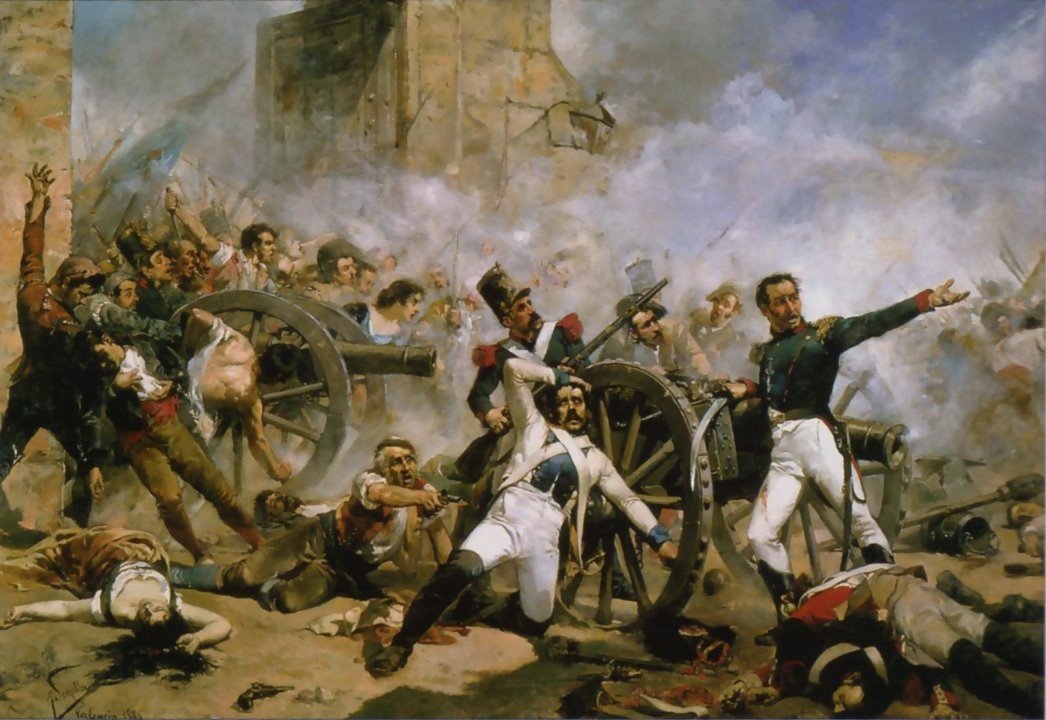
File:Defensa del Parque de Artillería de Monteleón.jpg
Defensa del Parque de Artillería de Monteleón by Joaquín Sorolla y Bastida depicts Pedro Velarde's last stand (he died May 2 1808)

And then we see a twist and redirect out attention to the Spanish maidens, the real subject our poet is paying praises to. The last five lines show us the transformation of a woman in the times of war: she's no longer the young girl, unexposed to any of the real danger, but a pilgrim of Athena's wisdom and courage, contributing to the victory in her own way.


There are incredible visual and sound elements within this stanza: the shrieking of an owl at night, the shiver of a maiden seeing, maybe a scratch on her skin, all in the memory now; and we see the ruins of a city, and the flashing weapons.

Some background information about the weapons mentioned here:
Bayonet: baïonnette. That's the knife, or spike shaped tip you see inserted on top of a musket or a rifle.
Falchion: fauchon. A one handed, single edged sword. It's heavy and is similar in shape to Chinese Dao.

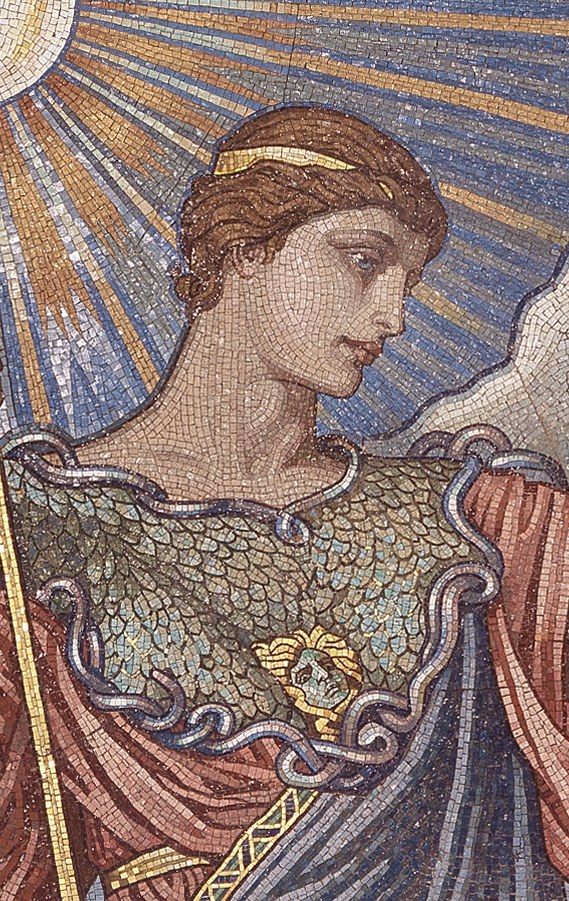
Minerva and Mars. They are Roman names of Athena and Ares. (I'm not sure why the Greeks always prefer names starting with an A, and Romans an M). Minerva is the goddess of arts and craftsmanship. Interestingly her symbol is an owl (for the wisdom). Mars, on the other hand, is the god of war. Those two brother and sister are equally strong. Byron is probably indicating the male and females of Spain with them.

File:Minerva-Vedder-Highsmith-detail-1.jpeg
Mosaic of the Minerva of Peace (detail), Elihu Vedder, 1896


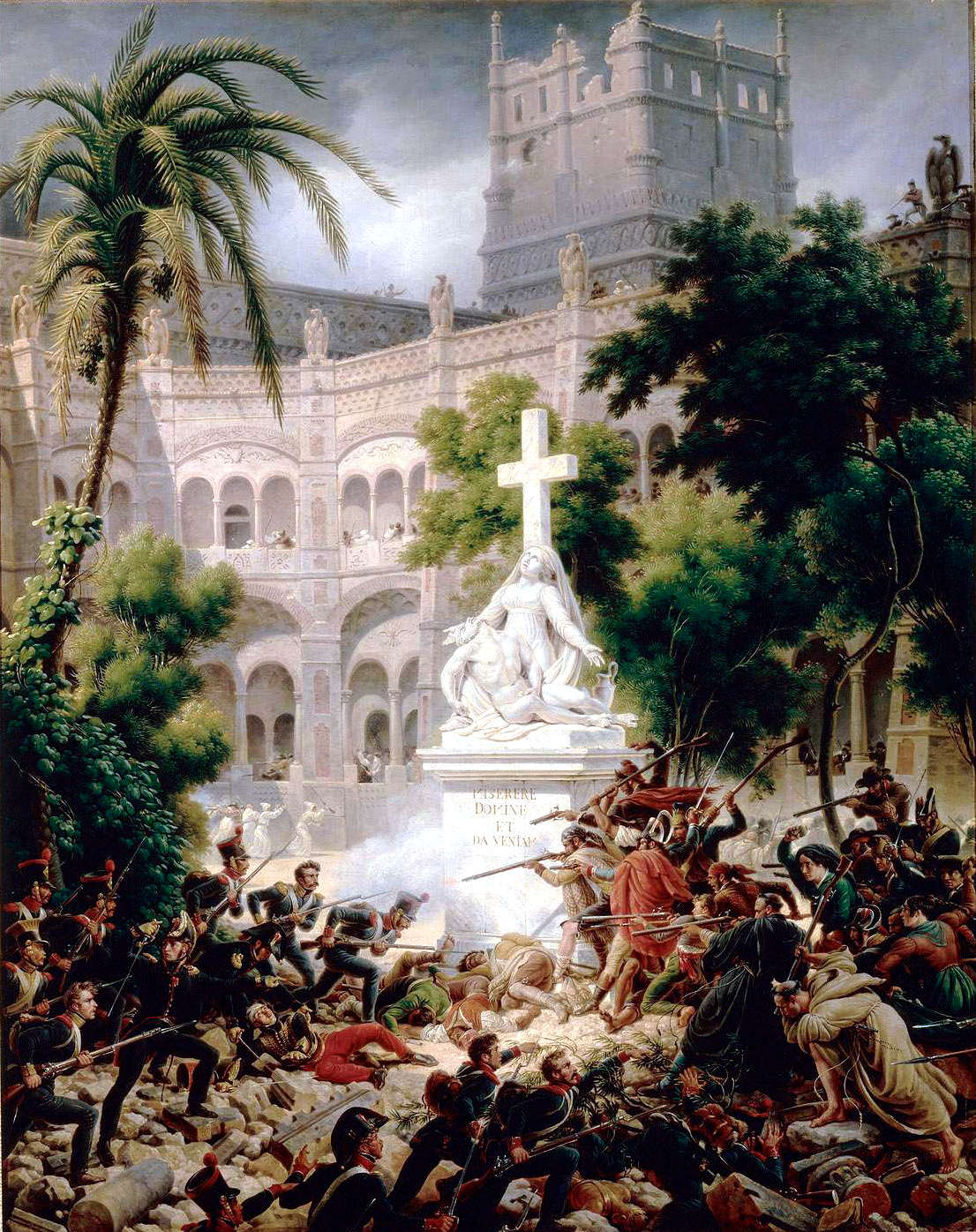
Zaragoza (known as Saragozza) is the city where Basilica, Cathedral of Our Lady of the Pillar is. It's a city of stories,and beautiful, mind I repeat myself, BEAUTIFUL architectures (mostly Roman Catholic cathedrals of course). The two sieges Zaragoza endured between 1808 to 1809 cost her some 50,000 lives. 

File:Santa Engracia - Lejeune.jpg
Assault of the French army at Santa Engracia Monastery 8 Feb 1809
The female strength depicted here is soft, yet enduring. It's her grace and serenity in the face of danger, or even death, that marvels us the most. It's quite likely that the beautiful "her" has two layers of meanings: the actual women of Spain, and Virgin Mary, the spiritual symbol that several of the landmarks of Zaragoza represent.


During the second siege of Zaragoza, the defender surrendered rather quickly. In a way, it's submission and death at the same time - gravest tragedy of all. Ode to the women who stood still when the men fell; ode to the women who remain calm and hopeful when weapons lost their use, and all that's left is dignity.

There's an old fable that goes like this: the wave laughs at the dripping water below the cliff as he smashes onto the rock, but the dripping steam just keeps going. The wave, of course, eventually accomplished nothing with smashing against the giant rock, but the dripping water managed to make a hole on the stone. Persistence, or, as Byron put it so well, "tender fierceness" is the best quality one can have when all hope is lost.

The Spanish maidens embodies romance and tender beauty as opposed to the Amazonian women warriors. The contrast, of course, impresses us even more.


In stanza 58 our focus comes back to the men, yet showing another strength of the women. They seem to have the power of encouraging men to fight for their country, to win their love. The kisses are as if trophies, only bestowed to the victors.

The poet is so fascinated by the maidens in Spain as they are so very different from those in the North, which I'm assuming means England.  The portrait of a Spanish lady with a fan might vaguely depicts what is considered beauty in early 1800s. As you can see, it's definitely not what you expect in a stereotypically slender and meek British woman around the same era - just think about Byron's old lovers and you'll see my point.

Eugene Pierre Francois Giraud (French artist, 1806-1881) A Spanish Beauty with a Fan
It's her people that show the true beauty of a city. Its palaces may fall; its reigns may change; its technologies and fashions evolve, even the climate, can be altered by the traveler's perceptions. Only people leave consistent impressions. Jean-Paul Sartre's famous "L'enfer, c'est les autres" (hell is other people) can be reinterpreted as, at least for me personally, that Paradise is other people as well. It's just the difference of our perspectives. In the beauty of humanity we seek paradises, and only then, maybe, wars and conflicts will cease.

I : XLIX - LII Sierra Morena's Sorrow

On the 4th of August, 1809, Byron's arrived at the Rock of Gibraltar, the southern end of the peninsular, leaning north towards Andalusia, more precisely, the region of Sierra Morena. I'm not entirely sure about the location of Childe Harold in this particular stanza, but if he can see the Moorish turrets, which I'm assuming was the Moorish Castle constructed in the Marinid Dynasty. 

File:Rock of Gibraltar 1810.jpg
The Rock of Gibraltar's North Front cliff face from Bayside (c.1810) showing the embrasures in the Rock.
The Tower of Homage was the tallest construction during the Islamic period of the peninsular, and played a huge part in the conquest of Iberia. Interestingly, there are two architectures on the peninsular that could have been the Moorish Castle. One is, of course, the one in Gibraltar; the other one, is the Castle of the Moors in Sintra, Portugal. There are clear distinctions between the appearances of the two. One is the only Marinid construction outside of Africa, the other, well, a Medieval castle made of stones, overlooking Sintra from the mountains. Both of them, however, witnessed much of the sorrow of people whose homes were ruined, and countries taken over by a trail of different conquerors. 

The Moorish Castle, Gibraltar by Terence Humphries


In 1808, the year before Byron's visit, Ferdinand VII had been King of Spain. He was, well, the other potato head (apart from Godoy) that primarily caused most of Spain's suffering. Stanza 50 is about him, his colourful story of betrayal and rumors of his birth.

File:Francisco de Goya y Lucientes 070.jpg
Portrait of Ferdinand VII by Goya

Landscape cloaked by an atmosphere of war becomes an entirely different kind of scenery. It's as though every single turn of the mountain path, or the fog, or the plantation all become saturated with military strategies. Simple, innocent landscape, now every thread of it is woven with tension.

File:Battle of Bailen.jpg
The Surrender at Bailén by José Casado del Alisal. Oil on canvas. Museo del Prado.
In stanza 49, the dragon nest is actually Province of Jean where The Battle of Bailen took place. Spain had a so-called victory and it ended with the negotiated surrender of French occupiers. At the same time, hero stories of Spain also ignited the spirit in Austria, whose warriors defended their homeland against France with passion. 


The spirit is up after the Battle of Bailen: it's no longer impossible to defeat Napoleon, says Spain, look what we've just done! Their victory was, of course, more of a temporary luck. Before long, Spain was once again almost completely lost to the Gaul, as Harold here "foreseeing" the bad omen coming down. Bear in mind that Byron wrote all this after his journey's done. He could make all of his political commentaries in Harold's name and call it speculations.

11.2.13

I : XLVI - XLVIII Tales of Sevilla

Imagine a party in a house made of glass, and the glass is cracking all over the ceiling, the walls, the columns... but no indeed they're not in denial, but are just ignorant of the oncoming danger.

There's music and songs about love; prostitutes walking around trying to find their clients.

Rebec Player by hondacd175


This stanza reminds me of a similar part in Notre Dame de Paris and here's a clip from the musical of the same title. This song, from the voice of the bard, is about what happens at night, what "vices are still clinging to the walls" of a city about to shatter. Enjoy Les Portes de Paris.


Seville had been an important place in the western literary world. Flowers of arts have been blooming in Andalusia thanks to the richness of Seville. Just to name a few titles that nobody can say they're unfamiliar with: The Marriage of Figaro, Don Giovanni, The Barber of Seville...this list can go on and on. Artists of different generations created stories set in Seville. It's sort of life in today's entertainment world: in movies, novel, musicals, everything happens in New York City, even in comic books, all the superheros and bad guys saves, or destroys NYC, or the big apples in an alternate universe, you get the drill. 

In short, Seville had been, in a way, the center of universe, and it enjoyed it. All the desires and beauty of many a superficial kind of pleasure brews the poison of war underneath it all. 

After taken back from the Muslim control, indeed the Christians turned Seville into a cultural and economical centre which lasted for centuries. It also became a, what can I say, religious enter. Feasts of At this point Byron, or Childe Harold is giving a predicament about the changing fate of nations and how easily something glorious can be taken away. (sadly he's right.)

Seville Corpus Christi procession
Corpus Christi in 19th Century Seville, Spain.


During 1801-1808, Manual de Godoy, Prince of Peace had his second term as Spain's prime minister. If you'd been reading this blog up to this point, you can pretty much blame this guy for all the bloody scenes I've made you imagine previously. At a young age Manual de Godoy became the royal family's favourite, although for reasons I cannot possibly comprehend, and gained political power. Then comes disasters after disasters that he brought upon the people of Spain, and yet, he still got to be prime minister fot the second time after all those shitty things he's done for his country. Just to name a few: he's the one who decided to invade Portugal with France; he's the one who made Spain split with England, causing thousands' death. 

File:Manuel Godoy Spain.jpg
Portrait of Manual de Godoy by Goya

At the age of 17, Godoy was nothing less of a "rockstar" in today's sense. He was accomplished in, wait for it, chanting and playing guitar! Queen Maria Luisa of Parmar loved it, and so Charles IV, honouring his wife's wishes, loved the boy too, so much so that he gave him the office of "Cadete supernumerario".

To some extent I'm sure Harold sees a glimpse of himself in Godoy's "legacy": his youthful stupidity, his mistresses, his chanting and dreams to become a knight, his ruining everything his father had built.

There's a certain connection, I'm assured of it, between Harold and Manuel, as our hero seeks redemption on the road.