Showing posts with label knowledge. Show all posts

13.2.13

I : LIII - LIX Ode to the Spanish Maidens

There's always the constant struggle for a boy as he's at the turning point of becoming a man. Just you see, without a miss, in all literature formats: the ultimate choice between his country and his woman. If this statement sounds too sexist to you, well, you'll have to keep in mind that this was 19th Century, and people were shedding blood to prove themselves...competitions are still pretty primal if you ask me.


And here again we question the purpose of all those people giving up their lives for the glory of those few in power. It's a rather simple-minded attitude towards winning and losing: you either win (then you get all that glory, wealth and women and what not),or fight till the last drop in the battle field. There's no grey area in between, and submission is worse than hell.

For a romantic poet these few stanzas have been intense, almost hypnotizing with the war call and drum rolls as though phantom from the past. "Manhood's heart of steel" says Harold, as he sees his weak self.
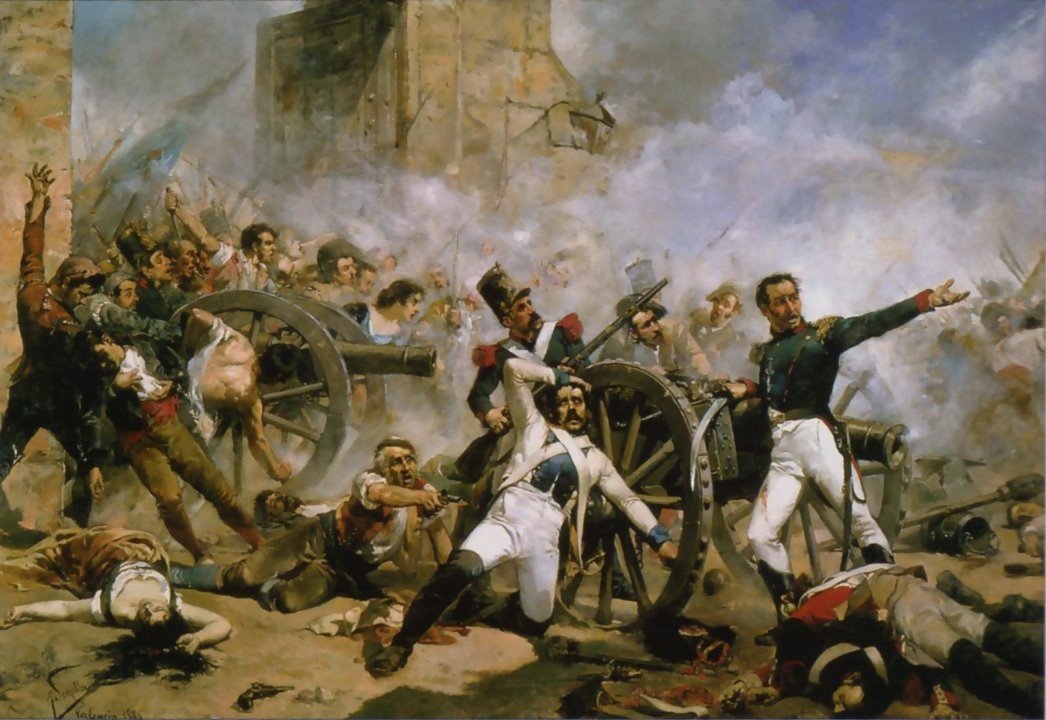
File:Defensa del Parque de Artillería de Monteleón.jpg
Defensa del Parque de Artillería de Monteleón by Joaquín Sorolla y Bastida depicts Pedro Velarde's last stand (he died May 2 1808)

And then we see a twist and redirect out attention to the Spanish maidens, the real subject our poet is paying praises to. The last five lines show us the transformation of a woman in the times of war: she's no longer the young girl, unexposed to any of the real danger, but a pilgrim of Athena's wisdom and courage, contributing to the victory in her own way.


There are incredible visual and sound elements within this stanza: the shrieking of an owl at night, the shiver of a maiden seeing, maybe a scratch on her skin, all in the memory now; and we see the ruins of a city, and the flashing weapons.

Some background information about the weapons mentioned here:
Bayonet: baïonnette. That's the knife, or spike shaped tip you see inserted on top of a musket or a rifle.
Falchion: fauchon. A one handed, single edged sword. It's heavy and is similar in shape to Chinese Dao.

Minerva and Mars. They are Roman names of Athena and Ares. (I'm not sure why the Greeks always prefer names starting with an A, and Romans an M). Minerva is the goddess of arts and craftsmanship. Interestingly her symbol is an owl (for the wisdom). Mars, on the other hand, is the god of war. Those two brother and sister are equally strong. Byron is probably indicating the male and females of Spain with them.
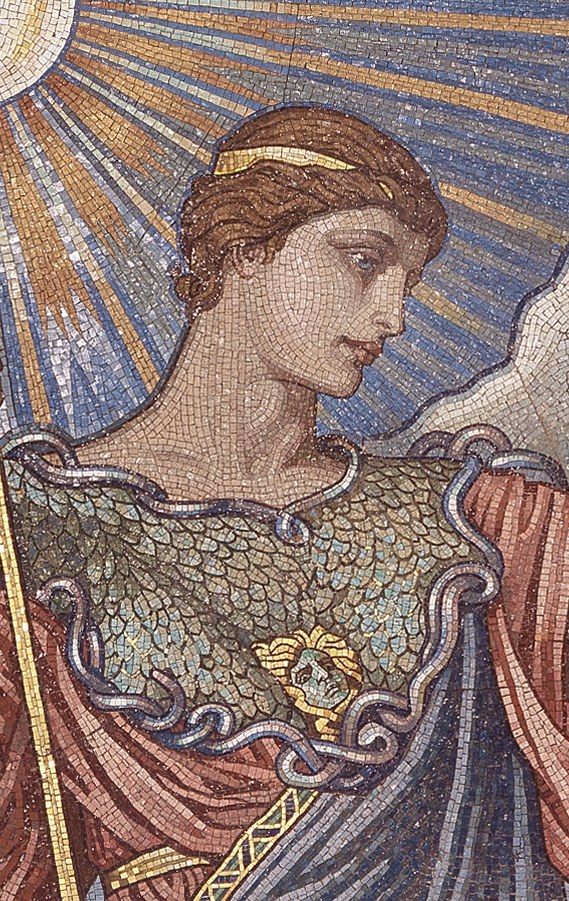
File:Minerva-Vedder-Highsmith-detail-1.jpeg
Mosaic of the Minerva of Peace (detail), Elihu Vedder, 1896


Zaragoza (known as Saragozza) is the city where Basilica, Cathedral of Our Lady of the Pillar is. It's a city of stories,and beautiful, mind I repeat myself, BEAUTIFUL architectures (mostly Roman Catholic cathedrals of course). The two sieges Zaragoza endured between 1808 to 1809 cost her some 50,000 lives. 
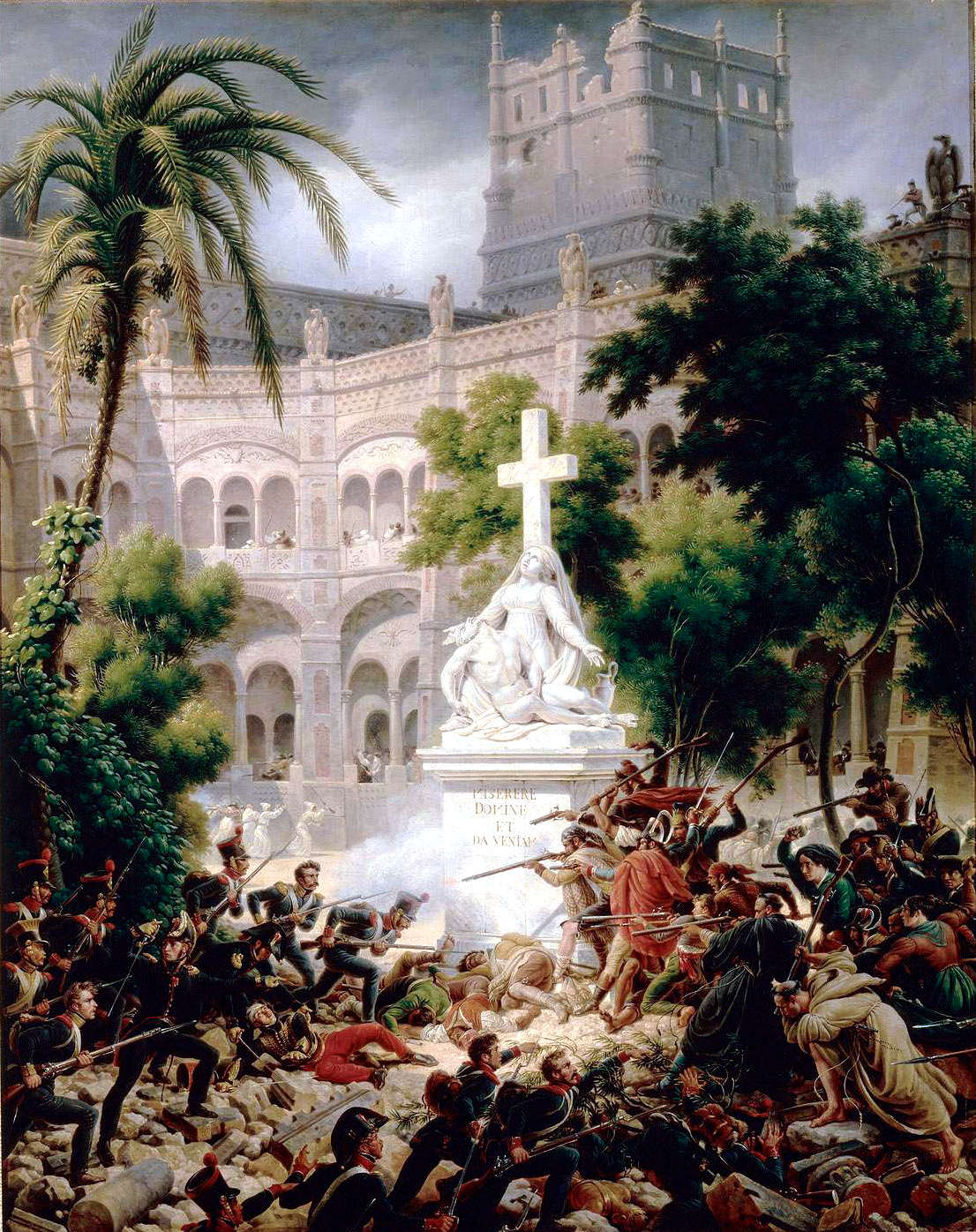
File:Santa Engracia - Lejeune.jpg
Assault of the French army at Santa Engracia Monastery 8 Feb 1809
The female strength depicted here is soft, yet enduring. It's her grace and serenity in the face of danger, or even death, that marvels us the most. It's quite likely that the beautiful "her" has two layers of meanings: the actual women of Spain, and Virgin Mary, the spiritual symbol that several of the landmarks of Zaragoza represent.


During the second siege of Zaragoza, the defender surrendered rather quickly. In a way, it's submission and death at the same time - gravest tragedy of all. Ode to the women who stood still when the men fell; ode to the women who remain calm and hopeful when weapons lost their use, and all that's left is dignity.

There's an old fable that goes like this: the wave laughs at the dripping water below the cliff as he smashes onto the rock, but the dripping steam just keeps going. The wave, of course, eventually accomplished nothing with smashing against the giant rock, but the dripping water managed to make a hole on the stone. Persistence, or, as Byron put it so well, "tender fierceness" is the best quality one can have when all hope is lost.

The Spanish maidens embodies romance and tender beauty as opposed to the Amazonian women warriors. The contrast, of course, impresses us even more.


In stanza 58 our focus comes back to the men, yet showing another strength of the women. They seem to have the power of encouraging men to fight for their country, to win their love. The kisses are as if trophies, only bestowed to the victors.

The poet is so fascinated by the maidens in Spain as they are so very different from those in the North, which I'm assuming means England.  The portrait of a Spanish lady with a fan might vaguely depicts what is considered beauty in early 1800s. As you can see, it's definitely not what you expect in a stereotypically slender and meek British woman around the same era - just think about Byron's old lovers and you'll see my point.

Eugene Pierre Francois Giraud (French artist, 1806-1881) A Spanish Beauty with a Fan
It's her people that show the true beauty of a city. Its palaces may fall; its reigns may change; its technologies and fashions evolve, even the climate, can be altered by the traveler's perceptions. Only people leave consistent impressions. Jean-Paul Sartre's famous "L'enfer, c'est les autres" (hell is other people) can be reinterpreted as, at least for me personally, that Paradise is other people as well. It's just the difference of our perspectives. In the beauty of humanity we seek paradises, and only then, maybe, wars and conflicts will cease.

11.2.13

I : XLVI - XLVIII Tales of Sevilla

Imagine a party in a house made of glass, and the glass is cracking all over the ceiling, the walls, the columns... but no indeed they're not in denial, but are just ignorant of the oncoming danger.

There's music and songs about love; prostitutes walking around trying to find their clients.

Rebec Player by hondacd175


This stanza reminds me of a similar part in Notre Dame de Paris and here's a clip from the musical of the same title. This song, from the voice of the bard, is about what happens at night, what "vices are still clinging to the walls" of a city about to shatter. Enjoy Les Portes de Paris.


Seville had been an important place in the western literary world. Flowers of arts have been blooming in Andalusia thanks to the richness of Seville. Just to name a few titles that nobody can say they're unfamiliar with: The Marriage of Figaro, Don Giovanni, The Barber of Seville...this list can go on and on. Artists of different generations created stories set in Seville. It's sort of life in today's entertainment world: in movies, novel, musicals, everything happens in New York City, even in comic books, all the superheros and bad guys saves, or destroys NYC, or the big apples in an alternate universe, you get the drill. 

In short, Seville had been, in a way, the center of universe, and it enjoyed it. All the desires and beauty of many a superficial kind of pleasure brews the poison of war underneath it all. 

After taken back from the Muslim control, indeed the Christians turned Seville into a cultural and economical centre which lasted for centuries. It also became a, what can I say, religious enter. Feasts of At this point Byron, or Childe Harold is giving a predicament about the changing fate of nations and how easily something glorious can be taken away. (sadly he's right.)

Seville Corpus Christi procession
Corpus Christi in 19th Century Seville, Spain.


During 1801-1808, Manual de Godoy, Prince of Peace had his second term as Spain's prime minister. If you'd been reading this blog up to this point, you can pretty much blame this guy for all the bloody scenes I've made you imagine previously. At a young age Manual de Godoy became the royal family's favourite, although for reasons I cannot possibly comprehend, and gained political power. Then comes disasters after disasters that he brought upon the people of Spain, and yet, he still got to be prime minister fot the second time after all those shitty things he's done for his country. Just to name a few: he's the one who decided to invade Portugal with France; he's the one who made Spain split with England, causing thousands' death. 

File:Manuel Godoy Spain.jpg
Portrait of Manual de Godoy by Goya

At the age of 17, Godoy was nothing less of a "rockstar" in today's sense. He was accomplished in, wait for it, chanting and playing guitar! Queen Maria Luisa of Parmar loved it, and so Charles IV, honouring his wife's wishes, loved the boy too, so much so that he gave him the office of "Cadete supernumerario".

To some extent I'm sure Harold sees a glimpse of himself in Godoy's "legacy": his youthful stupidity, his mistresses, his chanting and dreams to become a knight, his ruining everything his father had built.

There's a certain connection, I'm assured of it, between Harold and Manuel, as our hero seeks redemption on the road.

9.2.13

I : XXXV - XXXVIII Spain: A History of Blood Stain

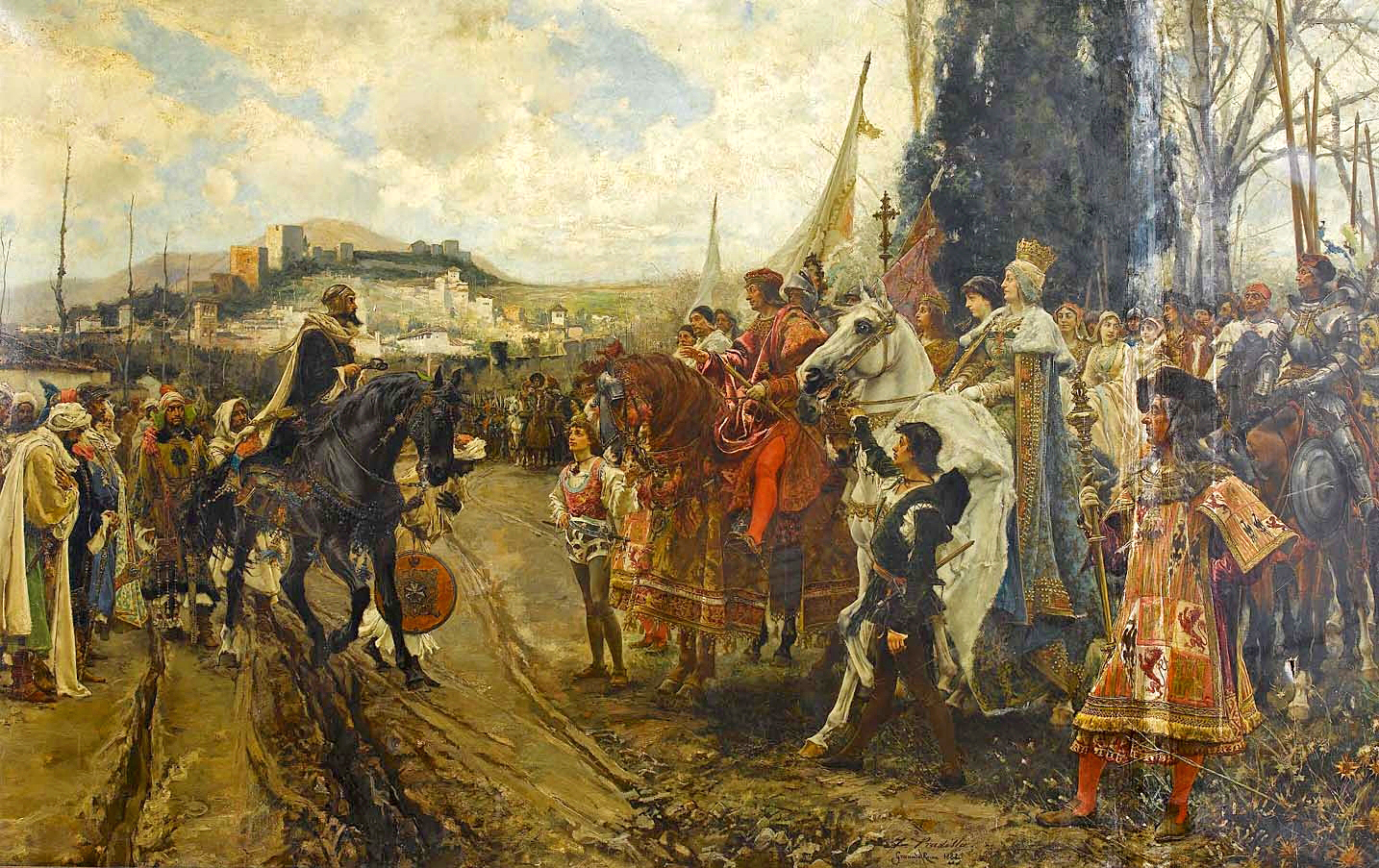
The history of Spain is lined with conflicts between the Moor and the Christian. After the Battle of Covadonga, Pelagius of Asturias was the big guy. He established the first state independent of the Moors and reclaimed Iberian Peninsular, hence the beginning of Reconquista of the Christian. Pelagio's name was mentioned here by the poet, of course, to lament the Christian pride while at the same time, shed empathy to the Moors. 

File:La rendición de Granada.jpg
The Surrender of Granada by Francisco Pradilla Ortiz


Around the year of 682, a general (possibly) under the name of Julian, Count of Ceuta sent her daughter, later became known as La Cava (means scarlet woman) Rumia, to King Roderic's court for education, only to turn into an affair between the daughter and the Visigothic King. Julian betrayed Hispania to the Moor...so of course the Christian later call La Cava a whore and Julian a traitor, while the Muslim deified the girl. Inspired by this story, there's Dana Broccoli's novel Florinda, later became a musical La Cava.

LaCava.JPG


All the poet is saying is: pride shouldn't come from materialized grandiose. Memories can fade and castles can rot, an army of thousands and defense of steel can be annihilated and eventually become some syllables in the bard's song. If lessons from the past cannot be learned, than a leader would be worthless, especially when he's content with superficial flattery of his subordinates. 

http://www.artble.com/imgs/5/6/e/514534/don_quixote.jpg
Don Quixote by Honoré Daumier 1868

Spain should be nothing short of bravery. Chivalry should be her middle name! The man of La Mancha amused the whole world but also showed them how honourable Don Quixote is as a Spanish knight. By 19th Century, King Charles IV had to ally with France during the peninsular war after previous defeats. Spain had been an underdog for so long, and, in those eyes of Harold with the same blunt bravery as Don Quixote, it's about time she wakes up and pick up her lance once again.

You could almost hear the drum rolls with the intensifying rhythms, stanza by stanza. Tis almost time for the big battle, and all you can feel in the air, in the whispers around you are war calls. All the lost souls in the battlefields, they died for the conflicts of nations!

The thing about wars in ancient times: those who shed blood in the heart of the fight, their lives seemed expendable. Doesn't make you flinch and shiver just to think about that? The tyrants, no scratch that, even the kindest rulers wouldn't really care about his peasant soldiers' lives during the war.

This peninsular has had rulers of so many different religious beliefs and ethnic backgrounds. A long tapestry of history shrank into a few words in this stanza. Siroc, for one, is short for Sirocco, a wind from Mediterranean sea that originates from North Africa, the homeland of those Moors that ruled this land for centuries past.

8.2.13

I : XXXI - XXXIV Lusitania and Hispania: The Unlikely Rivals

There's an apparent geographical change in sight: all of a sudden the mountainous region of Sintra has been left behind and we now follow Harold, or Byron to the plain. 

http://iamachild.files.wordpress.com/2012/05/the-shepherd-boy.jpg
Shepherd Boy


We see the serenity of Spanish prairie life and contemplate how easy it is to break that kind of peace. It's all so easy to get into conflicts, and it's all so easy to turn those peasants' paradise into hell.


Between Spain and Portugal, we don't see a lot of natural boundaries that are difficult to conquer. Tagus river touches gently upon both nations but never does anything too dramatic. (Speaking of Tagus, it took me incredibly long time to figure out that Byron meant Tagus by Tayo. He might have spelled it phonetically as Tajo (pronounced Tayo) was the Spanish name for Tagus.) Andalusia's Sierra Morena does lie between the two of them, but the mountains separates Spain from Moraco if anything, not Portugal! There's nothing terribly high, or deep, or vast, or ruthless that you think would have more chances pissing off either sides, stirring up some quarrels between "neighbours" whose backgrounds are so much alike.The Pyrenees on the other hand, is a MASSIVE boundary between Spain and France. In the 17th century the two of them fought for 24 years, yet ironically, they became allies in opposition of Anglo-Portugal in the 1800s.

[IMG]
Geographical Layouts of Iberian Peninsular


If there's one thing we can learn from what Childe Harold sees, it's that what it seems is never what it is. The peaceful appearance of what separates Portugal from Spain is merely an illusion, covering the hostile situation they're in.


Rio Guadiana, or Rio Odiana is one of the waterways between Portugal and Spain. It's also the fourth longest river on Iberian Peninsular. Where Guadiana flows is also close to Andalusia, a hot spot for the Moors and the Christians to shed blood. Paynim turban and Christian crest here, are used as parts to indicate the whole group of people.

Why do we get into fights? We now know that the natural boundaries play lesser part than religious beliefs. 

A Fairly Tedious Wiki Update

I never doubted the credibility of Wikipedia. Why would I? Isn't it the most inclusive source of knowledge in the entirety of internet universe? Everyone is a student AND an educator simultaneously: we are all equal in Wiki-World. So most of the time I would just take whatever comes.

Of course, we also know that you can't get too serious about what you learn from Wikipedia: it's not a scholarly resource if you're really only something that calls for total accuracy and academic integrity.
As I was examining the Wiki page for Childe Harold's Pilgrimage, I discovered that it contains error, along with the problem of inadequacy.

Once you're determined to edit a Wiki page, the rest is insufferably easy; the only monitor you have to answer to is your own conscience. 


It says here that Ianthe, Charlotte Harley was already 13. As a matter of fact, Charlotte was born in 1801, making her barely 11 when the poem was first published in 1812. See the following changes plus some extra information I added as a partial description of the content.


In the Cultural References section, Asterix in Belgium was mentioned and linked but there isn't any detail. Also, I'm not sure why Schadenfreude was included in the See Also section. While being an interesting word with entertaining meaning and pronunciation, The German word had no apparent connection to Childe Harold or Byron, so I decided to get rid of it.

I added a link to the webpage where you can read the entire chapter of Asterix in Belgium as well as the actual location of the quotes. I replaced the See Also slot with Byron's Don Juan, as it is a related topic.


Now, let's take a look at those three quotes in Asterix in Belgium (page 40, 44 & 45), just for the sake of it.

Enjoy!