19.2.13

I : LXXXV - LXXXVIII Blindly, They Fought On

On 5th of Feb. 1810, the French started bombarding Cadiz and the Siege of Cadiz continued until 24th of Aug. 1812. The fortification of this port city proved to be so strong. Those walls seemed to be invincible! Surrounded by three arm forces, Cadiz stood still, or at least, she held on for a long time. The French almost lost hope of ever taking this place. 

File:SitiodeCadiz.jpg
Map of Cadiz in 1813.


"War even to the knife!" A common mistranslation of the laconic phrase "guerra y cuchillo", General Palafox's respond to French invaders' demand during the brutal second siege of Saragossa "paz y capitulacion"(peace ans surrender). The phrase actually meant, concisely, "war and knife", the point being, they will defend till the last drop of blood. 

File:Palafox-goya.jpg
General Palafox painted by Goya

It was uneasy for the allied force to lift the siege, as the British didn't quite trust the Spanish. Of course, the Spanish didn't give up, hence winning Byron's high regards here. 

There's again, a time lapse in the mentioned events here. The author explored the city of Cadiz in 1809 when he witnessed the unforgettable bullfight. The siege happened a year after, and didn't commence until after the poem was published. When he was drafting the first canto of Childe Harold, Byron would have known about the struggle and hold-off between Anglo-Spanish defense and French assailers in the city of Cadiz. The ruthless fight between the noble looking matadors and the enslaved beast, is definitely similar to the people of Spain who's in a rather similar situation. 


Since his youthful years spent riding pony and reading a formidable amount of books in Aberdeen, Byron had been drawn to history. Of course, his lament on people's lack of perspective wouldn't make too much sense to those Spaniards in trouble. They couldn't do anything but picking up their knives and protect their families. No matter what era it is, war never ceases to cause unnecessary deaths. It's a vicious cycle that most of us just refuse to admit. 


The reality is, the human race is not very responsible when we take actions. The savage acts of destruction and barbarism leaves us barren lands, and a dejected sight of mortifying remains of our own kind. So many times have people of enlightenment stood and sigh in front of ruins of past generations, yet the more important question is: how do we break this behavior pattern?


I : LXXXI - LXXXIV When You're Engulfed in the Fire of Jealousy

Mozart's Magic Flute premiered on the 30th of September 1791, two months before the sorrowful early passing of the legendary musical prodigy. "Der Hölle Rache kocht in meinem Herzen" (Hell's Vengeance Boils in My Heart), was the Königin der Nacht, or Queen of the Night's second aria. The ultimate archetype of "the lady engulfed in the flame of jealousy". Get a taste of the song here:

File:QueenOfTheNightAria1.png
part of the sheet music from the opera
Queen of the Night played by Diana Damrau

Jealousy is that green-coloured devil who stirs up trouble and enjoys his destruction. The other Queen who had been famous for her jealousy was Hera, or Juno (depending on if you prefer the Greek way or the Roman). Her flame of jealousy ignited oh so many historical events, mostly saturated with blood and deaths: the exile of Europa, the fall of Troy, the terrible fate Aeneid had through, so on so forth.

File:Carracci - Jupiter et Junon.jpeg
Jupiter and Juno (Hera) by Annibale Carracci.


Lethe, one of the five rivers of the Underworld, is said to be the river of oblivion. You're supposed to drink it as you cross over to the other side, after which you forget everything about your earthly life. Our young traveler here is certainly going through some coming-of-age-aching. The scenes he's been exposed to, the events that have been exploding around him have all contributed his rapid emotional growth. He's no longer that lad whose main focus in life had been the tenderness of love. And he has also realized the danger of love. Indeed love many a time is related to jealousy, which is quite the root of most crimes, if you think about it! Now, I suppose the Cupid the cherubic angel will never seem the same to you, although he was a victim of jealousy himself, when Hera disapproved and got outraged by his love affair with Psyche.


Byron's The Girl of Cadiz might best demonstrate his impression of the women in this Spanish city of passion. It is said that the poet had the briefest encounter with a beautiful daughter of an Admiral, yet thanks to the rigid schedule he didn't hold a chance in developing any sort of relationship with her.


Harold's experience in Cadiz reminded me of the Kubler-Ross model, or, the five stages of grief: denial, anger, bargaining, depression, and finally, acceptance. The model couldn't perfectly fit describing someone as emotionally enriched as our poet himself, but we can definitely see a soup of sensitive experience between the lines, especially the last two stages. 


He's almost ready to forget, to give up love, although still "bargaining" with the attraction he still felt. Eventually he channeled the emotions towards creativity, hence the verses and the lays.

In the face of the formidable Jealousy, Love is weak, and Death is merely a childish solution as "denial" is only the first stage of acceptance. Of course, it is still believed that Beauty prevails, just like Cupid and Psyche had each other in the end, Aeneid rebuilt his country, and Rome flourished.

18.2.13

I : LXXV - LXXX The Cost of Glory (or Silent Death of the Raging Bull)

It always takes longer, sometimes it seems infinitely longer, to prepare for a battle than when it actually takes off. The bullfight is like war in every aspect, including the sound of its fatal moment. Three clarion notes, and the slashing, the attacking, the killing begin, two forcefield charged to their maximum.


The bull represents different things in different cultures, but all has fascinating tales. Europa's gorgeous white bull to her, and to everyone represents passion, transformation,virility, strength. We know that the bull was actually Zeus in disguise, indeed, but the fact that the king of gods chose the bull as his animal embodiment, clearly suggested the kind of image a bull can project. It's majestic, a monarch amongst the herbivores to be sure. In other words, if a bull is onto you and he wants to kill you, it's purely for emotional motivation and purpose, he does't even want to eat you. So don't ever mess with that family.


Like a gladiatore the matador stumbles his way around the beast, teasing and trying and giving a show. How much fear must he have endured! It's an enclosed space, yet a perfect metaphor of the survival of the fittest. It seems a chaotic and primal fight, yet every single step, every movement is calculated, given  much thought, one side manipulation the other, and vice versa, and eventually neither could walk out intact. For the matador, it's also an emotional torture.


Some 100 years after Lord Byron's time, 1926 to be specific, Hemingway described another bullfight in The Sun Also Rises, this time in Pampona during the Festival of San Fermin. Full house every night, featuring minor bullfighters and gallant horses, it's a tradition, or an addiction of human race. Why else do you think action films will always be blockbusters and enjoy killer box office? Men always feel good about themselves then they are proven to be conquerors of nature, even if the cost is more than the reward.

File:Hemingwaysun1.jpg


This action packed stanza described the process of the fight right to the moment as the bull gave up. It's all very sudden just as its sudden start. You can almost see the flashing red mantle, the darts sticking out of the bull's body which bloodstreams across his skin, the glistening sword in the matador's hand...


The bull's ear is bestowed to the winner. It's similar to the golden fleece I suppose, although much bloodier and more symbolic. It's a useless piece of meat from your victim! What good is that for? It's a silent death after much celebrated and expected struggle. It's a show, with equal likelihood of survival and death, at least on the surface.


Again, it's a show, attracting men and women alike. Men are envious of, women smitten by the glorious matadors, only a silent death is the cost. 

17.2.13

I : LXVIII - LXXIV Before the Killing

I could only imagine how the air would thicken before a bullfight. What an act of savage and grace, exciting and dreadful, sacred and barbaric. How ironic it happened to be the sabbath, and this city is giving the gods in all the glory, a competition between man and beast, a struggle till the last breath.

The arena is full, the bull restless, the energy spouting like blood, and you hear the roaring though uncertain whether it's from the magnificent animal, or the resonance and echoes of the crowd's breathes and thoughts.

arena before the fight
It's something insatiably beautiful and sad, for you know the fight goes on until one side of the opponents is dead. 


The sabbath, in a religious sense, is the 7th day in a week, god's sacred day of rest. Depending on which religion you're in, the timing would be different. Here the poet is indicating Christian sabbath, though in Judaism, sabbath starts after sundown on Friday.


It's strikingly a cultural thing, for a bullfight in Spain is like a religious gathering in, well, for example says the poet, in London. Nobilities from all directions swarm in from their country houses, their carriages jamming the streets, to the cathedrals they go. 


Yet here in this arena it's a celebration of men's conquering of nature, in finest apparels and noblest agility. Something Byron wouldn't be able to do if I may add, which is possibly why he got so overwhelmed and fascinated by this beauty, or terror, depending on your point of view. 


There's no differences between the votaries of god: young, old, rich, poor, their confessions alike, forgiven before the altar, similarly amongst the audience of a bullfight. They are witnessing a crime, committed by men, yet the killers will be rewarded for their courage and heroism. Isn't it ironic if you really think about the nature of the fight?


All is silent before the killing. Imagine, outside of the area the streets would be empty. Everyone you know would be sitting inside of this round, heated, tormenting space overlooking a stretch of crimson coloured earth. The battle between the matador and the bull will soon begin. 

You'd be surprised to find out that the audience consists mostly of ladies. It's an exhibition of strength and agility of men, to be sure, indeed an attraction and a fantastical scene. 


The arena is a power source ready to release its energy at any time now. It's almost as though nothing else in the universe mattered, and all is focused on the centre of this space: the matador dressed in gold and embroidery; the bull, o that magnificent creature, is a spiritual embodiment of what is expected of the matador. The two of them, discrepant in size and actual strength, yet equivalent in their bosting aura.


It's been documented in memoirs that Byron didn't enjoy the bullfight although inspired by it. I cannot imagine what kind of emotional turmoil he'd been in during the show, but I believe that he would see more of himself, not in the matador  but rather in the bull, panting and prancing underneath the gazing of an entire universe. There about to be bloodshed and injury. Just like what his fame did to him, which exploded too quickly when he was mere 24.

the Matador - from Charles Lisanby

Vicente Blasco Ibanez wrote a Blood and Sand (Sangre y Arena). The entire act of a bullfight is almost a reflection of Byron's life, which had been teaming with struggle and mess, metaphorically presented in a limited space: it has more symbolism but much more exciting and concise. I'm not certain whether he enjoyed much of the act, but he surely understood all and sympathized with both. Maybe more with the bull, for the matador represents more of his vanity, yet the bull, his truth identity.


16.2.13

BBC's Byron: A Character Study of The Conflicted Poet

About a decade ago BBC gave us a ravishingly detailed account of Lord Byron's life from the epitome of his fame to his pitiful death in Missolonghi.  The TV movie Byron, starring Jonny Lee Miller as the title role, was directed by Julian Farino and written by Nick Dear, who would later collaborate with Miller again in the internationally reclaimed, Danny Boyle's triumphant National Theatre production of Frankenstein revival, having Miller and Benedict Cumberbatch rotating the roles of the monster and the scientist every fortnight.  Dear's script is compact and precise, encompassing all the major events in Byron's life after his overnight fame. After the 2002 documentary Exile on Fame Street, the 2003 production of Byron had quite a star-studded team, with Vanessa Redgrave as Lady Melbourne, Stephen Campbell Moore as John Cam Hobhouse, Julie Cox as Lady Annabella Milbanke, Camilla Powers as (the infamous) Lady Caroline Lamb, etc. The cinematography is more intimate than that of a movie made for the big screen, this tasteful production is quite meticulously made and deserves to be savoured rather than rushed through.

Jonny Lee Miller as George Gordon Byron, 6th Baron Byron

The opening scene shows the aftermath of Byron's death, his closest friends gathering together, making the decision of burning his memoir. It was revealed in the film how the real accounts of Byron were discovered (Annabella Noel Byron, nee Milbanke who lived to be 80 had a lot to do with the complete disruption of Byron's reputation, but you wouldn't know that just by watching the film).  
I must say that the dramaturgs of the film was excellent in capturing all the details about Byron's life: the appearance of the grandeur Newstead Abbey, detailed all the way to the skull filled with wine! Miller also did a good job portraying the extremely self-conscious young lord: a effeminate youth, lame with a deformed right foot and features of Adonis; a narcissistic, yet insecure poet who's at war with himself. 

the legendary Vanessa Redgrave as Lady Melbourne

The order of events presented in the film was, to be honest, not quite truthful. I suppose that could be neglected as we are trying to get a general familiarity with this most controversial literary figure in European history, rather than scrutinizing scholarly accuracy. 

The audience were shown the different aspects of Byron's literary and personal life almost bluntly. His most gossiped bi-sexuality was revealed from the beginning as we see his intimacy on his trip, with who appeared to be, I'm assuming, Robert Rushton the pageboy. Many a details are packed in the seemingly not-so-fast-paced film: we see Byron swimming in Tagus, rescuing the Turkish maiden who were to be executed by adultery (which actually happened later on during his second trip, but that's another story); we see the loyal valet Fletcher and Hobhouse's pen and paper that he packed so many of for the trip...before the fame hits. 

The we were immediately introduced to the high society of Britain and the later half of Byron's life, including how his Hints From Horace proved unfavourable to the publishers while Childe Harold became an overnight hit; he became the national celebrity, having his portrait done, his peculiar diet because of his tendency of getting fat (inherited from his mother), etc, etc. And then there's the notorious affair with the then already married Lady Caroline Lamb, the infamous first known groupie of a modern superstar. Camila Powers' portrayal of Caro the "little volcano" fits the profile of a spirited woman of passion, with beauty like an antelope; maniac yet fragile. Her almost obscurely modern look set stark contrast against Annabella Milbanke, yet according to documentation, was quite truthfully reflected as what Lady Lamb was like. 

Some of the choices the producers made for the characters haven't been entirely factual, the reason being, I suppose, to somewhat glorify Byron the poet and Byron the hero, and to romanticize his love life and scandals. Although I have to admit that the genius of the creative team successfully conveyed the character of the protagonist and summarized Byron's life story even though they went off the track a little about his relationship with Lady Milbanke, which was portrayed as though Annabella was the one who got starstruck, while in reality it had been Byron who initiated the proposal, got rejected for the first time, and then finally succeeded in 1815 after the two of them corresponding through post for about three years. Also, the appearance of Annabella Milbanke was adjusted in favour of the public eyes, Julie Cox being a slim and attractive Lady Milbanke, while historically she was supposed to be plain looking, somewhat voluptuous, though philosophical and insufferably bright. 

The disappointing part of the production, if I may, is the lack of Byron's life pre-fame. His upbringing, experiences as a young boy in Cambridge, even his trauma at a young age, were missed out, as was his relationship with several important people including his mother, with whom Byron held a love-hate relationship till the end of his day, Edleston (his male lover since boyhood), etc. It's understandable that the main purpose of the movie is to show Byron's controversial society life and his public image, but I still believe it would have helped to have some exposure of his formative years. For a biopic, only one segment of the hero's life cannot make the audience see the whole entity. Also, the story missed out on Lady Oxford, Elizabeth Jane Scott, who had as strong an impact on Byron's life as any other mistresses he had, and her daughter Charlotte Harley, better known as Ianthe, to whom the first two cantos of Childe Harold was dedicated.  

File:Richard Westall & W. Finden, "Ianthe".jpg
Lady Charlotte Bacon, nee Harley. Ianthe

Of course, it's quite a challenge to shrink such a colourful character's life to a short TV movie with limited time and resources. Indeed Byron's descriptive style and enormous amount of letter correspondence with various individuals helped recreating his universe and fleshing out his character. On the other hand, we had been told since the beginning of the film, that most of his personal memoir had been destroyed in order to protect his reputation. The film left us wondering; Byron, thanks to his loyal friends, left us wondering who he truly was, for there's always something about him, just out of sight and remain mysterious. 

The 2003 BBC production's biggest strength is its captivating and realistic details, as well as its impressive casting. Its shortcoming, though forgivable, had been a lack of completeness, representing only the later stages of Byron's life rather than from the beginning. This Byron fascinates and leaves you spellbound, yet these are still the illusion of the celebrity on the surface, not the roots of the problem.  

(Go to this link to watch the whole film.)

15.2.13

I : LXV - LXVII Interlude

On the 29th of July, Byron arrived at Cadiz. Of course, it's impossible to match perfectly his agenda to that adventure of the Childe (the timeline would be skipped and sometimes backwards if you insist doing so.) In Cadiz, Byron was startled, and nonetheless, marveled by the bullfight, which I will get into details in a future post. And now as we get ready for a bloodier scene, let's do some fact check of the surroundings. 

File:CarnavalCadiz1926.jpg
Poster of Cadiz's carnival of 1926

Being one of those ever-so-populated cities, Cadiz have always attracted revels and its streets are always loud. The poster is for the carnival in 1926, more than 100 years since Byron set foot on its shore, but hey, things don't change that much, and the Spanish passion lives on. Rather different from the amiable Seville with her more sensible taste in arts and culture, Cadiz had an appetite much more fierce. Her blood-thirst desire fascinated the boy who hungered for strange sights.


Paphos is the birthplace is Aphrodite, also the name of Pygmalion's son with Galatea, the marble maiden that came to life thanks to the goddess herself. Another of her most noted business here was when Odysseus was on his way homewards, the goddess stopped by her birthplace to help our beloved hero.   


There's proper magic in those words: "a thousand altars rise, for ever blazing bright". The cult of Aphrodite started in Paphos. The city and the goddess is linked together for eternity.

The Temple of Aphrodite

The snapshots of Spain have been the richest of kinds. The votaries of Venus were, turned out to be, brought up to be compared with the crowds at the bullfight. It's a feast of sight, sound and scent all at once; and emotion too. You can almost see the ladies in the audience holding their breaths, worrying about the bullfighter, yet still over-excited about the glorious sight they about to witness.

All is ready and all is waiting; time stands still.


14.2.13

I : LX - LXIV Where the Poet's God Lives

The thing about Greek mythology is that the tales are tangible. You can trace the evidences of the places in the stories, imagine the paths of the protagonists. Even the gods, well, they are all rather human-like and imperfect. The pythoness of Delphi could very well be living in that wuthering heights, as Harold observed from a distance. It's amazing when you see something that seems to have come out of a legend right in front of you. Parnassus, home of the Muses, a place held dear to Apollo himself! Tis the Jerusalem of arts, the pilgrim's pursuit. 

Venus and Ares on top; Apollo with his lyre, Hermes on far right with his horse; nine muses dancing in the front
Actually, this has been the first time the poet mentioned the muses and the Parnassus save for the few lines in To Ianthe. Having seen so much destruction by war and human failure that has caused deaths and tragedies, we are now once again trying to focus on the unchanging wonders of the world. 


Mount Parnassus, as mentioned, is the archeological sight of the Delphic Oracle, the most famous oracles, dare I say, of all. She was said to have predicted Socrates being the most intelligent person in Greece, to which Socrates himself responded "it's because I'm most aware of my own ignorance", or something along those lines. The mountain's beauty is created by the stories and myths associated with it. Those are its essence, and reasons of existence.

A bard like Byron himself, can only go yowzah at how a place can inspire a lineage of poets, connected through generations spiritually.

Artificial Mount Parnassus by JohannesVan den Aveele

There's a sense of superiority here. A young poet on the road is calling himself more fortunate than most bards throughout the history who couldn't come close to the Mecca of art in person. Aside from the boyish exaggerations, there's real admiration towards this sacred sight before him. It's almost like religion: when you believe something fabricated and think of it so real as though it has become a part of the history, at least your version of history, then the places it involves would be also saturated with details and, let's just call it, self-fulfilling prophecies 

The muses are not here. Why yes of course they left; look at those stupid war people have been having all these years and a general lack of devotion towards art! Apollo isn't here either, yet as though you can still hear his footsteps from centuries past, his melodies still delivered by the wind.


Art. The art of poetry. It's beauty. It's fleeting beauty is like that of Daphne. Apollo's passionate pursue proved to be unfruitful. Those stories all happened around here. The seraphic young maiden who eventually got swallowed into the earth by her mother Gaia, and the birth of the first laurel tree. She would be crowned the goddess of all the poet, those apprentices of Apollo. The chase between Apollo and Daphne serves as a perfect metaphor of the relationship between a poet and his art. It's a constant struggle and the poet will forever be one step behind. Just when he thought he finally got it, his price appears to be lost forever, once again. But still he sees it right there, evergreen, resembling perfection in all perspectives.

File:Antonio del Pollaiolo Apollo and Daphne.jpg
Apollo and Daphne by Antonio del Pollaiolo, c. 1470–80 (National Gallery, London

The moral of Daphne's story is rather not about the chastity, but a triumph of spiritual pursuit over desire of the flesh. 


It takes a complete romantic to praise love to this extent. To Byron there's more in human love that of the ethereal mount of Apollo. The poet's love is full of passion, and insufferably realistic, as he's been notoriously depicted as someone who detest loneliness, always needing someone to be his companion. Love, to him is a habit, an attitude of life; more important than art. He's got a quote that goes like it: "To be a poet, you need to be in love, or miserable."  I do believe he's both. 

13.2.13

I : LIII - LIX Ode to the Spanish Maidens

There's always the constant struggle for a boy as he's at the turning point of becoming a man. Just you see, without a miss, in all literature formats: the ultimate choice between his country and his woman. If this statement sounds too sexist to you, well, you'll have to keep in mind that this was 19th Century, and people were shedding blood to prove themselves...competitions are still pretty primal if you ask me.


And here again we question the purpose of all those people giving up their lives for the glory of those few in power. It's a rather simple-minded attitude towards winning and losing: you either win (then you get all that glory, wealth and women and what not),or fight till the last drop in the battle field. There's no grey area in between, and submission is worse than hell.

For a romantic poet these few stanzas have been intense, almost hypnotizing with the war call and drum rolls as though phantom from the past. "Manhood's heart of steel" says Harold, as he sees his weak self.

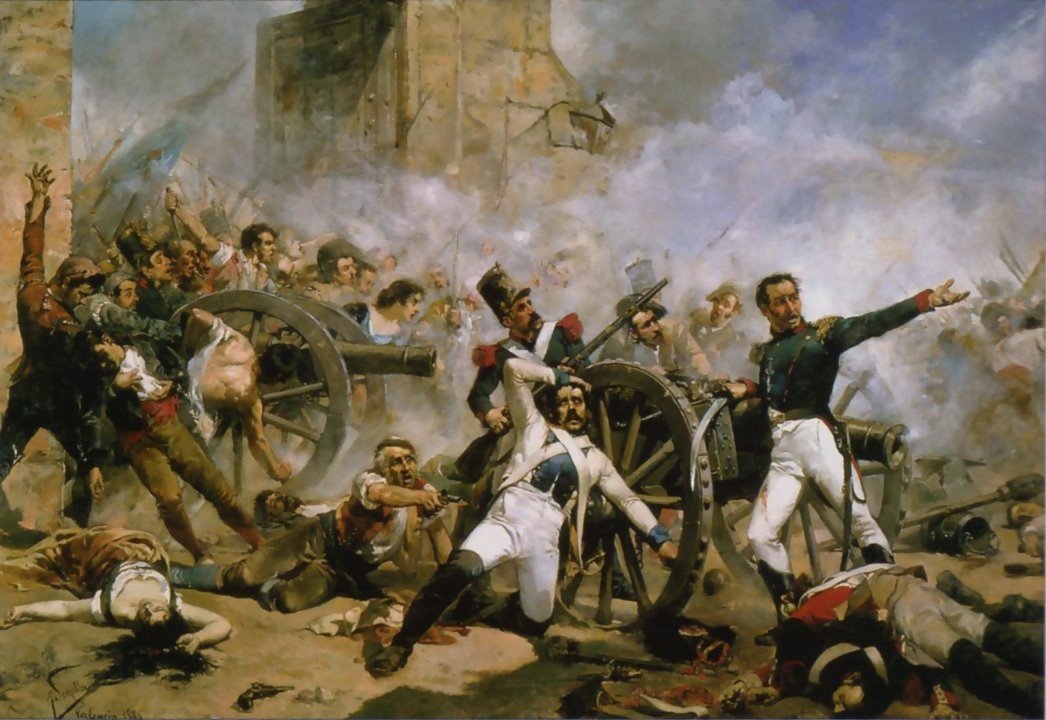
File:Defensa del Parque de Artillería de Monteleón.jpg
Defensa del Parque de Artillería de Monteleón by Joaquín Sorolla y Bastida depicts Pedro Velarde's last stand (he died May 2 1808)

And then we see a twist and redirect out attention to the Spanish maidens, the real subject our poet is paying praises to. The last five lines show us the transformation of a woman in the times of war: she's no longer the young girl, unexposed to any of the real danger, but a pilgrim of Athena's wisdom and courage, contributing to the victory in her own way.


There are incredible visual and sound elements within this stanza: the shrieking of an owl at night, the shiver of a maiden seeing, maybe a scratch on her skin, all in the memory now; and we see the ruins of a city, and the flashing weapons.

Some background information about the weapons mentioned here:
Bayonet: baïonnette. That's the knife, or spike shaped tip you see inserted on top of a musket or a rifle.
Falchion: fauchon. A one handed, single edged sword. It's heavy and is similar in shape to Chinese Dao.

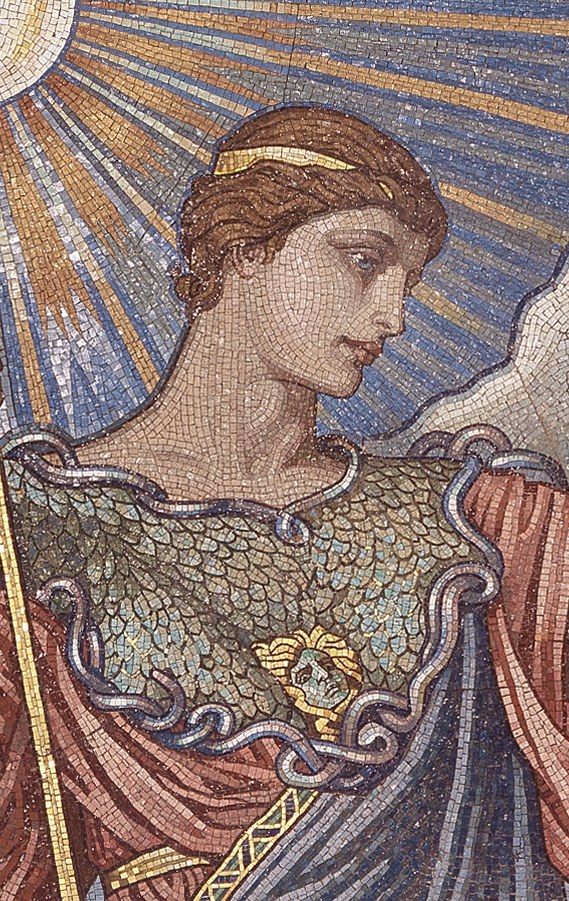
Minerva and Mars. They are Roman names of Athena and Ares. (I'm not sure why the Greeks always prefer names starting with an A, and Romans an M). Minerva is the goddess of arts and craftsmanship. Interestingly her symbol is an owl (for the wisdom). Mars, on the other hand, is the god of war. Those two brother and sister are equally strong. Byron is probably indicating the male and females of Spain with them.

File:Minerva-Vedder-Highsmith-detail-1.jpeg
Mosaic of the Minerva of Peace (detail), Elihu Vedder, 1896


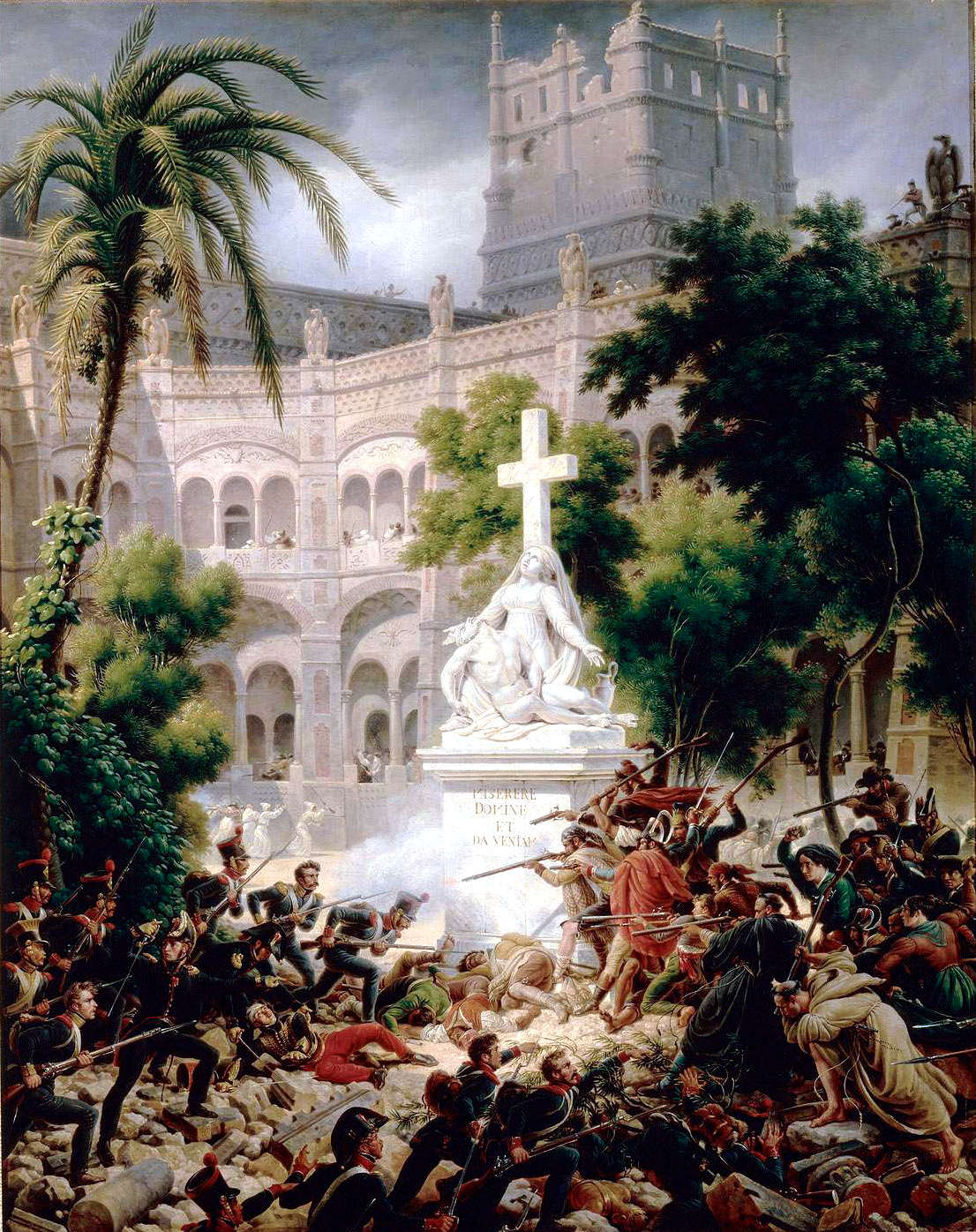
Zaragoza (known as Saragozza) is the city where Basilica, Cathedral of Our Lady of the Pillar is. It's a city of stories,and beautiful, mind I repeat myself, BEAUTIFUL architectures (mostly Roman Catholic cathedrals of course). The two sieges Zaragoza endured between 1808 to 1809 cost her some 50,000 lives. 

File:Santa Engracia - Lejeune.jpg
Assault of the French army at Santa Engracia Monastery 8 Feb 1809
The female strength depicted here is soft, yet enduring. It's her grace and serenity in the face of danger, or even death, that marvels us the most. It's quite likely that the beautiful "her" has two layers of meanings: the actual women of Spain, and Virgin Mary, the spiritual symbol that several of the landmarks of Zaragoza represent.


During the second siege of Zaragoza, the defender surrendered rather quickly. In a way, it's submission and death at the same time - gravest tragedy of all. Ode to the women who stood still when the men fell; ode to the women who remain calm and hopeful when weapons lost their use, and all that's left is dignity.

There's an old fable that goes like this: the wave laughs at the dripping water below the cliff as he smashes onto the rock, but the dripping steam just keeps going. The wave, of course, eventually accomplished nothing with smashing against the giant rock, but the dripping water managed to make a hole on the stone. Persistence, or, as Byron put it so well, "tender fierceness" is the best quality one can have when all hope is lost.

The Spanish maidens embodies romance and tender beauty as opposed to the Amazonian women warriors. The contrast, of course, impresses us even more.


In stanza 58 our focus comes back to the men, yet showing another strength of the women. They seem to have the power of encouraging men to fight for their country, to win their love. The kisses are as if trophies, only bestowed to the victors.

The poet is so fascinated by the maidens in Spain as they are so very different from those in the North, which I'm assuming means England.  The portrait of a Spanish lady with a fan might vaguely depicts what is considered beauty in early 1800s. As you can see, it's definitely not what you expect in a stereotypically slender and meek British woman around the same era - just think about Byron's old lovers and you'll see my point.

Eugene Pierre Francois Giraud (French artist, 1806-1881) A Spanish Beauty with a Fan
It's her people that show the true beauty of a city. Its palaces may fall; its reigns may change; its technologies and fashions evolve, even the climate, can be altered by the traveler's perceptions. Only people leave consistent impressions. Jean-Paul Sartre's famous "L'enfer, c'est les autres" (hell is other people) can be reinterpreted as, at least for me personally, that Paradise is other people as well. It's just the difference of our perspectives. In the beauty of humanity we seek paradises, and only then, maybe, wars and conflicts will cease.