Not sure if I had said it expressively here, but the whole point of tracking Childe Harold's journey was my attempt in making Lord Byron a character in my play coming up next spring, this tortured, nonetheless brilliant soul who had had such great influence on English literature. Having little dramatic writing experience myself, I see it as an advantage of not having restriction in creating new forms and styles.
Wouldn't it be interesting to make it into a site specific piece, of course, with the help of augmented reality achieved through internet? Of course, there's also the part where I had to look for models and seek mentors form people deep into the industry.
There aren't many theatrical works related to Byron or Childe Harold, but many a pieces about modernizing classical characters, individuals battling with individual growth, internal struggles, etc. I'm picking Macbeth as a model, a scope through which I'd like to try finding ways to bring my own characters into life. Through a chat with British artist Laura Hooper, I was able to find some insights into the new trends in theatre: it's going to be about the communication between performers and audience; it's going to be inventive, and stimulating to the senses. And a conversation with associate producer Hunter Chancellor, I found out the importance of social media as well as publicity in reviving classics in the public's eyes...
The scent of fog and old, faded ink; the chipped paint on furniture and half peeled wallpaper; the bittersweet, smoky voice of a lounge singer in warm, dim house light; a record player slowly turns and occasionally skip a beat…all swooped up together and even just the tiniest hint of it would sparkle my memories from that place: after a night of panting out of breathe, chasing ill-fated young Mrs. De Winter, vengeful Lady Macbeth who eventually went into frenzy, or Hecate whose haunting smile makes you forget that you’re barely a few feet away from 21st century civilization. I’ve been there twice, each time storm clouds hovered west Manhattan like a canopy, wind passing architectures that look like those out of a vintage photograph; wicked nights like that might bring nightmares, but we are such creatures that yearn to touch the fire. Mysteries and danger attracts us; those question marks had been tattooed in our destinies since Pandora opened that godforsaken box!
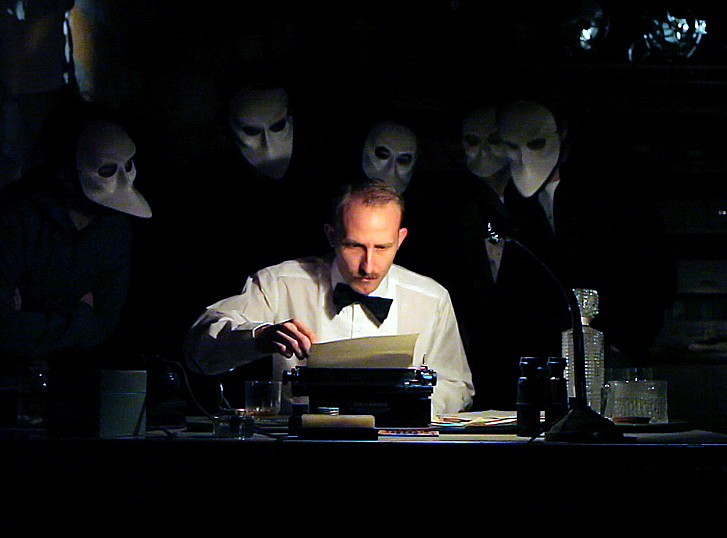
Sleep No More triggers multi-faceted sensations for the audience with all its mystery elements. For me, ultimately its best costume is the hotel itself: the structure of the space makes you believe that rooms pop up with their free will; the age of the building gets every brick in the wall infused with memories; the richness of the piece lies in not only its complexity, but also a dimension across time and space.
The recent rise of site-specific theatre (especially interactive ones) aims to break the last of the invisible wall between performers and audience: actors adjust acts as they interact with different crowds with different responses; audiences contribute to the play as they observe. Not a single night would be like any other: the uncertainty and improbability is addictive to many.
Site-specific theatre is attributed to anything performed at an adapted location that is not a standard theatre. Traditionally there are two major types:
- Environmental theatre, the location is merely adding to the atmosphere of a pre-existing production (e.g. Murder On the Nile in a cruise ship, or Hamlet in a Danish Castle).
- Promenade theatre, Punchdrunk’s Sleep No More falls in this category: audience members are integrated in the performance.
Londoner Laura Hooper had her personal take on the subject. A fan of site-specific theatre, she remembers her experience performing The Persians with the ocean as a backdrop:
You can hear the surging waves as we tell the tragic stories of war…it was beautiful.Laura and playwright Mark O’Neil’s MORA Productions brought Crumble, a one-woman play to NYC last year after its creation 6 years ago back in England. After many stages of evolution, Crumble now sets in main character Sylvie’s apartment and she performs from the kitchen. Sylvie, a traditional English housewife with a secluded life of self-pity and an abusive husband, lives off her fantasy as she invites all the imaginary celebrities to her dinner party. The audience members, as they enter the space, are greeted as Lady Gaga, John Travolta, etc.
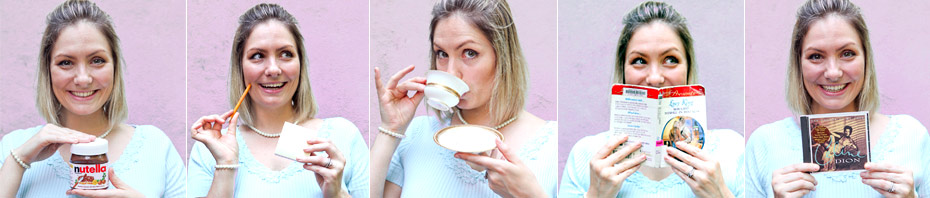
Crumble can be adapted into different spaces. Its dynamics, setups and props change depending on the locations and how the audience react.” She laughed recalling “One time in Ireland, the guy who was John Travolta acted as if he was in love with Sylvie, and his wife, Marilyn Monroe, pretended to get jealous and smacked him.
When asked how the cultural differences come into play, she responded with a bit surprise in her tone:
I feared that the character wouldn’t translate well. She’s so very British. But the only challenge turned out to be recognizing the celebrities. One Japanese girl was bewildered when I greeted her Pamela Anderson (Baywatch).
Laura shared with me her thoughts comparing Crumble and Sleep No More:
Punchdrunk is amazing and experimental but for me Sleep No More is live art, not a play that you can control the storytelling. It’s hard to follow a character’s journey because you lose track and everyone gets a different story.
Site specific theatre is, of course, one extreme of the spectrum while on the other end, theatre reaches out to the audience in a more vicarious and omniscient way. Hunter Chancellor, although still a senior in college, has had an impressive bio of working on shows with high profiles. Being the associate producer of Alan Cumming's modern take of Macbeth, he's currently working with the prestigious Broadway producer Ken Davenport (whose Producer's Perspective have always been a great example of how theatre businesspeople can use social media to reach out to a larger audience). He shared with me a few thoughts being a start-up blogger:
I started my own blog Associate Producer's Perspective, writing about my own experiences and hoping to get responses.
It's interesting and weird to get comments from people, sometimes they can be nasty, but most of the time helpful and instructive even. There are some people emailing me back with ideas and information on the topic I was writing about. It's funny how most people don't expect me to give them responses. People look forward to the conversation made possible through a public blog, yet when they actually get the attention, they're usually taken by surprise.

I then go on and asked about whether he's using social media as a character or a voice representing himself and the show.
It's a rather new experience for me as I usually prefer to talk to people face to face. Having a voice online definitely help to promote ideas. Having giveaways also help. I had a giveaway of Macbeth's final dress rehearsal, which got me almost 500 followers. People love freebies.
It's always great when you can strike up a dialogues with your readers and make connections with people you don't really know through the internet.That is certainly something we can only expect in the age of internet. How far can we really push with social media? Theatre, this extremely physical form of art, how can its marriage with internet, this elusive technology with unattainable shape, achieve accomplishments we've never imagined before? Hunter shared with me an example that quite surprised me:
Situation Interactive did a campaign for Next to Normal when it was on Broadway and first starting up. Tom Kitt, and the original creators of the musical transformed the play into twitter format. SO the media representative started tweeting pieces of the show every day and eventually, the entire play is on the internet, composed of pieces of 140 characters. That campaign got them a gazillion of followers. And that was when social media, and twitter was first becoming hot.

You can see the adaptation of the play here, and a NYT report from then here.
It gives one a lot of hope realizing what you can do with social media and the positive impact it has on theatre, There isn't any boundary of time and space, or the limitation of formality in virtual reality: you can set up, or specify any situation or backdrop of your story and then start to travel, and put together characters. That's the direction I'm trying to push my project towards, as I have told Mr. Chancellor, and a new found land for the industry as well. I'm assured of it.


