Showing posts with label Literature. Show all posts

8.3.13

What Would the Abandoned Woman Do?

Previously we were introduced to Calypso, the lonely sea nymph who fell in love with Odysseus and hoped that he would stay with her. She was tragically left behind. She bargained a little after receiving the final decree from Hermes, of course. She had to let go and couldn't do anything to revenge. And still she got called names, got blamed for seducing the hero.

Similarly, theres another woman who got abandoned cold-heartedly with even worse consequences. Queen of Carthage, Dido, took Aeneas under her care when the Trojan Prince was in a desolate state. She heard all of his stories and felt compassion towards him, which gradually turned into love, yet, what did she got in the end? The guy who would later start the ancient Rome civilization left the woman who pretty much offered her everything. She burnt everything that could remind her of Aeneas, and then killed herself with his sword. Virgil gave her a comparatively nice ending where her soul was brought to heaven by Iris, and when she met Aeneas in the underworld, she refused to forgive him.

Some say that Aeneas and Dido's story was to some extent inspired by the legend of Jason and Medea. In the story of Jason and the Argonauts, Medea was the one who possessed the mythical power, the one who essentially helped Jason retrieving the golden fleece hence ensuring his throne at Iolcus. She murdered her own brother and did everything one could possibly imagine, or one COULDN'T possibly imagine, to win Jason's heart, as the man's taking all measures to win his title. Euripides told us that later on Jason fell in love with Glauce, King Creon's daughter, and left Medea on the island of Crete. Medea was engulfed in the fire of jealousy and set off to take revenge. She killed the princess and the king as well as her own two children with Jason! Today Medea's name is usually associated with an evil woman, heartless and remorseless, who would even kill innocent babies. (And don't forget, they are her own babies!)

Of course people couldn't care less about Jason's wrongs. Look, he was definitely a hero and a man of integrity, but also a cheater and a jerk. Medea happened to be a resourceful and powerful woman who wouldn't swallow her humiliation and acted on her emotion. What she had done was unforgivable, but I'd say it's mostly Jason's own fault.


The clip you saw is from Medea, a modern dance show created by Greek avant garde stage director Dimitris Papaioannou. It's a mesmerizing and unique rendition of the ancient story. Papaioannou utilizes human bodies and their contortions to create incredible shapes. His composition and design of the stage is just out of the world. The director is also known for his excellent work for the 2004 Athens Olympics opening and closing ceremonies.    

Dimitris Papaioannou

In this short excerpt, you can see the marching of the Argonauts, although in modern military attire; the majestic forms of a powerful woman, although full of anger and sorrow; Medea's killing of her own children in desperation, etc. It's very hard to appreciate the whole scale of what's going on in this extraordinary production, but I highly suggest you see it in fullscreen, which slightly helps enhancing the visual experience. 

7.3.13

II : XXXVI - XLI Flowers of Love and War

Entering 19th Century, the power of what used to the Ottoman Empire was diminishing. Albania had been taken over since the end of 14th, and would be under Islamic/Turkish control for another 100 years until the blooming of Albanian nationalism. Beautiful country it is, Albania has been famous for her fearless warriors. Those are the brave ones who managed to keep their identity by escaping to Italy, Egypt, and other surrounding countries. 

File:Albania state emblem.svg
State Emblem of Albania

It only makes sense that we are now heading towards Albania, the country of both Islamic and Christian background. On the other hand, being a land historically occupied by both the Greeks and the Turks, Albania has witnessed a past of conflict between the two distinct races.  


Mother nature is generous to Albania. The country has a wealth of extraordinary fossils and rare animal species, some of the most beautiful and unusual, for example, the golden eagle (the country's national symbol), and the Balkan Lynx. Besides biological resources, 1/3 of the land is covered by forestry, and that is indubitably a fortune.

File:Lynx lynx poing.jpg
Lynx

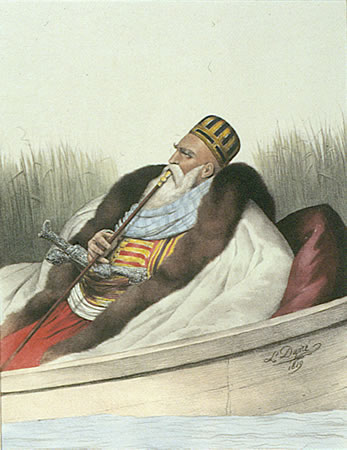
When Byron landed Albania, the country was still subordinated to Turkish control, Ali Pasha being its ruler at the time, who was extremely hospitable to his guests, sending them gifts frequently and hosting feasts each night. The poet and his entourage spent some grand time there. He also had a lot of time to emulate the journey he had had up to that point, getting ready to start penning Childe Harold's story.
File:Dupré - Ali Pasha.jpg
Ali Pasha


There's this guy who managed to take Albania back from the Turks, well at least for a while. His name is George Kastrioti Skanderbeg (Iskander Bey, which means, literally, lord Alexander); usually people know him as simply Skanderbeg.  Think of him as someone without whom Albania wouldn't exist today. While working for the Ottoman Empire as a governor, Skanderbeg organized a rebellian military force against the Turks, bringing Christianity back to Albania. Ask anyone from that country to name you a national hero, they'll probably give you Skanderbeg, the men whose army won more than 20 battles against Ottoman force. Vivaldi wrote an opera based on his story; Byron was merely one of the many poets who wrote odes to Skanderbeg.

Henry Wadsworth Longfellow's Scanderbere revealed the characters of the hero quite vividly, as in:

Anon from the castle walls
The crescent banner falls,        150
And the crowd beholds instead,
Like a portent in the sky,
Iskander’s banner fly,
The Black Eagle with double head;
And a shout ascends on high,        155
For men’s souls are tired of the Turks,
And their wicked ways and works,
That have made of Ak-Hissar
A city of the plague;
And the loud, exultant cry        160
That echoes wide and far
Is: “Long live Scanderbeg!”
 
It was thus Iskander came
Once more unto his own;
And the tidings, like the flame        165
Of a conflagration blown
By the winds of summer, ran,
Till the land was in a blaze,
And the cities far and near,
Sayeth Ben Joshua Ben Meir,        170
In his Book of the Words of the Days,
“Were taken as a man
Would take the tip of his ear.”

During times of its struggle and sorrow, a nation calls for a hero. It takes a lot of courage to be a hero, for the individual must face not only the demanding task of leading the crowd, but also the burden of accusation from those who misunderstand. It's a risky business to be the only who rise up from the crowd. It's never easy to be a leader, for the individual must take up to be responsible for all the followers. The leader's decision can affect too many lives to be taken lightly. Today we write stories about superman and extraordinary individuals who possess distinguished powers; they are the modern time saviours of our society who fight the crimes and intruders and eventually ride off into the sunset, mostly go on without attachment to family. Joseph Campbell calls it monomyth because we all hope someone would rise up above all to be the one who leads., yet rarely does anyone actually take on the job themselves. We all have too much to lose.


War and Love usually come in pair. It's no wonder: just look at the most celebrated and scandalous love affair of all time, the one between Ares and Aphrodite. The goddess of love is unsatisfied with her insufferably dull marriage with the crippled god of fire Hephaestus, so she started seeing the god of war, secret rendezvous and what not. Logical or not, the point is, from the soil that the flowers of war grow, blossoms love as well.

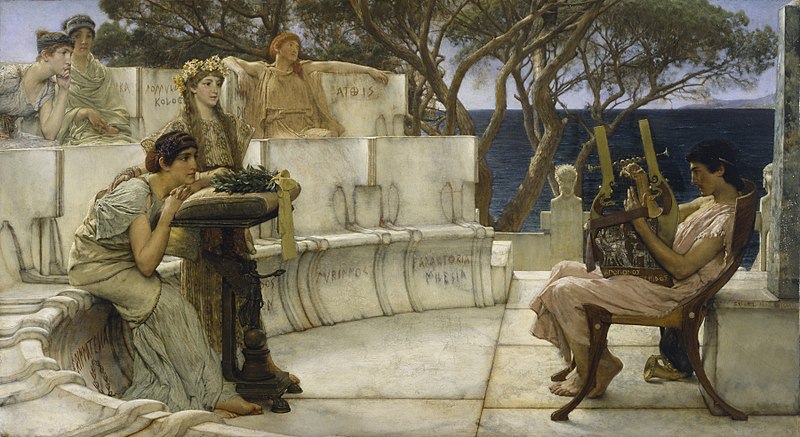
Sappho, Greek lyric poet, or better still, the girl who inspired generations to come; or BETTER STILL, the woman called "the tenth muse" by Plato. Most of her life that we know of are just fragments and traces we estimate from her surviving poetry pieces. I was first introduced to her work by Aaron Poochigian's translation of Stung with Love: Poems and Fragments by Sappho.

File:Sir Lawrence Alma-Tadema, RA, OM - Sappho and Alcaeus - Walters 37159.jpg
Sappho and Alcaeus by Lawrence Alma-Tadema

The kind of love described in Sappho, is no doubt a bigger kind than the heterosexual one in a traditional sense, which ironically made Sappho become earliest example of homosexuality in female, the words sapphic and lesbian being derived from her name and birth place. Scholars suggested that Sappho's love is similar to what was described by Socrates: a universal love that has nothing to do with the attraction between sexes; an appreciation towards all things beautiful, which is the origin of love.

Lefkada, or Leucadia, is the place where Sappho committed suicide. It's also believed to be the original place of Ithaca in Odyssey. According to legends, this island in the middle of Ionian sea is dear to Aphrodite. At the spot from which Sappho fleet to meet her fate, the poet recounted the battles that costed lives and honour. 

Battle of Actium opened the struggle between Octavian and Anthony. Historians lead us to believe in Cleopatra's role in this war as a woman more than her role as a Pharaoh because the affair between her and Mark Anthony somewhat caused the final war of Roman Republic, after which the Egyptians enjoyed a long period (207 years) of Pax Romana.   

Battle of Lepanto, mourned by the Ottoman Empire and cheered by the Christians. Although the victory on the Christian side wasn't an apparent turning point for the course of history, it raised morale and, looking back it from a larger scale, it had been the battle that turned the course around. The Christian navy captured experienced Turkish sailor with superior naval skills and knowledges. They had losses afterwards, but Lepanto was an invisible beginning to the downfall of the Ottoman Empire.
File:Trafalgar, ships scattered.jpg
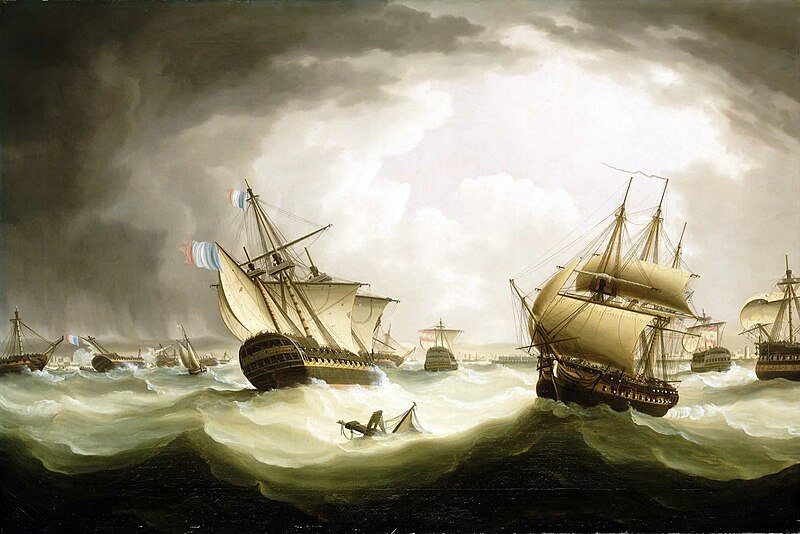
After the Battle of Trafalgar

Battle of Trafalgar, had been more recent to the poet than anything else. England, France and Spain, all out with their vast league of fleets, met at the cape of Trafalgar. This battle ended the French Naval's challenge to the Royal Navy of Britain, although it'd still take another decade for the Napoleon war to cease. 


Those battles, varied in scales and origins as well as the historical backgrounds, share some underlying connections. Obviously they're all naval combats, which is how Leucadia Cape reminded Byron of them. All of them had been subtle turning point of the war of a larger scale. As you can see, the unpredictable nature of history usually make all the contemporary mad with fear and agression, and only 100 years from the present can we figure out a logic connection between events.

Of course, a shortcut would be to understand history, for everything you need to learn about now or the future, you can learn the pattern from the past. 


She sings about love, of the most passionate kind, living at a time of war and turbulence. She dies, or rather, falls from the cliff of time, plunging into the mote of history. In her poem she talks about being remembered and thought of by someone in the future, calling for her lover to stand on her side, to fight as her comrades in all the battles. Her words are the lyrical presentation of how love is stronger than war. It's ironic that throughout history, love appeared to be, many a time, the cause of wars, but that doesn't discredit its power to end the wars.

This particular one of Sappho's few surviving fragments is perfect for the occasion:

“Some say an army of horsemen,
some of footsoldiers, some of ships,
is the fairest thing on the black earth,
but I say it is what one loves.

It's very easy to make this clear
to everyone, for Helen,
by far surpassing mortals in beauty,
left the best of all husbands

and sailed to Troy,
mindful of neither her child
nor her dear parents, but
with one glimpse she was seduced by

Aphrodite. For easily bent...
and nimbly...[missing text]...
has reminded me now
of Anactoria who is not here;

I would much prefer to see the lovely
way she walks and the radiant glance of her face
than the war-chariots of the Lydians or
their footsoldiers in arms.” 
― Sappho  

4.3.13

II : XXIX - XXXV Calypso!

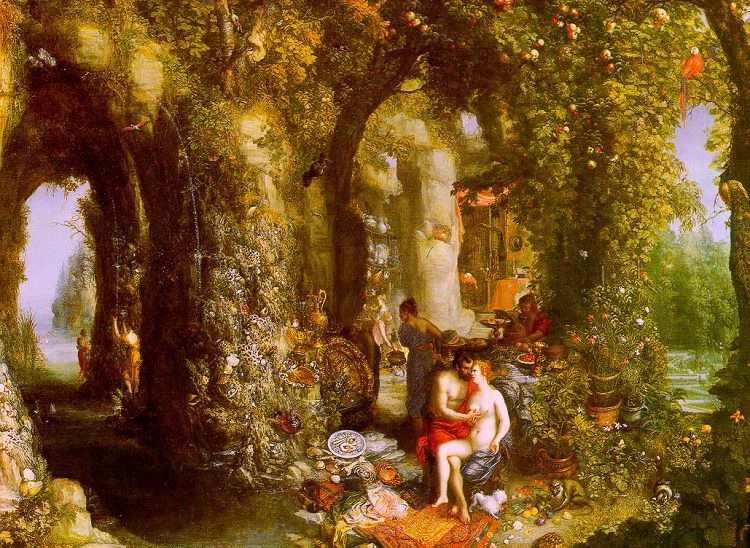
After holding Odysseus for 7 years on her island, Calypso was visited by Hermes who ordered her to release the man she had been in love with. Of course, after all that, she was the one accused of being seductive and puling the hero back from his ultimate task. Our hero turned down her offer of immortality, built a raft and left the nymph who took care of him when he was at rock bottom without a drop of hope. Indeed, indeed, we eventually cheer for the reunion of Odysseus and the virtuous Penelope. We sing songs about the King's wisdom and the faithful queen as well as the courageous prince who managed to make out his father in the beggar's clothing... Epics are usually written in favour of the hero, whose purpose is so important that everything along the way that becomes sort of an obstacle would be labeled "evil". I've always been sympathetic towards Calypso. She's like a female CEO that runs the whole island with nothing much exciting going on in her never-ending immortal life, and, forget not, without a companion. Then comes Odysseus, a hero of some sort, a mortal human yes, but look, she has the ability to convert him if they can reach consensus. 

File:Odysseus and Calypso.jpg
Odysseus and Calypso by Jan Brueghel the Elder. circa 1616

We know what happened in the end. Calypso's name became the synonym of a deceitful and seductive lover. Byron here, is comparing his beautiful "Florence" to the nymph, being self-pitiful about the love he never got. For someone like Byron who's so used to women throwing themselves to him, what he experienced with "Florence" was rare. 


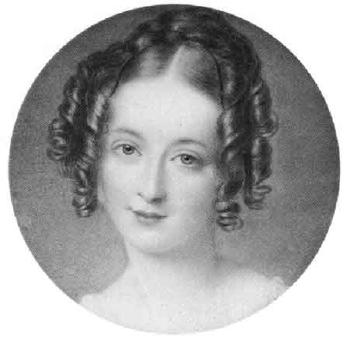
Florence, is the poetical alias for Mrs. Spencer Smith.  In 1830, John Galt penned the memoirThe Life of Lord Byron, reserving one part of chapter 9 for the special incidents in Malta. Our adventurous heroine, was no other than Mrs. Spencer Smith. Her life, almost as equally scandalous and eventful as Byron's, had been indubitably some best topic in town. She'd been arrested by order of Napoleon, had a "romantic escape" with Marquis de Salvo and had wondrous expeditions with said gentleman, as noted in Napoleon's memoir by Laure Junot Abrantes.


It's only understandable that Byron would become affectionate over Mrs. Spencer Smith, although their relationship ended up platonic. It's decided: the lady won this chess game between the pair, beguiling Byron's yellow diamond ring for a keepsake without offering anything in return. Byron, on the other hand, wrote plenty of lines in memory of this chapter of his life.

You can read one example below (with editorial notes by Prothero Coleridge):


I'm not entirely certain if it's proper comparing Mrs. Smith to Calypso. Understandably there's the exaggeration from a Romantic poet. To me, Mrs. Smith was an independent woman in the early 19th century, who possessed unimaginable courage and character. It's rare for a woman to be like that at the time, a pretty risky business too. Byron was undoubtedly bitter that their relationship didn't advance, but his words also revealed much admiration and respect. After all, who doesn't prefer a worthy opponent and enjoy an exciting game to something dull and monotonous?


Diane, Hecate, now Calypso, all of whom possessing indescribable power over nature and men alike. All these goddesses or immortal beings have been appearing in this section of canto ii. There's never a shortage of female characters in Byron's life. They bewildered him since his childhood: his emotionally unstable mother, his childhood crush who ended up pursuing a more reliable marriage... at this point of his life he hasn't encountered the crazier bunch who are yet to occupy his emotional realm, including Caro Lamb, and the revengeful princess of parallelogram, his future wife Annabella Milbanke. At this point of his life, those magnificent women had been simply casting traps with their elegant gestures and soft voices, in which he called himself wasting his youth indulging.


This "lamenting" part of the poem also reminded me of Shakespeare's "Sigh No More" (from Much Ado About Nothing), where the deceitful characters had been men. A reverse relationship here, but equally entertaining. Romance had been, and will always be confusing for both men and women. Words of self-pity and comfort with sarcastic accusations remain to be some of the most interesting elements in literary world:
Sigh no more, ladies, sigh no more.
Men were deceivers ever,
One foot in sea, and one on shore,
To one thing constant never.
Then sigh not so, but let them go,
And be you blithe and bonny,
Converting all your sounds of woe
Into hey nonny, nonny.
 
Sigh no more ditties, sing no more
Of dumps so dull and heavy.
The fraud of men was ever so
Since summer first was leafy.
Then sigh not so, but let them go,
And be you blithe and bonny,
Converting all your sounds of woe
Into hey, nonny, nonny.


Unlike Odysseus on Calypso's island, Byron didn't spend too much time in Malta. Of course, the hero from Ithaca would be inspiring to him at least for the determination and loyalty. Byron once wrote that watching over the ocean from the cliff made him homesick. His childhood in Scotland brought him an accent he was always ready to get rid of, as well as many a sweet memory of the carefree years. In previous stanzas the poet has already expressed the desire to start over, lamenting over the cruel and never-pausing flow of time; and here, regretting the years wasted on his "personal Calypso's island", he's telling a cautionary tale to warn his fictional self.


Of course, we must not forget Byron's tendency to exaggerate: his emotional rollercoaster brings him instantly cheery and then suddenly gloomy, mostly because of unfulfilled or overwhelming love. For him it is an addiction that eventually brings more disappointments than joy. Passion established him and made him an everlasting name, yet at the same time, bound to destroy him.

28.2.13

II : XVI - XXI Of the Sea and the Moon

Before commercial airlines were invented, there's only one way daredevils go exploring the world: hit the wave and go to uncharted waters. It hasn't been long since human being finally grasped the whole scope of our planet, if you think about it. For the most part of our race's time on earth, we've just been satisfied with the comfort of ignorance. However, once you tasted the sweetness of adventures, there's no turing back. 

Harold, for one, is cutting himself loose from all his past attachments, moving on to the next destination. Of course, it's easier to leave a place that had depressed him so much: Greece, was like a tomb of a civilization, a shell of what used to be so vivacious and rich.

Between 1809-1810, Lord Byron went back and forth from Greece (the general Mediterranean area) to Turkey (especially Constantinople, Troy, etc.) 
He visited important geographical marks in Odyssey and Iliad during that time including Ithaca, Odysseus' home, Athens, Troy, spending long bulks of time in that area, while writing the first two cantos of Childe Harold's Pilgrimage. 
The imageries in Canto the Second were, of course, fresh and vivid. 

The ocean possesses something entirely inexplicable to our logical minds. It pulls you in and calms you down even when you see those fierce waves and hear those restless howls. It's as though a kind of subliminal siren song draws you close to the heart of the ocean. There's no way to escape it once you're intoxicated by the salty wind. 


The "dark, blue sea" has been a constant motif in Lord Byron's poetry. Having spend so much time abroad and about, it's understandable that the ever-changing climes at the sea would inspire the romantic poet. In stanza XVII, the ocean presents itself as a peaceful and vast sight in front of Childe Harold's eyes, filled with spirit. The sea is an interesting symbol, for it represent different things for different people. Byron, for instance, was an individual who's saturated with knowledge of history, hence the ocean to him became more than just a body water, but rather a mote of memories that connects the past and the presents. Here's another poem about the ocean:

The Dark, Blue Sea
by Lord Byron
There is a pleasure in the pathless woods,There is a rapture on the lonely shore,There is society where none intrudes,By the deep sea, and music in its roar:I love not man the less, but nature more,From these our interviews, in which I stealFrom all I may be, or have been before,To mingle with the universe, and feelWhat I can ne'er express, yet cannot all conceal.-
Roll on, thou deep and dark blue ocean-roll!Ten thousand fleets sweep over thee in vain;

Read the rest of the poem here, and the attached video provides you with a narrative perspective of the literature. This poem, to me is almost an expansion and a microscopic view of a small segment of "Childe Harold".

Let your mind race when facing the dark, blue sea...
you wouldn't be able to resist it.


The structure of a ship crew, called warlike here by Byron, to me is more like a corporation. You have the Captain who commands the executive decisions like a CEO; you have the experienced boatswain who functions as the maintenance head; and you have the mate who would be more similar than you think to a modern day PR department, overlooking crisis and figuring out how to solve all kinds of problems.


It takes a lot of will power and the calmest personality to be a captain, for he is responsible for the well being of the entire crew, just like what a good CEO of the company would be. He would be the one to blame for the crisis and the last one to loose up. Recently I heard the story of the captain of a ship that went on an exploration voyage to the north pole. A man of few words, the captain revealed in front of the journalist that he's accustomed to danger and accepted the fact that you have to be ready to yield to the power of nature at any time.


The sea is also a provider of neutral environments where people can forget about all the daily nuisances. Maybe that's why we still go on cruises although many a times those voyages prove to be the opposite of what the advertising says. Of course, it depends on what you ask for in the first place. Personally I've always had this fantasy of going sailing at the sea and see all the different colours of the water and all the different shapes of clouds. You get what you sign up for...minus the romanticized part. 

The brine consumes it all. 
The flow of your thoughts stirs into the unknown. 
The process is irreversible. 


The other universal motif that fascinates people across time and space is, if you still haven't guessed it yet, the moon. Every single poet, visual artist, singer as far as I know, regardless of age, cultural background, gender or race, has used the ethereal being, the moon, as a subject and a muse. Chinese poet Li Bai in Tang Dynasty would look up the sky with his drunken eyes, inviting the moon and his own shadow for another round. It's a whimsical sight, incredibly zen.


There are endless tales about the origin of moon and fascinating lores explaining the man in the moon, or in my case, I grew up knowing that the goddess Chang Eh took a leap of faith in her desire of coming immortal, left her home and her husband, and took residence in the palace of the moon. There's a white rabbit and a flowering three there to keep her company. The moon has always been a place of solitude and self reflection for philosophers throughout history. Since man's first step onto the surface of moon, we already know that it's a barren satellite planet of the earth, tucking and pulling the tides being one of her functions; yet we still enjoy fantastical stories with no scientific basis about the moon. Why? Because the moon we talk about in stories is more than a boring astronomical being, but a symbol that connects humanity and makes us one.


Here's a modern rendition by Pigpen Theatre Co. telling the tale of how the moon changes shape. A story of the steward of the moon with shadow puppetry in digital animation...the cutting edge modern and the traditional, the handicraftsman and the digital editing, you can't get more integrated than that!


22.2.13

II : I - VI In Ruins

People call it the cradle of western civilization, Athens, the city named after the goddess of wisdom. There is a constellation of temples dedicated to her, or at least carrying her title. The Parthenon is probably the one that attracts most attention. I remember visting the "fake Parthenon" in Nashville in the summer of 2012. Although it is almost impossible to imagine what it would be like to see the Parthenon in Socrate's time, or even in Byron's, with the newly constructed temple in front of my eyes, sitting amidst the lawns beautifully laid out and all those greeneries in the Mecca of American country music. Of course, I did catch glimpses of the past glory and was given the opportunity to visualize the scale of the worship Athena had. 


Being a Pagan temple, the Parthenon represents values that the Christian church wouldn't approve. After 900 years of its time being a shrine for the votaries of Athena, the Parthenon was transformed into a Christian church dedicated to the Virgin, although ironically Athena was actually one of the only three virgin goddesses in Greek mythology.

painting of the Parthenon ruin

In 1456, the Turks turned the Parthenon into a mosque, only to be destroyed yet again after 231 years by the Venetian crusaders.

Mosque inside Parthenon - the evidence of its Turkish past is now gone as well

Layers and layers of changes: generations of rulers and robbers adding new trophies of their victories and ripping off evidences of past glories of their enemies. In 1806, the last of the Turkish mosque on the original ruin was finally removed, giving the site its Greek origin, although a mere graveyard of what was once the most beautiful of ancient architecture and the epitome of arts. In 1816, several years after Byron's steps onto this piece of soil, the Parthenon marbles were sold to British Museum in London.


I wondered for about an hour in the Nashville Parthenon, most of which spent looking up at it from afar. There isn't any spirit around that structure. I can only imagine the haunting air Byron must have felt at the site of conflicts for centuries past. Standing in front of a ruin with several zeroes on her age, one can only stay silent in awe, and sigh over the tempest of fate: who would have thought, those constructors who originally designed and built the Parthenon, that future tenants of this building will have a completely belief system?

In short, power decides culture, religion, and belief.


Parthenon was one of the chief examples of architectures featuring Doric orders. Another great example was Temple of Zeus in Olympia with the same striking characters. By the time Byron visits the site, the temple of Zeus, although finally identified during the 18th century, was still in the state of partial burial due to the destruction in 426 CE and the subsequent earthquakes in 522 and 551 CE.

Ruins of the Temple of Zeus Olympio


There's one thing you'll realize indubitably if you see the ruins of a lost civilization, that eternity doesn't exists. Time and space shrink into one spot when you stand in front of a ruin, especially a ruin of a society you have known so well in your head. When Canto ii of Childe Harold was written, Byron was barely 25 years old, an age of great expectations and hopes. All his childhood had been spent having an endless longing of the Greek culture, thus the almost unreasonable sympathy the poet had for this land. His fateful fight during the Greek independence war was unavoidable if you think about how much influence this culture had on him.


The destruction of something beautiful is the roots of tragedy. The ruined temples of ancient Greece are proofs. Childe Harold saw an empty shell, unoccupied, abandoned by the gods who supposed to bestow blessings onto a city that needed them the most. The words are with sorrow, yet also with distain: for the human-like gods of Olympia understandably left the shattered houses once built for them, yet neglected and unrecovered. 


I remember a trip to the Forbidden Palace in Beijing back in high school with all my buddies. There was an exhibition room in which you can see all the past images of the palace, different from each dynasties. Emperors had this habit of burning down everything from the last kingdom and rebuild their own on top of the original site. Thus the Forbidden Palace became a site of blood and tears of generations as well as glories and wealth. It's a surreal and indescribable sight, for you have no idea whether to sigh in melancholy or in awe.

Arch of Hadian

I'm in no position imagining if it'd be the same looking at the Greek ruins, but the trip ti the Forbidden Palace would be the closest thing I can think of to embody an experience like that. It's pointless to recreate ancient sights, at least I don't think it necessary. The ruins are the evidence of what human beings are capable of and premonitions of what could happen if we don't respect what is sacred and succumb to the desire of power.

21.2.13

I : LXXXIX - XCII Spain: A History of Violence

The Spaniards, the French and the Dutch all helped America during the Revolutionary War. On the 3rd of Sep. 1783, The Treaty of Paris ended the tedious war that crossed several continents and prolonged for almost a decade after United States had already declared its independence on 4th of July, 1776, the glorious date that you're supposed to remember as long as you're a citizen of planet earth and believe in liberty of humanity. Anyway, it almost seemed to me that the American Revolutionary War inspired the French Revolution, which broke out as early as in 1791, although most of us attributed the year of 1793 of more importance during the progress of the war, during which a young Napoleon Bonaparte proved his worth for the first time. 

Everything that happened was connected, dare I say, especially since the world is getting smaller as men's ambition and thirst for power grows infinitely bigger, and of course, communication is made more convenient. The rise of Lady Liberty indubitably influenced the entirety of western civilization. (The statue physically rose in 1886 but since it's commemorating 1776 in the first place, let's pretend that Lady Liberty had already been there in spirit.)

File:ColumbiaStahrArtwork.jpg
A modern personification of United States (Columbia) during WWI 

Columbia had been the name for a land with which we associate freedom, after the guy who discovered her of course, Christopher Columbus, whose accomplishment initiated the Spanish colonization of the new world. 


So why is that part of the history relevant to our subject of discussion now? Obviously there's the connection of the Spanish Empire, but it's far more than just a name. The War of Pyrenees, or better known as the Great War, pitted the first coalition during the French Revolutionary Wars. After the initial outbreak in January, France got in full on attack mode and in two months' time, decided to break up with her long-term-ally Spain. Spain was miserably defeated. 

Francisco Pizarro

There's almost a bitterness in the poet's tone. Francisco, Gonzalo, Juan and Hernando, those are the names of the Pizarro brothers, their reign in Peru was quite short (1531-1538) but still a major part in the Spanish conquest of the new world, Quito (The Royal Audience of Quito) being a part of it, was established in 1563, ruling most parts of Ecuador, northern Peru, southern Columbia and some part of Brazil. 

And now? Spain is under attack! It's all cause and effect says the poet. 


There are three major battles mentioned in Stanza 90, all of which violent and none can draw a conclusion to the never-ending conflicts. Wellesley gradually becomes a name almost as big as Napoleon, who would eventually defeat the legendary French modern Achilles, Byron's personal hero.

  • Battle of Talavera Think France, Spain and Britain as three gambler in Vegas. No matter what the statistics say in  the end, the biggest winner will always, did I say ALWAYS, be the house. Death was hosting the game this time, seizing his prize from all sides, with France losing the most at the battle of Talavera. Previously I mentioned this battle in The Inglorious Three, with Byron's descriptive and heart wrenching stanzas (around XLI) telling the tale of devastation.
  • Battle of Barrossa This was a pointless one: that day in March 1811, the ally of Britain, Portugal and Spain trying to lift the siege of Cadiz against France and the battle of Barrossa broke. Technically they won, according to numbers and what not, but Cadiz remained under French control until more than a year later. French Marshal Claude Victor was even able to bargain a partial victory. Of course in war if the two sides both won it also meant that they both lost. Again, the grave played the house.
  • Battle of Albuera Elaborated in stanza XLIII, (again, reference The Inglorious Three) the battle of Albuera was called the bloodiest of all during Peninsular War. Not only did it fail to lift the siege of Badajoz, it wounded the relationship between Spain and Britain, for it was said that Britain didn't play hard enough.

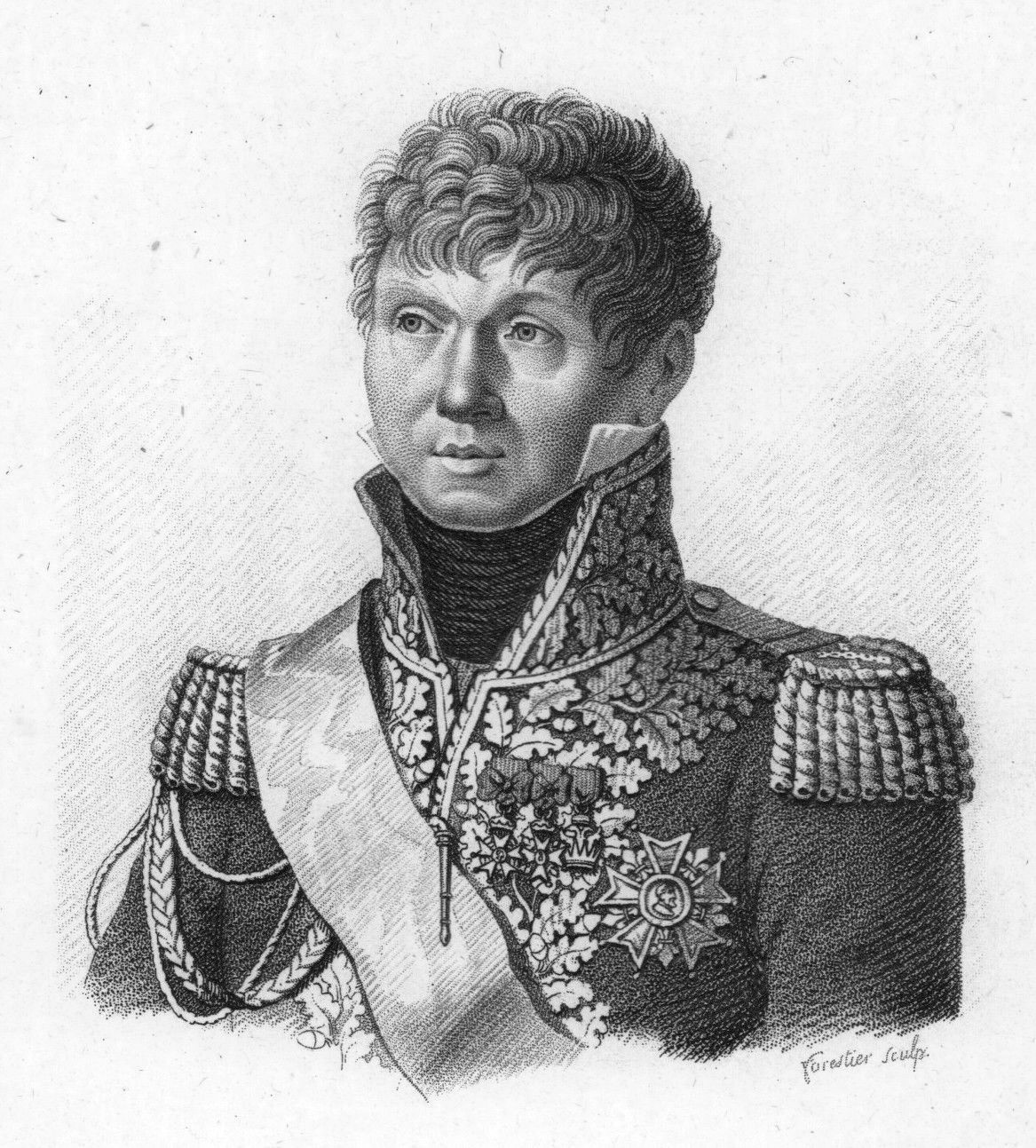
File:Marechal-victor.jpg
Marshal Claude Victor

All those struggles and all those lives lost, sill Spain didn't get her freedom and peace. It's such a tiresome and emotionally draining thing to do looking at the timeline of the war, for you see how people just so too far and plant so many seeds of evil over something rather trivial.


It is very hard to look at things the same way again after you've read lots about history. Sometimes, most of the time, we repeat the same mistakes our ancestors did. All the lost glory of past civilization was the cost of a transient vanity.


For Childe Harold, this has been a trip of personal growth. At this point, the boy who lamented the fall of his family estate is thinking about something much bigger. When you've climbed mountains and watched the rise and fall of nations, you would start to realize the frivolity of what you thought you held so dear.

19.2.13

I : LXXXV - LXXXVIII Blindly, They Fought On

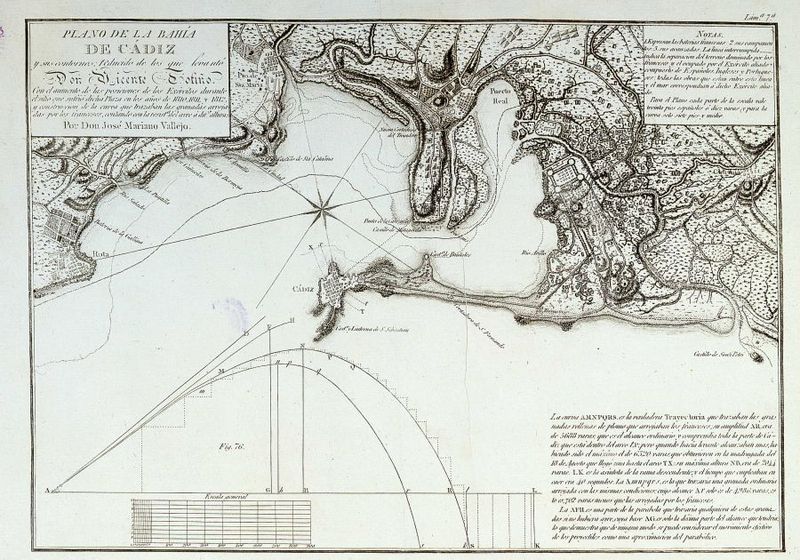
On 5th of Feb. 1810, the French started bombarding Cadiz and the Siege of Cadiz continued until 24th of Aug. 1812. The fortification of this port city proved to be so strong. Those walls seemed to be invincible! Surrounded by three arm forces, Cadiz stood still, or at least, she held on for a long time. The French almost lost hope of ever taking this place. 

File:SitiodeCadiz.jpg
Map of Cadiz in 1813.


"War even to the knife!" A common mistranslation of the laconic phrase "guerra y cuchillo", General Palafox's respond to French invaders' demand during the brutal second siege of Saragossa "paz y capitulacion"(peace ans surrender). The phrase actually meant, concisely, "war and knife", the point being, they will defend till the last drop of blood. 

File:Palafox-goya.jpg
General Palafox painted by Goya

It was uneasy for the allied force to lift the siege, as the British didn't quite trust the Spanish. Of course, the Spanish didn't give up, hence winning Byron's high regards here. 

There's again, a time lapse in the mentioned events here. The author explored the city of Cadiz in 1809 when he witnessed the unforgettable bullfight. The siege happened a year after, and didn't commence until after the poem was published. When he was drafting the first canto of Childe Harold, Byron would have known about the struggle and hold-off between Anglo-Spanish defense and French assailers in the city of Cadiz. The ruthless fight between the noble looking matadors and the enslaved beast, is definitely similar to the people of Spain who's in a rather similar situation. 


Since his youthful years spent riding pony and reading a formidable amount of books in Aberdeen, Byron had been drawn to history. Of course, his lament on people's lack of perspective wouldn't make too much sense to those Spaniards in trouble. They couldn't do anything but picking up their knives and protect their families. No matter what era it is, war never ceases to cause unnecessary deaths. It's a vicious cycle that most of us just refuse to admit. 


The reality is, the human race is not very responsible when we take actions. The savage acts of destruction and barbarism leaves us barren lands, and a dejected sight of mortifying remains of our own kind. So many times have people of enlightenment stood and sigh in front of ruins of past generations, yet the more important question is: how do we break this behavior pattern?