Showing posts with label greek. Show all posts

1.5.13

II : LXVII - LXXII On a Distant Shore with a Wild Heart

It was long ago and far away; it was a community united by war and despair, speaking an extinct dialect, surrounded by an aura of danger and mischief. It's a group of barbarians, or so they called them, band of misfits, blood thirsty bandits, and their existence threatens the weary sailors who happened to reach the shore where the Souliotes reside.

https://upload.wikimedia.org/wikipedia/en/7/78/Deux_%CE%B9tudes_de_costumes_souliotes.JPG

Childe Harold wasn't too crazy about those legends of Souliotes: those outcasts of both Greek and Albanian societies, expelled and had nowhere else to go; they are the Robinhoods on the shore, dancing and singing war songs around the campfire. Maybe they'd even kill their prisoners and drink their blood, like how they are described in stories. Simply put, Suli was the last place Childe Harold would willingly be if he had any other choices. And for the first time since he took off, for the first time during his turbulent voyage, he was scared. He felt a shiver down his spine as he feels his damp clothes, as he struggles to keep his weary eyes open.

They're about to anchor, and the rest is at the mercy of fate.


Coming just from Ali Pasha's hub, personally I wouldn't know what to think approaching the Souliotes. This pitiful group of outlaws have been in conflict with the tyrannic ruler since 1803, and there doesn't seem to be a perceivable end. Comparing the two sides, anyone would feel sympathetic to the Souliotes: these are the soldiers without proper food or equipments, whereas Ali Pasha, as we now know very well, is having it all: his luxurious lifestyle, his relentless spending... He was respectful to Lord Byron, we'd learnt about that, but him being hospitable couldn't change Byron's contempt towards him. As for the Childe, he's mostly overwhelmed by the journey by now. The crust of waves pushed his ship up and dragged him down as if to the depth of hell. And when the spirit is low and the body has succumbed to exhaustion, all one asks for is some stillness.
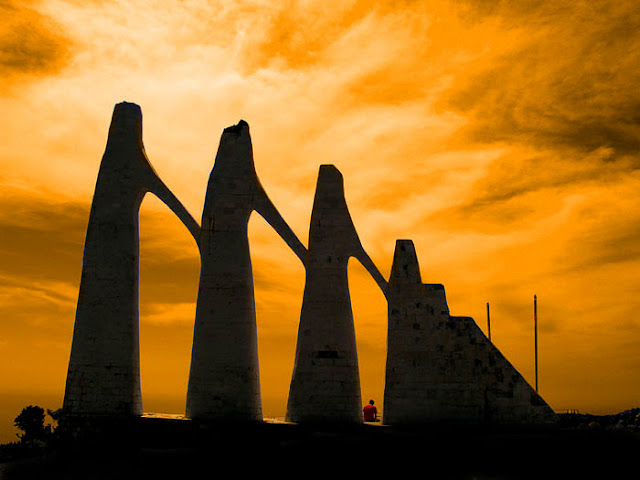
 

https://blogger.googleusercontent.com/img/b/R29vZ2xl/AVvXsEhAs-7I9_Hwcrt_VZD6E5rgz2RIIBR-4C7L27l-AC7qo-bjRAqGlxcPneZYSaWi5WT8tpW2USuTUi26nHji8ZJ-lXU9sFGD_cZpGDfCcAEs1ofGrALoJbHNl-RUaD-tzN_tBvF7QU5Q3WZ4/s1600/tromaktiko12.jpg


Suli had been the least likely place for Harold to get his blissful rest. But he, along with everyone else on the ship, was surprised by the locals who offered the Childe not only kindness but also stirred up his curiosity, restored his spirit. (It's quite believable that this experience led to Byron's eventual leading in the Greek Independence War, but that's thereby another story.)


It's rather tricky, the work of our hearts. We always feel the most fondness towards those who happened to reach out to us and lend us a hand when we're at rock bottom, even when they're the most unlikely bunch of people we'd make friends with. In universal sorrow we make the strongest bond and form the greatest friendship, though sometimes incomprehensible to the distant spectators. It's all in perspective.

Harold sees unfamiliar faces on people who speak an entirely different language, wearing strange costumes and moving in ways, the meaning of which he couldn't quite grasp. But their kindness opened his heart and he found beauty in their ugliness, forgiving their ungentle characteristics and perceived their vulgar nature as simply something he's yet to familiarize.

In a world without prejudice and hostility, the construction of babel tower would be simple task.


At dusk Harold joins the Souliotes for their feast. The local break out a banquet for the guests from a faraway land, who talks and dresses in a way they wouldn't even try to understand. Their intentions were simple, though might not be understood by the cynical, overly sophisticated minds from "civilized societies": to feed the hungry, to sooth the tired, to care for the poor in spirit, to be merry at the simple happiness and to celebrate the victories in protecting their land.

http://upload.wikimedia.org/wikipedia/commons/e/e5/Souliotes_19th_century_painting.jpg


Sometimes we claim to look at different cultures and different people of the world with an open mind, yet we wears filters through which we speculate the world we live in too much, too constantly that we forgot about them. It takes a lot of courage to rip them off and cast away the standards we're all too familiar with when taking in something new and initially hard to swallow. I guess Harold's situation makes it easier for him, on a distant shore with a wild heart, when there's nowhere else he can turn to.


The Souliotes chant their song as if it's a spell. No doubt they sing it to the gods they worship, but they mostly sing it to themselves, to forget about their tragedies, to sooth their wounds, to gather their courage and to fight on when the sun comes up in the morning.


Byron included a complete translation of the Souliotes' war song in Canto II, which I'll talk more about in the next post. Stay tuned and we'll meet again soon.

8.3.13

What Would the Abandoned Woman Do?

Previously we were introduced to Calypso, the lonely sea nymph who fell in love with Odysseus and hoped that he would stay with her. She was tragically left behind. She bargained a little after receiving the final decree from Hermes, of course. She had to let go and couldn't do anything to revenge. And still she got called names, got blamed for seducing the hero.

Similarly, theres another woman who got abandoned cold-heartedly with even worse consequences. Queen of Carthage, Dido, took Aeneas under her care when the Trojan Prince was in a desolate state. She heard all of his stories and felt compassion towards him, which gradually turned into love, yet, what did she got in the end? The guy who would later start the ancient Rome civilization left the woman who pretty much offered her everything. She burnt everything that could remind her of Aeneas, and then killed herself with his sword. Virgil gave her a comparatively nice ending where her soul was brought to heaven by Iris, and when she met Aeneas in the underworld, she refused to forgive him.

Some say that Aeneas and Dido's story was to some extent inspired by the legend of Jason and Medea. In the story of Jason and the Argonauts, Medea was the one who possessed the mythical power, the one who essentially helped Jason retrieving the golden fleece hence ensuring his throne at Iolcus. She murdered her own brother and did everything one could possibly imagine, or one COULDN'T possibly imagine, to win Jason's heart, as the man's taking all measures to win his title. Euripides told us that later on Jason fell in love with Glauce, King Creon's daughter, and left Medea on the island of Crete. Medea was engulfed in the fire of jealousy and set off to take revenge. She killed the princess and the king as well as her own two children with Jason! Today Medea's name is usually associated with an evil woman, heartless and remorseless, who would even kill innocent babies. (And don't forget, they are her own babies!)

Of course people couldn't care less about Jason's wrongs. Look, he was definitely a hero and a man of integrity, but also a cheater and a jerk. Medea happened to be a resourceful and powerful woman who wouldn't swallow her humiliation and acted on her emotion. What she had done was unforgivable, but I'd say it's mostly Jason's own fault.


The clip you saw is from Medea, a modern dance show created by Greek avant garde stage director Dimitris Papaioannou. It's a mesmerizing and unique rendition of the ancient story. Papaioannou utilizes human bodies and their contortions to create incredible shapes. His composition and design of the stage is just out of the world. The director is also known for his excellent work for the 2004 Athens Olympics opening and closing ceremonies.    

Dimitris Papaioannou

In this short excerpt, you can see the marching of the Argonauts, although in modern military attire; the majestic forms of a powerful woman, although full of anger and sorrow; Medea's killing of her own children in desperation, etc. It's very hard to appreciate the whole scale of what's going on in this extraordinary production, but I highly suggest you see it in fullscreen, which slightly helps enhancing the visual experience. 

4.3.13

II : XXIX - XXXV Calypso!

After holding Odysseus for 7 years on her island, Calypso was visited by Hermes who ordered her to release the man she had been in love with. Of course, after all that, she was the one accused of being seductive and puling the hero back from his ultimate task. Our hero turned down her offer of immortality, built a raft and left the nymph who took care of him when he was at rock bottom without a drop of hope. Indeed, indeed, we eventually cheer for the reunion of Odysseus and the virtuous Penelope. We sing songs about the King's wisdom and the faithful queen as well as the courageous prince who managed to make out his father in the beggar's clothing... Epics are usually written in favour of the hero, whose purpose is so important that everything along the way that becomes sort of an obstacle would be labeled "evil". I've always been sympathetic towards Calypso. She's like a female CEO that runs the whole island with nothing much exciting going on in her never-ending immortal life, and, forget not, without a companion. Then comes Odysseus, a hero of some sort, a mortal human yes, but look, she has the ability to convert him if they can reach consensus. 

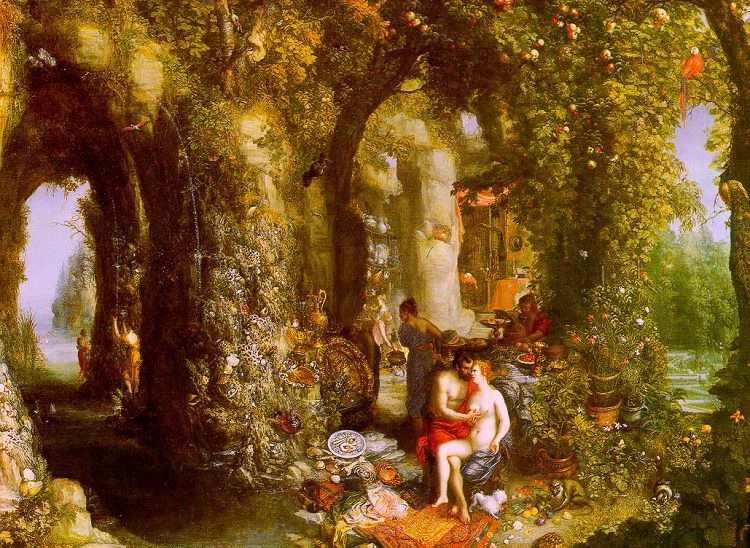
File:Odysseus and Calypso.jpg
Odysseus and Calypso by Jan Brueghel the Elder. circa 1616

We know what happened in the end. Calypso's name became the synonym of a deceitful and seductive lover. Byron here, is comparing his beautiful "Florence" to the nymph, being self-pitiful about the love he never got. For someone like Byron who's so used to women throwing themselves to him, what he experienced with "Florence" was rare. 


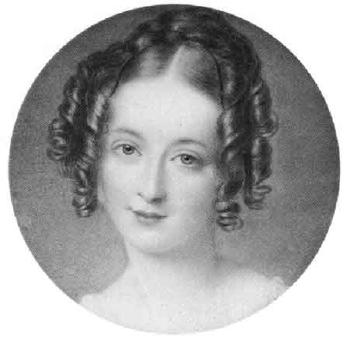
Florence, is the poetical alias for Mrs. Spencer Smith.  In 1830, John Galt penned the memoirThe Life of Lord Byron, reserving one part of chapter 9 for the special incidents in Malta. Our adventurous heroine, was no other than Mrs. Spencer Smith. Her life, almost as equally scandalous and eventful as Byron's, had been indubitably some best topic in town. She'd been arrested by order of Napoleon, had a "romantic escape" with Marquis de Salvo and had wondrous expeditions with said gentleman, as noted in Napoleon's memoir by Laure Junot Abrantes.


It's only understandable that Byron would become affectionate over Mrs. Spencer Smith, although their relationship ended up platonic. It's decided: the lady won this chess game between the pair, beguiling Byron's yellow diamond ring for a keepsake without offering anything in return. Byron, on the other hand, wrote plenty of lines in memory of this chapter of his life.

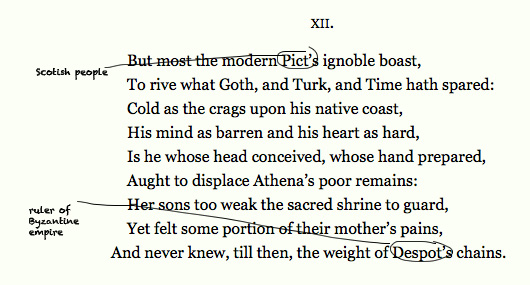
You can read one example below (with editorial notes by Prothero Coleridge):


I'm not entirely certain if it's proper comparing Mrs. Smith to Calypso. Understandably there's the exaggeration from a Romantic poet. To me, Mrs. Smith was an independent woman in the early 19th century, who possessed unimaginable courage and character. It's rare for a woman to be like that at the time, a pretty risky business too. Byron was undoubtedly bitter that their relationship didn't advance, but his words also revealed much admiration and respect. After all, who doesn't prefer a worthy opponent and enjoy an exciting game to something dull and monotonous?


Diane, Hecate, now Calypso, all of whom possessing indescribable power over nature and men alike. All these goddesses or immortal beings have been appearing in this section of canto ii. There's never a shortage of female characters in Byron's life. They bewildered him since his childhood: his emotionally unstable mother, his childhood crush who ended up pursuing a more reliable marriage... at this point of his life he hasn't encountered the crazier bunch who are yet to occupy his emotional realm, including Caro Lamb, and the revengeful princess of parallelogram, his future wife Annabella Milbanke. At this point of his life, those magnificent women had been simply casting traps with their elegant gestures and soft voices, in which he called himself wasting his youth indulging.


This "lamenting" part of the poem also reminded me of Shakespeare's "Sigh No More" (from Much Ado About Nothing), where the deceitful characters had been men. A reverse relationship here, but equally entertaining. Romance had been, and will always be confusing for both men and women. Words of self-pity and comfort with sarcastic accusations remain to be some of the most interesting elements in literary world:
Sigh no more, ladies, sigh no more.
Men were deceivers ever,
One foot in sea, and one on shore,
To one thing constant never.
Then sigh not so, but let them go,
And be you blithe and bonny,
Converting all your sounds of woe
Into hey nonny, nonny.
 
Sigh no more ditties, sing no more
Of dumps so dull and heavy.
The fraud of men was ever so
Since summer first was leafy.
Then sigh not so, but let them go,
And be you blithe and bonny,
Converting all your sounds of woe
Into hey, nonny, nonny.


Unlike Odysseus on Calypso's island, Byron didn't spend too much time in Malta. Of course, the hero from Ithaca would be inspiring to him at least for the determination and loyalty. Byron once wrote that watching over the ocean from the cliff made him homesick. His childhood in Scotland brought him an accent he was always ready to get rid of, as well as many a sweet memory of the carefree years. In previous stanzas the poet has already expressed the desire to start over, lamenting over the cruel and never-pausing flow of time; and here, regretting the years wasted on his "personal Calypso's island", he's telling a cautionary tale to warn his fictional self.


Of course, we must not forget Byron's tendency to exaggerate: his emotional rollercoaster brings him instantly cheery and then suddenly gloomy, mostly because of unfulfilled or overwhelming love. For him it is an addiction that eventually brings more disappointments than joy. Passion established him and made him an everlasting name, yet at the same time, bound to destroy him.

26.2.13

II : X - XV The Lost Treasures of Greece

About the disappearance of the statue of Zeus at the Temple of Zeus of Olympia, there are many stories, some fantastical. Some said that Roman emperor Caligula wanted to take the statue from Athens so he could remove its head and put his own on it. There's tale of the statue letting out laughters as it was being removed and transported to Rome, foretelling the approaching assassination of Caligula.

6th Son of Cronos (Saturn in Stanza X), Zeus became the king of gods, fulfilling the oracle and his father's biggest fear, thanks to his mother's protection from the envious and murderous Cronos. Here's how Homer described Zeus in Iliad. Indeed the big boss of the Olympia, Zeus had been feared and revered by gods and men alike, maybe save Hera, his deservingly jealous wife.

ἦ καὶ κυανέῃσιν ἐπ' ὀφρύσι νεῦσε Κρονίωνἀμβρόσιαι δ' ἄρα χαῖται ἐπερρώσαντο ἄνακτοςκρατὸς ἀπ' ἀθανάτοιο μέγαν δ' ἐλέλιξεν Ὄλυμπον. 
He spoke, the son of Cronos, and nodded his head with the dark brows,and the immortally anointed hair of the great godswept from his divine head, and all Olympos was shaken.                                                                                    
---- Iliad Homer

Now, Iliad (read it, seriously, it's one of my all time favourite books), is about two plundering forces collide: the Aegean and the Trojan fought to their last drop, losing the lives of most magnificent heros: Hector, Patroclus, Achilles, Ajax...just to name a few. Byron paid a visit to Patroclus' tomb himself. He amongst all would be moved by the friendship between Achille and Patroclus. It's a war without a righteous side, partially caused by the Priam's no-good-son Paris yielding to his desire (the golden apple was merely a bait as far as I'm concerned), leading to the Aegean's' despicable deeds, blood-washing a city that used to be glorious and peaceful.
  
Achilles and Patroclus


I don't think Byron was on the Aegean's side completely, but he idolized Achilles. Proof? He designed his own armour and helmet according to the one Athena bestowed to Achilles! Hobhouse thought the plumes were way overly fancy, and Byron didn't end up wearing it either because he died before confronting the enemies...but that's another story.


It's hard to imagine the span of time when the poet includes the history of thousands of years within one stanza. Mycenaean Greece, or better known as the Bronze Age, marked a series of conflicts and at the same time, artistic development. The construction of many beautiful temples in Athens with Doric order had been taken place during that time, as well as many Homeric epics. And then Virgil depicted Aeneas' journey out of Troy and thus the beginning of Ancient Roman Civilization which lasted until the year of 480. I always thought it's quite proper that Aeneas is Venus' son, and a civilization was born out of Love after a lifetime of suffering and loss.

Venus and Aeneas


The Elgin Marbles somehow survived all the rise and fall of empires, until in the beginning of 19th Century, Britain started to transport all the remaining sculptures from Parthenon and other temples across the ocean. Byron was obviously unhappy about it, scathing the fact that the British is finally taking away Greece's last bits of wealth and memory of their bountiful history. One can argue that to this point, the remnants of ancient Greek have become heritage of the entire human race, and it's understandable to take those sculptures to better care, such as in a museum, it's still robbery by all means.

After the war, treasures of the defeated side usually end up getting ripped off, for they're trophies for the victors.


There are five rivers in the realm of Hades, Styx, the river of Hate, being one of them. It was the very river Achilles had been dipped in to be made invincible by his mother when he was merely an infant. We all know what happened afterwards: the mother missed one spot, which let to the son's fateful downfall. Achilles didn't enjoy his afterlife. In Homer's Odyssey, Achille's soul said to Odysseus: "I would rather follow the plow as thrall to another man, one with no land allotted to him and not much to live on, than be a king over all the perished dead". And a much more serious problem is: the Greek hero can no longer protect his beloved land, lest she's lost to the foreign robbers.


There's always a conflict of interests when it comes to deciding what to do with ancient cultural heritages. There's nothing the Greek can do in the beginning of 19th century. They were week, wounded and seemed unrecoverable. The Britannica had been on the rise, conquering the ocean with flying colours. Is it moral to transport the Elgin Marbles from a country that wasn't able to say no, even with the best intentions? You can only have an attitude towards this kind of things, but not a sound explanations.


History can always be examined, studied, evaluated, with which we predict the future, for it is based on human nature. Yet even if we see through it in all clarity, it's still impossible for us to offer an explanation to the tendency towards conflicts and destruction throughout our history. It takes a lot of precaution and willpower to protect a legacy, which is all so easy to lose.  

22.2.13

II : I - VI In Ruins

People call it the cradle of western civilization, Athens, the city named after the goddess of wisdom. There is a constellation of temples dedicated to her, or at least carrying her title. The Parthenon is probably the one that attracts most attention. I remember visting the "fake Parthenon" in Nashville in the summer of 2012. Although it is almost impossible to imagine what it would be like to see the Parthenon in Socrate's time, or even in Byron's, with the newly constructed temple in front of my eyes, sitting amidst the lawns beautifully laid out and all those greeneries in the Mecca of American country music. Of course, I did catch glimpses of the past glory and was given the opportunity to visualize the scale of the worship Athena had. 


Being a Pagan temple, the Parthenon represents values that the Christian church wouldn't approve. After 900 years of its time being a shrine for the votaries of Athena, the Parthenon was transformed into a Christian church dedicated to the Virgin, although ironically Athena was actually one of the only three virgin goddesses in Greek mythology.

painting of the Parthenon ruin

In 1456, the Turks turned the Parthenon into a mosque, only to be destroyed yet again after 231 years by the Venetian crusaders.

Mosque inside Parthenon - the evidence of its Turkish past is now gone as well

Layers and layers of changes: generations of rulers and robbers adding new trophies of their victories and ripping off evidences of past glories of their enemies. In 1806, the last of the Turkish mosque on the original ruin was finally removed, giving the site its Greek origin, although a mere graveyard of what was once the most beautiful of ancient architecture and the epitome of arts. In 1816, several years after Byron's steps onto this piece of soil, the Parthenon marbles were sold to British Museum in London.


I wondered for about an hour in the Nashville Parthenon, most of which spent looking up at it from afar. There isn't any spirit around that structure. I can only imagine the haunting air Byron must have felt at the site of conflicts for centuries past. Standing in front of a ruin with several zeroes on her age, one can only stay silent in awe, and sigh over the tempest of fate: who would have thought, those constructors who originally designed and built the Parthenon, that future tenants of this building will have a completely belief system?

In short, power decides culture, religion, and belief.


Parthenon was one of the chief examples of architectures featuring Doric orders. Another great example was Temple of Zeus in Olympia with the same striking characters. By the time Byron visits the site, the temple of Zeus, although finally identified during the 18th century, was still in the state of partial burial due to the destruction in 426 CE and the subsequent earthquakes in 522 and 551 CE.

Ruins of the Temple of Zeus Olympio


There's one thing you'll realize indubitably if you see the ruins of a lost civilization, that eternity doesn't exists. Time and space shrink into one spot when you stand in front of a ruin, especially a ruin of a society you have known so well in your head. When Canto ii of Childe Harold was written, Byron was barely 25 years old, an age of great expectations and hopes. All his childhood had been spent having an endless longing of the Greek culture, thus the almost unreasonable sympathy the poet had for this land. His fateful fight during the Greek independence war was unavoidable if you think about how much influence this culture had on him.


The destruction of something beautiful is the roots of tragedy. The ruined temples of ancient Greece are proofs. Childe Harold saw an empty shell, unoccupied, abandoned by the gods who supposed to bestow blessings onto a city that needed them the most. The words are with sorrow, yet also with distain: for the human-like gods of Olympia understandably left the shattered houses once built for them, yet neglected and unrecovered. 


I remember a trip to the Forbidden Palace in Beijing back in high school with all my buddies. There was an exhibition room in which you can see all the past images of the palace, different from each dynasties. Emperors had this habit of burning down everything from the last kingdom and rebuild their own on top of the original site. Thus the Forbidden Palace became a site of blood and tears of generations as well as glories and wealth. It's a surreal and indescribable sight, for you have no idea whether to sigh in melancholy or in awe.

Arch of Hadian

I'm in no position imagining if it'd be the same looking at the Greek ruins, but the trip ti the Forbidden Palace would be the closest thing I can think of to embody an experience like that. It's pointless to recreate ancient sights, at least I don't think it necessary. The ruins are the evidence of what human beings are capable of and premonitions of what could happen if we don't respect what is sacred and succumb to the desire of power.

14.2.13

I : LX - LXIV Where the Poet's God Lives

The thing about Greek mythology is that the tales are tangible. You can trace the evidences of the places in the stories, imagine the paths of the protagonists. Even the gods, well, they are all rather human-like and imperfect. The pythoness of Delphi could very well be living in that wuthering heights, as Harold observed from a distance. It's amazing when you see something that seems to have come out of a legend right in front of you. Parnassus, home of the Muses, a place held dear to Apollo himself! Tis the Jerusalem of arts, the pilgrim's pursuit. 

Venus and Ares on top; Apollo with his lyre, Hermes on far right with his horse; nine muses dancing in the front
Actually, this has been the first time the poet mentioned the muses and the Parnassus save for the few lines in To Ianthe. Having seen so much destruction by war and human failure that has caused deaths and tragedies, we are now once again trying to focus on the unchanging wonders of the world. 


Mount Parnassus, as mentioned, is the archeological sight of the Delphic Oracle, the most famous oracles, dare I say, of all. She was said to have predicted Socrates being the most intelligent person in Greece, to which Socrates himself responded "it's because I'm most aware of my own ignorance", or something along those lines. The mountain's beauty is created by the stories and myths associated with it. Those are its essence, and reasons of existence.

A bard like Byron himself, can only go yowzah at how a place can inspire a lineage of poets, connected through generations spiritually.

Artificial Mount Parnassus by JohannesVan den Aveele

There's a sense of superiority here. A young poet on the road is calling himself more fortunate than most bards throughout the history who couldn't come close to the Mecca of art in person. Aside from the boyish exaggerations, there's real admiration towards this sacred sight before him. It's almost like religion: when you believe something fabricated and think of it so real as though it has become a part of the history, at least your version of history, then the places it involves would be also saturated with details and, let's just call it, self-fulfilling prophecies 

The muses are not here. Why yes of course they left; look at those stupid war people have been having all these years and a general lack of devotion towards art! Apollo isn't here either, yet as though you can still hear his footsteps from centuries past, his melodies still delivered by the wind.


Art. The art of poetry. It's beauty. It's fleeting beauty is like that of Daphne. Apollo's passionate pursue proved to be unfruitful. Those stories all happened around here. The seraphic young maiden who eventually got swallowed into the earth by her mother Gaia, and the birth of the first laurel tree. She would be crowned the goddess of all the poet, those apprentices of Apollo. The chase between Apollo and Daphne serves as a perfect metaphor of the relationship between a poet and his art. It's a constant struggle and the poet will forever be one step behind. Just when he thought he finally got it, his price appears to be lost forever, once again. But still he sees it right there, evergreen, resembling perfection in all perspectives.

File:Antonio del Pollaiolo Apollo and Daphne.jpg
Apollo and Daphne by Antonio del Pollaiolo, c. 1470–80 (National Gallery, London

The moral of Daphne's story is rather not about the chastity, but a triumph of spiritual pursuit over desire of the flesh. 


It takes a complete romantic to praise love to this extent. To Byron there's more in human love that of the ethereal mount of Apollo. The poet's love is full of passion, and insufferably realistic, as he's been notoriously depicted as someone who detest loneliness, always needing someone to be his companion. Love, to him is a habit, an attitude of life; more important than art. He's got a quote that goes like it: "To be a poet, you need to be in love, or miserable."  I do believe he's both.