Showing posts with label beauty. Show all posts

24.4.13

The Swing Girl


When we are not travelling...

http://1.bp.blogspot.com/-vAzlnye7apE/UHgw3uwnBTI/AAAAAAAACqc/6CsDOYBR58Q/s1600/tumblr_lxpnh4VW4v1qg2xooo1_500_large.jpg


There’s this girl I know who swings. She stands on the plank, holding on to the chains that link the pendulum and an endless stretch to the unknown. He hair glows under the moonlit sky, her lips curves into a wistful smile, her eyes sparkle with lots of courage, and fear, and uncertainty of her prospects.

I can hear the chains squeak each time she swings by, suspended in time at one point, then fall with a speed accelerated with gravity. Her dress thrashes as the wind brushes upon her.

Beneath her, is profound darkness, abysmal, distant; you can hear the running water and its ferociously echo. Home is just steps away on the shore behind. It’s one of those things that you know it’s there but always out of reach; she’s too much in the action to really turn her head now. A familiar force pushes her up against the invisible obstacles every time she swings back to that shore. There’s mother’s embrace and friends’ fist bumps. “We’ll catch you whenever you decide to let go.” They say. They’ll be disappointed, surely, but they will catch her, surely. In front of her, a light shimmers through the darkness, from a path that leads on towards the future. She’s just one risk away from it, as long as she let go when she swings up towards the other side, she would let go, and leap, before gravity pulls her back down again.

Yet gravity pulls her back down again and she skims across the night sky, her feet rip apart the stillness of the atmosphere. She starts to try different things, picturing in her head, that the next time the force propels here upwards, it’d be the chance of flight. And on the grassy shore there’s serenity, optimistic plans, and lots of next steps.

There are spectators all around her, passing swiftly across the air. She’s suspended in an absolutely open space, yet simultaneously amidst a crowd of strange figures, with blank faces and movements as light as a feather, weightless, almost floating, almost transparent, surrounding her, omnipresent figures. And patterns made up with passages and words, chopped up and reassembled together, bustling about and filling her entire spectrum. She would hear voices, murmuring a familiar melody that she couldn’t seem to recall.

And she keeps on swinging.

At least the last time I saw her, she was still there, suspended between past and future, living her every moment pandering whether to let go of herself to the unknown, or to the deliciously dangerous temptation called, failure.

Both options take courage. And I heard one of the spectators say: “what a wonderful performance this has been!”

17.2.13

I : LXVIII - LXXIV Before the Killing

I could only imagine how the air would thicken before a bullfight. What an act of savage and grace, exciting and dreadful, sacred and barbaric. How ironic it happened to be the sabbath, and this city is giving the gods in all the glory, a competition between man and beast, a struggle till the last breath.

The arena is full, the bull restless, the energy spouting like blood, and you hear the roaring though uncertain whether it's from the magnificent animal, or the resonance and echoes of the crowd's breathes and thoughts.

arena before the fight
It's something insatiably beautiful and sad, for you know the fight goes on until one side of the opponents is dead. 


The sabbath, in a religious sense, is the 7th day in a week, god's sacred day of rest. Depending on which religion you're in, the timing would be different. Here the poet is indicating Christian sabbath, though in Judaism, sabbath starts after sundown on Friday.


It's strikingly a cultural thing, for a bullfight in Spain is like a religious gathering in, well, for example says the poet, in London. Nobilities from all directions swarm in from their country houses, their carriages jamming the streets, to the cathedrals they go. 


Yet here in this arena it's a celebration of men's conquering of nature, in finest apparels and noblest agility. Something Byron wouldn't be able to do if I may add, which is possibly why he got so overwhelmed and fascinated by this beauty, or terror, depending on your point of view. 


There's no differences between the votaries of god: young, old, rich, poor, their confessions alike, forgiven before the altar, similarly amongst the audience of a bullfight. They are witnessing a crime, committed by men, yet the killers will be rewarded for their courage and heroism. Isn't it ironic if you really think about the nature of the fight?


All is silent before the killing. Imagine, outside of the area the streets would be empty. Everyone you know would be sitting inside of this round, heated, tormenting space overlooking a stretch of crimson coloured earth. The battle between the matador and the bull will soon begin. 

You'd be surprised to find out that the audience consists mostly of ladies. It's an exhibition of strength and agility of men, to be sure, indeed an attraction and a fantastical scene. 


The arena is a power source ready to release its energy at any time now. It's almost as though nothing else in the universe mattered, and all is focused on the centre of this space: the matador dressed in gold and embroidery; the bull, o that magnificent creature, is a spiritual embodiment of what is expected of the matador. The two of them, discrepant in size and actual strength, yet equivalent in their bosting aura.


It's been documented in memoirs that Byron didn't enjoy the bullfight although inspired by it. I cannot imagine what kind of emotional turmoil he'd been in during the show, but I believe that he would see more of himself, not in the matador  but rather in the bull, panting and prancing underneath the gazing of an entire universe. There about to be bloodshed and injury. Just like what his fame did to him, which exploded too quickly when he was mere 24.

the Matador - from Charles Lisanby

Vicente Blasco Ibanez wrote a Blood and Sand (Sangre y Arena). The entire act of a bullfight is almost a reflection of Byron's life, which had been teaming with struggle and mess, metaphorically presented in a limited space: it has more symbolism but much more exciting and concise. I'm not certain whether he enjoyed much of the act, but he surely understood all and sympathized with both. Maybe more with the bull, for the matador represents more of his vanity, yet the bull, his truth identity.


14.2.13

I : LX - LXIV Where the Poet's God Lives

The thing about Greek mythology is that the tales are tangible. You can trace the evidences of the places in the stories, imagine the paths of the protagonists. Even the gods, well, they are all rather human-like and imperfect. The pythoness of Delphi could very well be living in that wuthering heights, as Harold observed from a distance. It's amazing when you see something that seems to have come out of a legend right in front of you. Parnassus, home of the Muses, a place held dear to Apollo himself! Tis the Jerusalem of arts, the pilgrim's pursuit. 

Venus and Ares on top; Apollo with his lyre, Hermes on far right with his horse; nine muses dancing in the front
Actually, this has been the first time the poet mentioned the muses and the Parnassus save for the few lines in To Ianthe. Having seen so much destruction by war and human failure that has caused deaths and tragedies, we are now once again trying to focus on the unchanging wonders of the world. 


Mount Parnassus, as mentioned, is the archeological sight of the Delphic Oracle, the most famous oracles, dare I say, of all. She was said to have predicted Socrates being the most intelligent person in Greece, to which Socrates himself responded "it's because I'm most aware of my own ignorance", or something along those lines. The mountain's beauty is created by the stories and myths associated with it. Those are its essence, and reasons of existence.

A bard like Byron himself, can only go yowzah at how a place can inspire a lineage of poets, connected through generations spiritually.

Artificial Mount Parnassus by JohannesVan den Aveele

There's a sense of superiority here. A young poet on the road is calling himself more fortunate than most bards throughout the history who couldn't come close to the Mecca of art in person. Aside from the boyish exaggerations, there's real admiration towards this sacred sight before him. It's almost like religion: when you believe something fabricated and think of it so real as though it has become a part of the history, at least your version of history, then the places it involves would be also saturated with details and, let's just call it, self-fulfilling prophecies 

The muses are not here. Why yes of course they left; look at those stupid war people have been having all these years and a general lack of devotion towards art! Apollo isn't here either, yet as though you can still hear his footsteps from centuries past, his melodies still delivered by the wind.


Art. The art of poetry. It's beauty. It's fleeting beauty is like that of Daphne. Apollo's passionate pursue proved to be unfruitful. Those stories all happened around here. The seraphic young maiden who eventually got swallowed into the earth by her mother Gaia, and the birth of the first laurel tree. She would be crowned the goddess of all the poet, those apprentices of Apollo. The chase between Apollo and Daphne serves as a perfect metaphor of the relationship between a poet and his art. It's a constant struggle and the poet will forever be one step behind. Just when he thought he finally got it, his price appears to be lost forever, once again. But still he sees it right there, evergreen, resembling perfection in all perspectives.

File:Antonio del Pollaiolo Apollo and Daphne.jpg
Apollo and Daphne by Antonio del Pollaiolo, c. 1470–80 (National Gallery, London

The moral of Daphne's story is rather not about the chastity, but a triumph of spiritual pursuit over desire of the flesh. 


It takes a complete romantic to praise love to this extent. To Byron there's more in human love that of the ethereal mount of Apollo. The poet's love is full of passion, and insufferably realistic, as he's been notoriously depicted as someone who detest loneliness, always needing someone to be his companion. Love, to him is a habit, an attitude of life; more important than art. He's got a quote that goes like it: "To be a poet, you need to be in love, or miserable."  I do believe he's both. 

13.2.13

I : LIII - LIX Ode to the Spanish Maidens

There's always the constant struggle for a boy as he's at the turning point of becoming a man. Just you see, without a miss, in all literature formats: the ultimate choice between his country and his woman. If this statement sounds too sexist to you, well, you'll have to keep in mind that this was 19th Century, and people were shedding blood to prove themselves...competitions are still pretty primal if you ask me.


And here again we question the purpose of all those people giving up their lives for the glory of those few in power. It's a rather simple-minded attitude towards winning and losing: you either win (then you get all that glory, wealth and women and what not),or fight till the last drop in the battle field. There's no grey area in between, and submission is worse than hell.

For a romantic poet these few stanzas have been intense, almost hypnotizing with the war call and drum rolls as though phantom from the past. "Manhood's heart of steel" says Harold, as he sees his weak self.

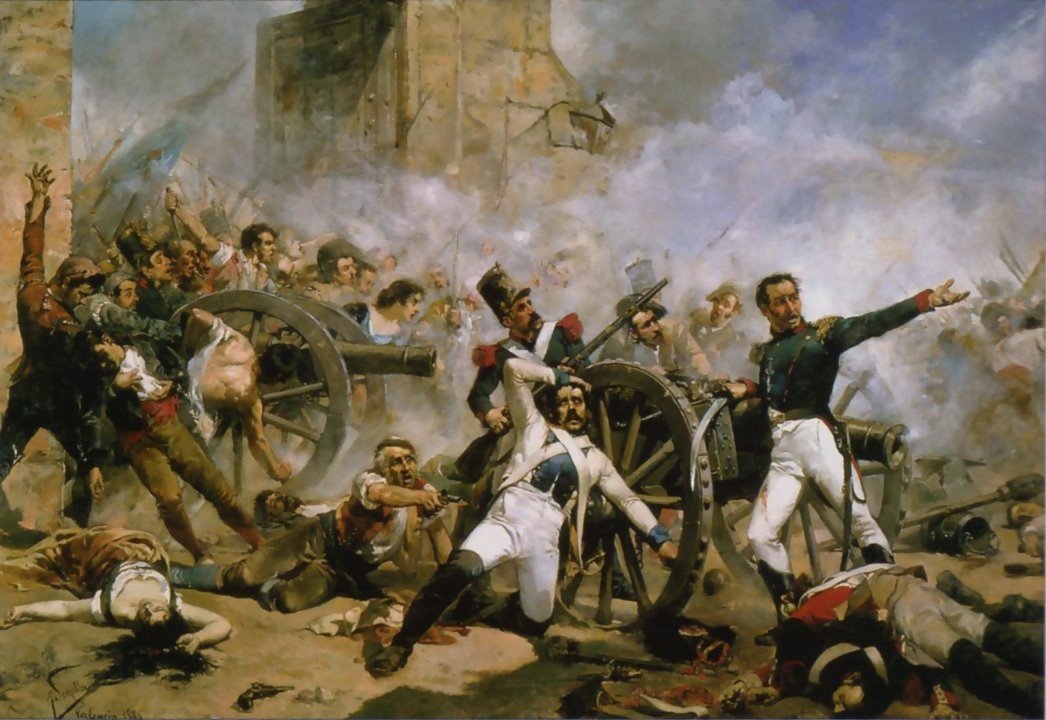
File:Defensa del Parque de Artillería de Monteleón.jpg
Defensa del Parque de Artillería de Monteleón by Joaquín Sorolla y Bastida depicts Pedro Velarde's last stand (he died May 2 1808)

And then we see a twist and redirect out attention to the Spanish maidens, the real subject our poet is paying praises to. The last five lines show us the transformation of a woman in the times of war: she's no longer the young girl, unexposed to any of the real danger, but a pilgrim of Athena's wisdom and courage, contributing to the victory in her own way.


There are incredible visual and sound elements within this stanza: the shrieking of an owl at night, the shiver of a maiden seeing, maybe a scratch on her skin, all in the memory now; and we see the ruins of a city, and the flashing weapons.

Some background information about the weapons mentioned here:
Bayonet: baïonnette. That's the knife, or spike shaped tip you see inserted on top of a musket or a rifle.
Falchion: fauchon. A one handed, single edged sword. It's heavy and is similar in shape to Chinese Dao.

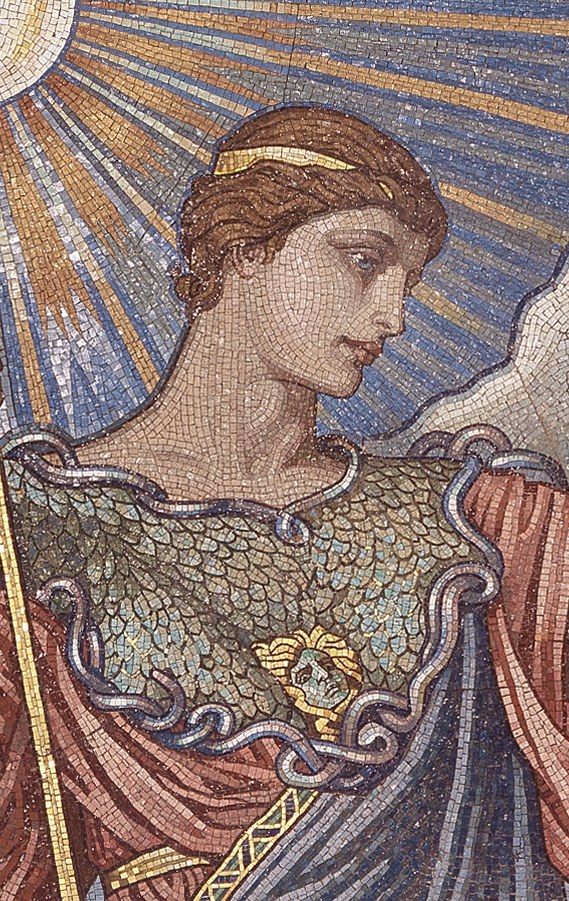
Minerva and Mars. They are Roman names of Athena and Ares. (I'm not sure why the Greeks always prefer names starting with an A, and Romans an M). Minerva is the goddess of arts and craftsmanship. Interestingly her symbol is an owl (for the wisdom). Mars, on the other hand, is the god of war. Those two brother and sister are equally strong. Byron is probably indicating the male and females of Spain with them.

File:Minerva-Vedder-Highsmith-detail-1.jpeg
Mosaic of the Minerva of Peace (detail), Elihu Vedder, 1896


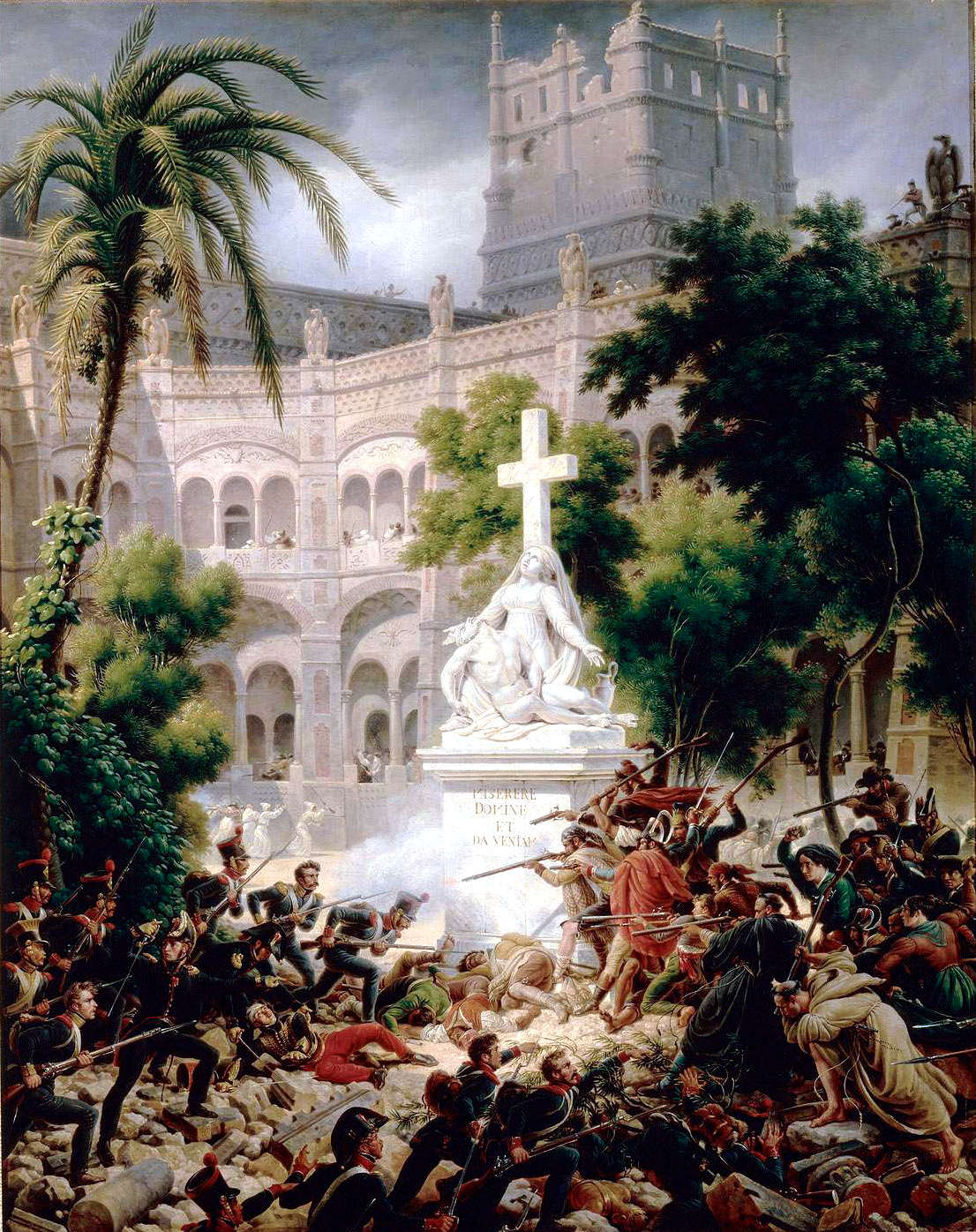
Zaragoza (known as Saragozza) is the city where Basilica, Cathedral of Our Lady of the Pillar is. It's a city of stories,and beautiful, mind I repeat myself, BEAUTIFUL architectures (mostly Roman Catholic cathedrals of course). The two sieges Zaragoza endured between 1808 to 1809 cost her some 50,000 lives. 
File:Santa Engracia - Lejeune.jpg
Assault of the French army at Santa Engracia Monastery 8 Feb 1809
The female strength depicted here is soft, yet enduring. It's her grace and serenity in the face of danger, or even death, that marvels us the most. It's quite likely that the beautiful "her" has two layers of meanings: the actual women of Spain, and Virgin Mary, the spiritual symbol that several of the landmarks of Zaragoza represent.


During the second siege of Zaragoza, the defender surrendered rather quickly. In a way, it's submission and death at the same time - gravest tragedy of all. Ode to the women who stood still when the men fell; ode to the women who remain calm and hopeful when weapons lost their use, and all that's left is dignity.

There's an old fable that goes like this: the wave laughs at the dripping water below the cliff as he smashes onto the rock, but the dripping steam just keeps going. The wave, of course, eventually accomplished nothing with smashing against the giant rock, but the dripping water managed to make a hole on the stone. Persistence, or, as Byron put it so well, "tender fierceness" is the best quality one can have when all hope is lost.

The Spanish maidens embodies romance and tender beauty as opposed to the Amazonian women warriors. The contrast, of course, impresses us even more.


In stanza 58 our focus comes back to the men, yet showing another strength of the women. They seem to have the power of encouraging men to fight for their country, to win their love. The kisses are as if trophies, only bestowed to the victors.

The poet is so fascinated by the maidens in Spain as they are so very different from those in the North, which I'm assuming means England.  The portrait of a Spanish lady with a fan might vaguely depicts what is considered beauty in early 1800s. As you can see, it's definitely not what you expect in a stereotypically slender and meek British woman around the same era - just think about Byron's old lovers and you'll see my point.

Eugene Pierre Francois Giraud (French artist, 1806-1881) A Spanish Beauty with a Fan
It's her people that show the true beauty of a city. Its palaces may fall; its reigns may change; its technologies and fashions evolve, even the climate, can be altered by the traveler's perceptions. Only people leave consistent impressions. Jean-Paul Sartre's famous "L'enfer, c'est les autres" (hell is other people) can be reinterpreted as, at least for me personally, that Paradise is other people as well. It's just the difference of our perspectives. In the beauty of humanity we seek paradises, and only then, maybe, wars and conflicts will cease.