Showing posts with label war song. Show all posts

2.5.13

II : "Tambourgi! Tambourgi! thy larum afar"

Growing up, I used to go to all kinds of military trainings at school as part of the political, cultural or who knows whatever kind of programs. I didn't care the least bit about the ideals, or ever looked forward to the ever so boring disciplinary routines: we would go to a training center in a park-like "resort" in the suburbs of Shanghai, where we'd march down the bridge in uniforms, and practice how to use a rifle... as if that'd ever be practical knowledge in your life. Of course, there's always something to look forward to, and the campfire nights are certainly in that category. The entire class of, well, class of 2008 if I remember it correctly, would be called a battalion, and each class a platoon. I'm not an expert on military terminologies, but you get the picture. The entire battalion, as I was saying, would sit in the square, each platoon occupying their own designated area. In the center of the square there's a gorgeous campfire, and we'd just stare at it all night; and there were performances from each group; and at the peak of the night, we'd start to sing. First each group their own songs, one by one, and gradually it becomes a unison of chanting, of something we all know, a melody engraved in our hearts whether you like it or not. Those are mostly songs from war times, with lyrics that no longer make much sense today other than something metaphorical, but sometimes they still make waves of emotions surge up inside of you, and make your spirits high.

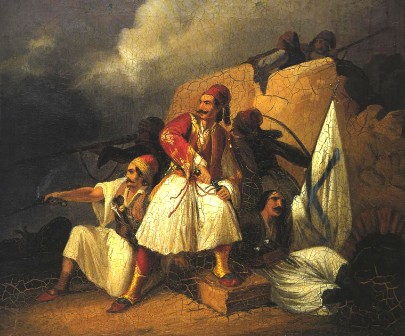
 http://www.smatsuk.yolasite.com/resources/Souliotes.jpg.opt405x336o0,0s405x336.jpg

I remember moments like that in my childhood, and moments like that in motion pictures. One of them, when I say it you'll recognize, was when those people all starting singing La Marseillaise in Casablanca. It's an emotional moment that makes you shed tears even if you're not French. And then there's that moment when the dwarfs sang in unison in the Hobbit. Their voices are almost as low as the center of earth, which makes you feel as if the memories of your past lives are flashing back right in front of your eyes, and the images of your ancestors fighting in the battle fields, relieved all over again.


Then there's the Souliotes' war song Byron offered, a complete translation of what he heard on that peaceful night after a stormy sail. Those "barbarians" with dark skin and wild locks and nimble limbs, chanting and calling out to the gods and to each other: it's war, war, hatred to the enemies and love to the comrades. In the miniseries version of Byron, which I mentioned before in previous posts, there's a modern rendition of Tambourgi, re-imagined by the screenwriter and director in order to recreate that moment that Byron remembered so well, which eventually carried him back to the shore on which he heard that song. I sincerely believe that the moment when Byron first heard the strange war song he couldn't entirely understand, is when he first felt a sense of belonging, a sense of serenity after all those years out on the sea and faraway from home.


It's not certain what the original tune would be like, but why does it matter? There are songs that doesn't requite a melody, but rather flow in the collective unconscious of human kind. it's also not certain whether the translation is entirely accurate. I'd like to believe that it's a combination of the original words and Byron's own reflection through his experience. If you read those words, it's quite understandable why Childe Harold's pilgrimage was considered controversial and threatening when it was first published in England. Giaours? Who would dare to use the word Giaours in the society where the church dominates political power?

There's a derogatory word for every race possible. People use them to drive away their own fear and cover up some levels of ignorance.


I doubt that common soldiers in the Souliotes tribe would sing specifically about Ali Pasha or the chieftain's weapon. Imagination can put words into moments in our memories, making songs personal to each one of us. Byron never forgot that song which turned his fear towards the Souliotes into understanding, and then respect. It's a strange yet not-so-uncommon thing to experience bonding with complete strangers with a culture you can hardly figure out... although today we call it democracy.

1.5.13

II : LXVII - LXXII On a Distant Shore with a Wild Heart

It was long ago and far away; it was a community united by war and despair, speaking an extinct dialect, surrounded by an aura of danger and mischief. It's a group of barbarians, or so they called them, band of misfits, blood thirsty bandits, and their existence threatens the weary sailors who happened to reach the shore where the Souliotes reside.

https://upload.wikimedia.org/wikipedia/en/7/78/Deux_%CE%B9tudes_de_costumes_souliotes.JPG

Childe Harold wasn't too crazy about those legends of Souliotes: those outcasts of both Greek and Albanian societies, expelled and had nowhere else to go; they are the Robinhoods on the shore, dancing and singing war songs around the campfire. Maybe they'd even kill their prisoners and drink their blood, like how they are described in stories. Simply put, Suli was the last place Childe Harold would willingly be if he had any other choices. And for the first time since he took off, for the first time during his turbulent voyage, he was scared. He felt a shiver down his spine as he feels his damp clothes, as he struggles to keep his weary eyes open.

They're about to anchor, and the rest is at the mercy of fate.


Coming just from Ali Pasha's hub, personally I wouldn't know what to think approaching the Souliotes. This pitiful group of outlaws have been in conflict with the tyrannic ruler since 1803, and there doesn't seem to be a perceivable end. Comparing the two sides, anyone would feel sympathetic to the Souliotes: these are the soldiers without proper food or equipments, whereas Ali Pasha, as we now know very well, is having it all: his luxurious lifestyle, his relentless spending... He was respectful to Lord Byron, we'd learnt about that, but him being hospitable couldn't change Byron's contempt towards him. As for the Childe, he's mostly overwhelmed by the journey by now. The crust of waves pushed his ship up and dragged him down as if to the depth of hell. And when the spirit is low and the body has succumbed to exhaustion, all one asks for is some stillness.
 

https://blogger.googleusercontent.com/img/b/R29vZ2xl/AVvXsEhAs-7I9_Hwcrt_VZD6E5rgz2RIIBR-4C7L27l-AC7qo-bjRAqGlxcPneZYSaWi5WT8tpW2USuTUi26nHji8ZJ-lXU9sFGD_cZpGDfCcAEs1ofGrALoJbHNl-RUaD-tzN_tBvF7QU5Q3WZ4/s1600/tromaktiko12.jpg


Suli had been the least likely place for Harold to get his blissful rest. But he, along with everyone else on the ship, was surprised by the locals who offered the Childe not only kindness but also stirred up his curiosity, restored his spirit. (It's quite believable that this experience led to Byron's eventual leading in the Greek Independence War, but that's thereby another story.)


It's rather tricky, the work of our hearts. We always feel the most fondness towards those who happened to reach out to us and lend us a hand when we're at rock bottom, even when they're the most unlikely bunch of people we'd make friends with. In universal sorrow we make the strongest bond and form the greatest friendship, though sometimes incomprehensible to the distant spectators. It's all in perspective.

Harold sees unfamiliar faces on people who speak an entirely different language, wearing strange costumes and moving in ways, the meaning of which he couldn't quite grasp. But their kindness opened his heart and he found beauty in their ugliness, forgiving their ungentle characteristics and perceived their vulgar nature as simply something he's yet to familiarize.

In a world without prejudice and hostility, the construction of babel tower would be simple task.


At dusk Harold joins the Souliotes for their feast. The local break out a banquet for the guests from a faraway land, who talks and dresses in a way they wouldn't even try to understand. Their intentions were simple, though might not be understood by the cynical, overly sophisticated minds from "civilized societies": to feed the hungry, to sooth the tired, to care for the poor in spirit, to be merry at the simple happiness and to celebrate the victories in protecting their land.

http://upload.wikimedia.org/wikipedia/commons/e/e5/Souliotes_19th_century_painting.jpg


Sometimes we claim to look at different cultures and different people of the world with an open mind, yet we wears filters through which we speculate the world we live in too much, too constantly that we forgot about them. It takes a lot of courage to rip them off and cast away the standards we're all too familiar with when taking in something new and initially hard to swallow. I guess Harold's situation makes it easier for him, on a distant shore with a wild heart, when there's nowhere else he can turn to.


The Souliotes chant their song as if it's a spell. No doubt they sing it to the gods they worship, but they mostly sing it to themselves, to forget about their tragedies, to sooth their wounds, to gather their courage and to fight on when the sun comes up in the morning.


Byron included a complete translation of the Souliotes' war song in Canto II, which I'll talk more about in the next post. Stay tuned and we'll meet again soon.