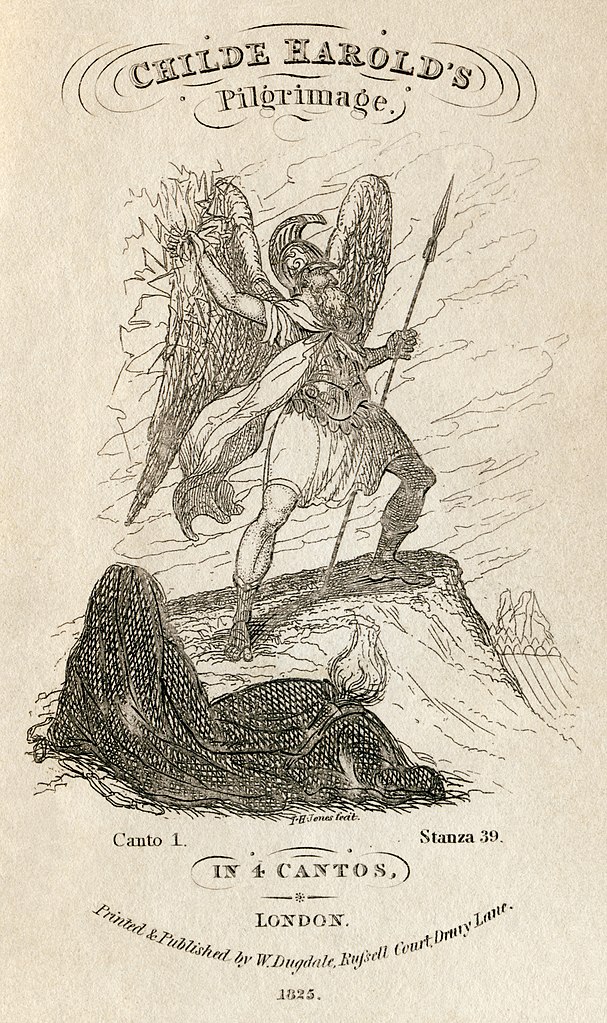
Before Childe Harold's journey unfolds, Lord Byron spent five stanzas to write a dedication page
To Ianthe. It's his hymn standing from a past of indulgence and regrets humming words of passion and wisdom to a child who was just starting her life. And he's telling her: be never changed by the bleak world; be not like me; be not like me.
In 1812, George Byron was four and twenty years of age, having already had a scandalous stray of careless courtships with various ladies of high society. In 1812, Byron started seeing
Lady Oxford (that's Jane Elizabeth Scott if you've forgotten her name).
Charlotte Harley was her daughter. The young girl was, well, young; she had probably just turned 10 at that point.
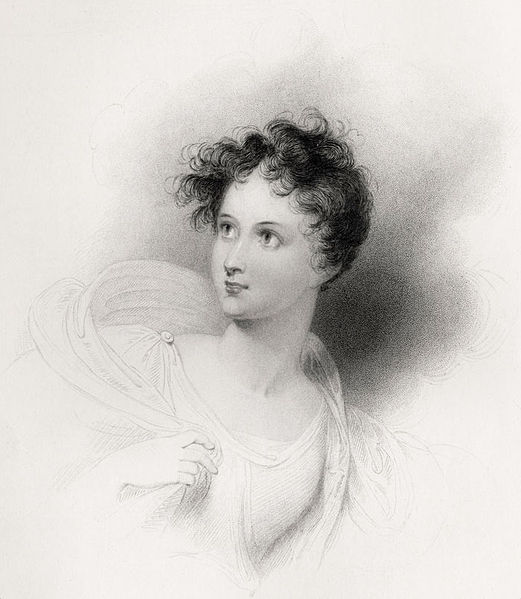
Little Charlotte was famously charming as a child and attracted attentions from pretty much everyone. Lord Byron was obviously enamored of her, as was his book illustrator
Richard Westall, who had been commissioned to illustrate the first two cantos of a version of
Pilgrimage. This painting was titled
Lady Charlotte Harley as Hebe by Westall. I couldn't figure out the exact date of the work, but it was surely around when these people first acquainted circa 1812-1814. Lord Byron's own portrait was painted around then as well (circa 1913).
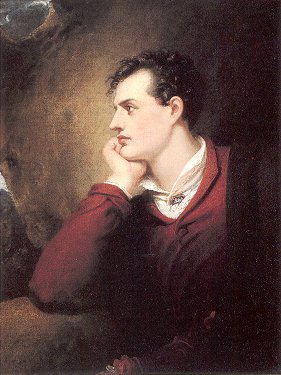


So why Ianthe? The word literally translates as "purple or violet flower". In Greek Mythology, that was the name of a Cretan girl who married
Iphis after he got turned male by Isis. The story, made well known in Ovid's
Metamorphoses, was probably the first ever tale about transgender marriage. The significance of giving young Charlotte Harley such a nickname probably is: firstly, to signify her youthful and pure beauty and secondly, as a subtle and suggestive wish from Byron to someone whose pureness in heart and unfamiliarity to the filths of the grown-up's world contrasts his own adulterated one. While Byron expressed affectionately to Ianthe dedicating his song of a battle against Time, it became almost a cautionary tale to the young girl; a warning, telling her not to follow his path and grow up gracefully against the race of Time.
“Ah, may'st thou ever be what now thou art,
Nor unbeseem the promise of thy spring,
As fair in form, as warm yet pure in heart...” (ln. 10-12)
Hope was the key word , as we see Byron praising Ianthe and comparing the two of them with those glowing words.
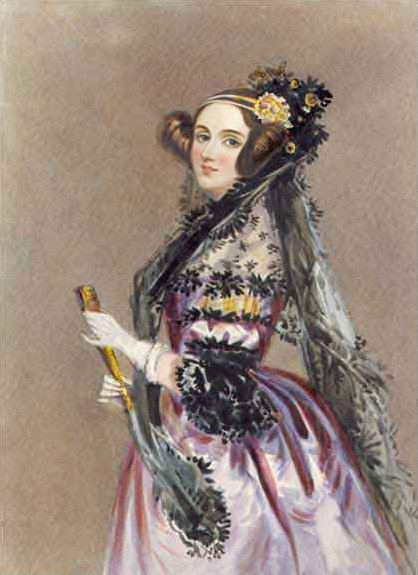 |
| Augusta Ada Lovelace |
Such a relationship between the poet and an innocent young girl was revived, at least in my opinion, in my favourite play, Tom Stoppard's
Arcadia.

It was suggested in the play, that daughter of the household Thomasina Coverly, a thirteen-year-old child mathematical genius had some connection with Lord Byron, who was visiting (the fictional) Lord and Lady Croom before setting off to sail. It has been mostly agreed that the character Thomasina is based on
Ada Lavelace, Lord Byron's daughter with
Anne Isabella Byron and coworker of mathematician
Charles Babbage. Indeed Ada Lovelace, inheriting much of her father's qualities (quite against her mother's will), had numerous affairs with men during her youth, including one with her tutor, much like Thomasina with her tutor Septimus in the play. There are numerous indication in the play that Thomasina could very well be based on a combination of Augusta Ada and Charlotte Harley, as the coming of age elements of the character were revealed throughout the play.